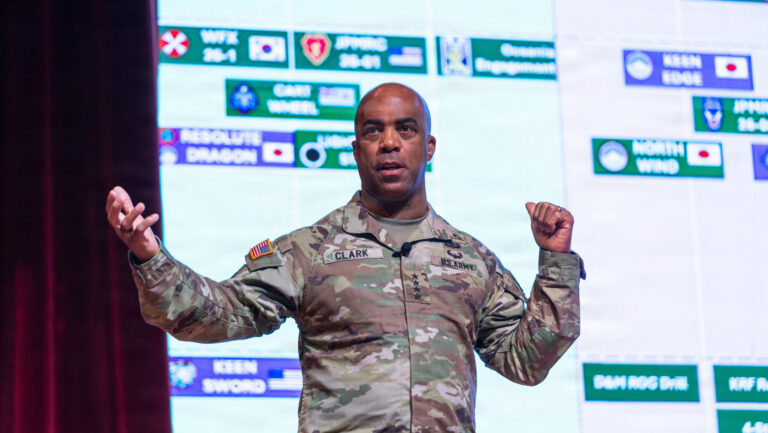
The continuing resolution (CR) is the “biggest challenge” facing U.S. Army Pacific (USARPAC). According to its commander, Gen. Ronald Clark, the delay in passing the fiscal 2027 budget is holding up new programs intended to improve the force’s unified network and long-range precision-strike capabilities.
“The biggest challenge is plans for new starts and being able to fund some of the programs that we know are going to yield benefit to the soldier on the ground,” Clark said when asked how the delayed budget was affecting operations in the region.
Partner network programs await funding
Clark did not identify the programs that could be affected, but said many are connected to experiments involving the Mission Partner Network (MPN). The Army describes MPN as a unified system through which U.S. forces, allies and partners can share information.
One of the new MPN programs involves a piece of equipment, Clark said, without providing further details.
Long-range fires must be cheaper and faster to build
USARPAC also needs long-range precision-strike capabilities that are currently in development. Clark said these systems must cost less and be quicker to produce than existing capabilities.
Such weapons are essential to maintaining the Army’s combat power. “We need [them] in order to remain the most lethal land force on the face of the Earth,” he said.
Proposed budget includes THAAD funding
The Defense Department’s fiscal 2027 budget includes more than 150 new-start programs, at least 29 of them from the Army. The count was based on searches for the term “new start” in procurement and research, development, test and evaluation budget documents.
Among the Army’s proposed initiatives are $921.9 million for the Terminal High Altitude Area Defense (THAAD) system and $132.1 million for the AN/TPY-2 sensor, described as the system’s “brain and eyes.” No MPN programs could be identified in the fiscal 2027 budget documents.
Operating under temporary funding has become familiar
Clark called the CR an obstacle the command must overcome, but also part of the fiscal environment the Army has learned to navigate.
“We have more experience operating under CR than we do with an appropriation,” he said. Still, the absence of an approved budget could delay programs the command considers necessary for U.S. forces in the Pacific.