Last month, Taiwan’s Mainland Affairs Council (MAC) released a report detailing how China is likely to employ its aircraft carriers as part of Beijing’s widely discussed anti-access/area-denial (A2/AD) strategy. Citing declassified information from Taiwan’s Ministry of National Defense (MND), the report indicated that Chinese carrier operations aim to “deny” U.S. military access to the Taiwan Strait.
While many naval experts — including this author, who has previously addressed this issue — believe that the People’s Liberation Army Navy (PLAN) carrier strike groups (CSGs) would play a limited role in a Taiwan scenario, the MAC suggests otherwise. This stance may hold some credibility given that the council based its conclusions on MND sources.
So, how might this situation — let’s project into the late 2020s when China’s carrier fleet could number three — unfold, and what are its implications?
Primarily, aircraft carriers may form part of China’s A2/AD framework primarily to divert attention from potentially more critical missions. Hence, Beijing could effectively utilize its carriers as a “fleet-in-being” rather than engaging directly for sea control.
In straightforward terms, a fleet-in-being is a force that does not actively engage a stronger opponent but whose mere existence factors into the calculations of opposing strategists. Trevor Phillips-Levine and Andrew Tenbusch aptly noted in an article for the Centre for International Maritime Security that enemy fleets-in-being “require considerable diversions of resources and capabilities kept in reserve, regardless of whether those fleets participate directly in an operation.”
This operational model could see the Fujian, Shandong, and Liaoning — whether organized into single or multiple task forces — patrolling the Philippine Sea without actively seeking confrontation with the U.S. Navy, thereby complicating Washington’s strategic calculations and utilizing American forces that could be deployed more effectively elsewhere. (If I were the PLAN commander, I would maintain two such groups — one centered on the more capable “large-deck” Fujian and the other consisting of the two “light” carriers. This force disposition would strike a meaningful balance between concentrating forces, a key wartime principle, and dispersing them, which is essential for maintaining a low profile in contemporary combat operations.)
It seems logical for PLAN to adopt this Concept of Operations (CONOPS). After all, the Fujian, Shandong, and Liaoning are the pride of the Chinese navy, and despite the supposed protection availed by Beijing’s highly touted yet untested “fortress fleet,” it might still be recklessly dangerous for these carriers to directly engage the U.S. Navy (USN). It is reasonable for the USN to deploy at least two carrier strike groups — possibly more — for operations concerning Taiwan due to the extremely high stakes involved.
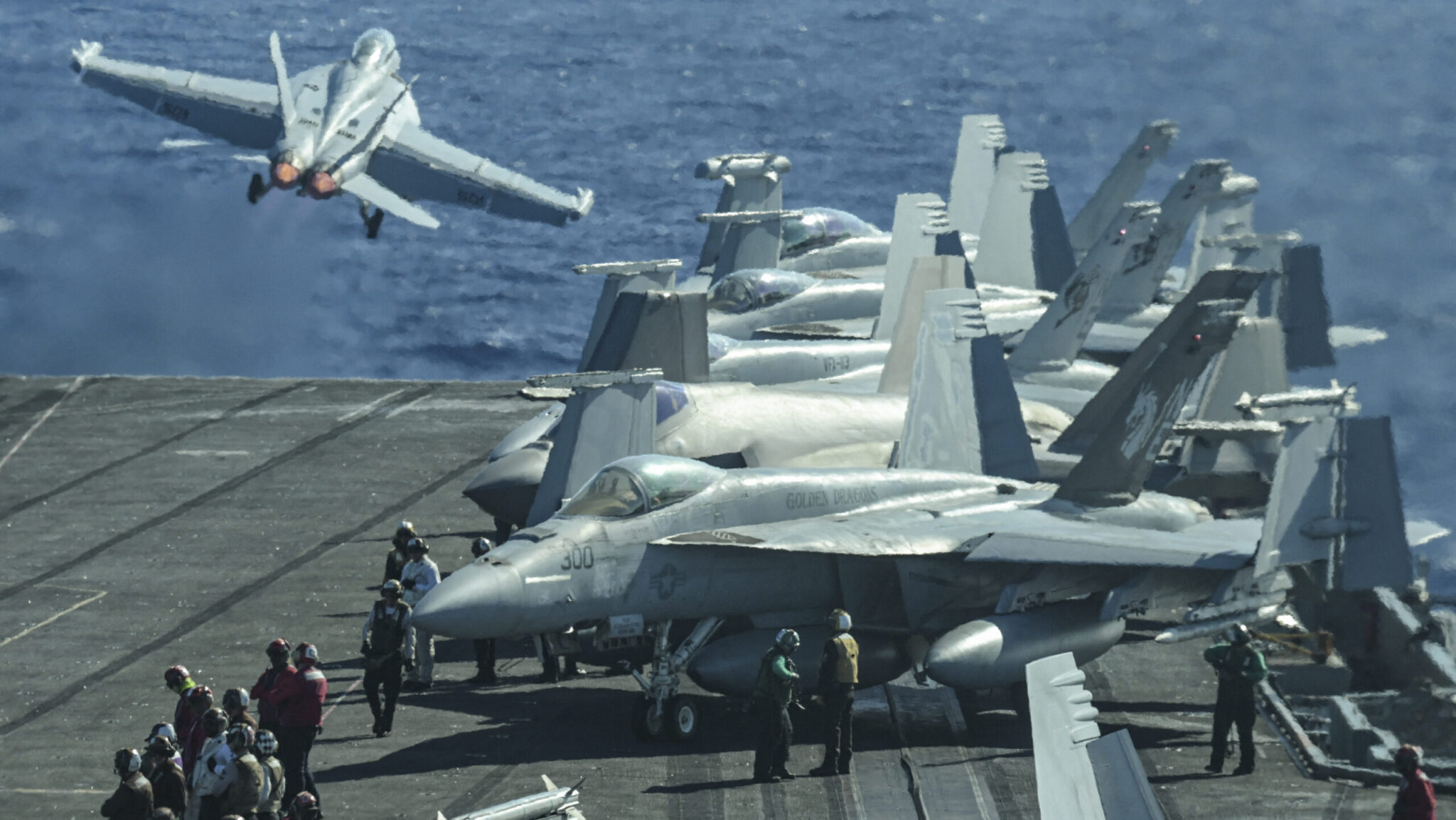
Should the Chinese engage in a 21st-century iteration of the 1944 Battle of the Philippine Sea, PLAN leaders acknowledge that the Americans have the advantage in experience. By the late 2020s, the U.S. would have nearly 110 years of experience in carrier operations, while China would have less than 20 years. Moreover, the USN’s primary carrier-based fighter, the F/A-18E/F Super Hornet, is combat-proven, whereas the PLAN’s counterpart, the J-15 Flying Shark, lacks such a track record.
Conversely, the dynamics regarding numerical superiority are less clear. While approximately 140 aircraft on the two theoretical U.S. carriers would face off against 110 across all three Chinese carriers, the latter could rely more heavily on support from land-based airpower. (Although an analysis of this nature is imperfect in assessing combat capabilities, it still provides a reasonable starting point for discussion.) Notably, retired Taiwanese admiral and former vice defense minister Lee Hsi-ming asserted last year that PLAN carriers “would not be able to withstand attacks by the U.S. military.”
The reaction of U.S. naval strategists to a Chinese fleet-in-being will depend on their interpretation of this force. American commanders, who are grounded in the concept of sea control, should recall the events of the Cape Engano engagement during the 1944 Battle of Leyte Gulf. During that confrontation, the entire U.S. carrier force was deployed against its Japanese counterpart, only to find that the latter was merely a decoy designed to distract from the Leyte beachhead — leading to almost disastrous results for the Americans.
One should also consider the disproportionate impact that a single U.S. carrier group, or even two, had on the Japanese war effort in the early months of the Pacific War. For instance, the 1942 Doolittle Raid, while it had minimal tactical results, was so strategically significant that it prompted Imperial Japan to allocate an entire operation—the Midway campaign—seeking a decisive battle against U.S. carriers.
In this context, any U.S. Navy (USN) platform targeting Chinese CSGs would be one less asset available to address what should be the primary objective: supporting the beleaguered Taiwanese forces. Consequently, each day that the USN spends searching for its adversary at sea provides additional time for the People’s Republic to enhance its military operations against Taiwan.
To bolster the concept of a fleet-in-being while taking advantage of the overall mobility of naval ships, China should refrain from confining its carriers to an area 300 to 800 kilometers off eastern Taiwan, as the Mainland Affairs Council’s report suggests. The data indicated that Chinese CSGs would position themselves such that eastern Taiwan falls within the reach of carrier air power. According to the MAC, such a deployment could result in an “east-west pincer attack” and create an “all-round island siege” of Taiwan.
Undoubtedly, this operational strategy could divert Taiwan’s focus toward its east coast, complicating its defense preparations. However, this CONOPS somewhat contradicts the principle of “do not tether a mobile fleet to a piece of ground.” Indeed, this author previously noted that such a scenario could lead to the Chinese navy being “boxed in from four directions by unfriendly forces,” rather than just two, as claimed in the MAC report.
PLAN strategists, well-versed in military history, might also recognize that this setup bears similarities to Japan’s tactics during the early phases of the Battle of Midway. At that time, Imperial forces were divided between two competing objectives — to engage the U.S. fleet and to conquer Midway Island. That decision, which violated the war principle concerning the selection and maintenance of objectives, played a significant role in Japan’s defeat in that encounter.
Overall, it should not be surprising if China employs its carriers in a somewhat unconventional manner during any conflict with Taiwan. Naval analysts have discussed the potential for deploying aircraft carriers in non-traditional ways in recent years, with articles like those by Phillips-Levine and Tenbusch even suggesting that the carriers could be used as “bait.”
Given China’s inclination to draw inspiration from Sun Tzu’s philosophies and utilize deception as a strategy of warfare, it would be unwise to underestimate the People’s Republic’s ingenuity with its carrier fleet.
Nonetheless, even if used in a secondary role, given the esteemed—and almost symbolic—status of aircraft carriers in China or indeed any nation that possesses them, expectations for these vessels to be weakly defended come wartime, akin to Imperial Japan’s Northern Force during the Battle off Cape Engano, would likely lead to disappointment.