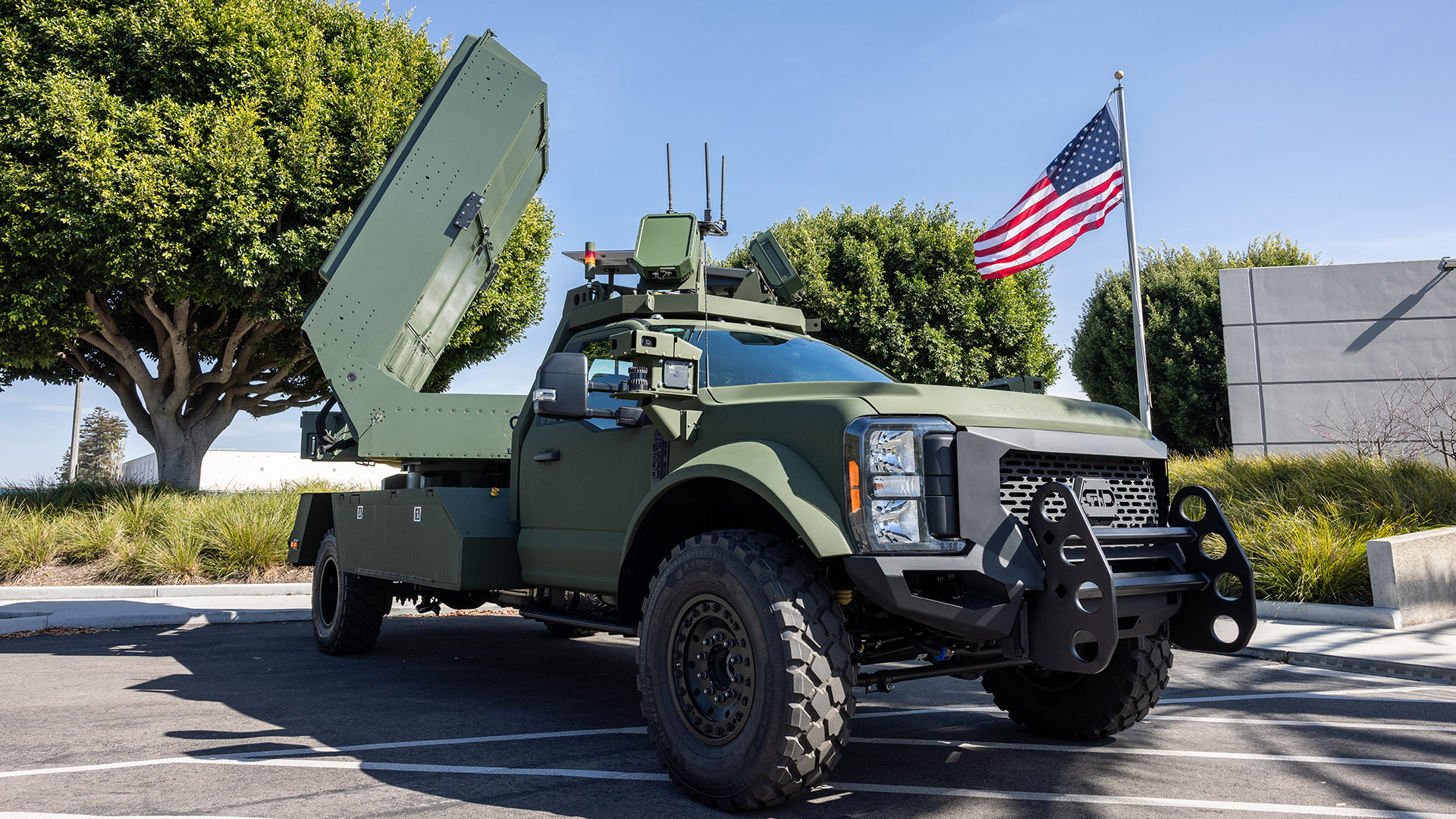
The future of counter-unmanned aerial system (UAS) defense is taking a significant leap forward with the unveiling of a new mobile, autonomous vehicle by General Dynamics Land Systems (GDLS), Epirus, and Kodiak AI. Dubbed the Leonidas Autonomous Ground Vehicle (AGV), this prototype promises to transform how the escalating threats from drones are addressed.
Cutting-Edge Engineering for Ground Security
The AGV prototype, showcased in Huntsville, Alabama, represents a clever fusion of technology. It leverages a commercial Ford F600 truck, equipped with Kodiak’s autonomous driving software and Epirus’ Leonidas high-power microwave (HPM) c-UAS platform. General Dynamics Land Systems served as the lead systems integrator, ensuring the cohesion and functionality of all components.
Andrew Brown, Epirus’ US Army growth lead, revealed that the partnership between the three companies originated from a „definitive direction” from the Army’s former Rapid Capabilities Critical Technologies Office, which sought a prototype mobile HPM solution.
A Multi-faceted Solution for Critical Protection
Designed to meet strategic needs, the Leonidas AGV is eyeing integration with the Army-led Joint Interagency Task Force (JIATF) 401, responsible for homeland defense counter-drone efforts, as well as the broader Army.
“We’re tight and close with the Army and the other services, but also JIATF 401,” Brown stated. “So we see the AGV as part of that solution for defense and homeland security, both for military installations, but also can be used for airports, air bases, railheads, national infrastructure [and] critical infrastructure.”
One of the AGV’s key appeals, Brown highlighted, is its ability to neutralize drones without causing significant collateral damage, while also being more cost-effective than traditional interceptor systems. The option for unmanned navigation also allows soldiers to remain out of harm’s way, a crucial aspect in modern conflict scenarios.
From Prototype to Field Testing: The Road to Operationalization
Ray Moldovan, business development manager at GDLS, acknowledged that the AGV is currently in the prototyping phase and has not yet been tested to take down drones while driving autonomously. However, the team hopes to conduct testing with JIATF 401 sometime this year, contingent on Army interest.
“As a team here, we’re looking for that definitive signal from the Army customer to go,” Moldovan said. “I think it’s akin to holding back race horses here, we’re ready to answer the call of the Army when it comes.”
Brown noted that the first generation of Epirus’ HPM system was deployed in the Indo-Pacific theater last year as part of the Army’s Balikatan exercise. The second generation recently completed testing with the Army in February, with the service now owning two of those systems.
Strategic Partnerships and Scalable Innovation
Chet Gryczan, the managing director of Kodiak Defense, emphasized that Kodiak’s autonomous driving solution enables the AGV to operate across varied terrain, from highways to off-road environments, without requiring a human driver. Kodiak also holds a contract with the Marines to integrate its autonomous driving system into Joint Light Tactical Vehicles for the service’s Remotely Operated Ground Unit for Expeditionary Fires platform. The company additionally provides its autonomous systems to the commercial market.
“The partnership here is really that this vehicle is delivering capability to the warfighter that’s, frankly, faster. We’re doing it faster and smarter and and really at a scale that we can kind of address the Army’s needs and what they’re asking for right now, where we see perhaps there’s a gap,” Gryczan explained. “The fact that we’re leveraging a commercial platform and a commercial driver, and bringing Epirus’ Leonidas to this as well is a match made in heaven, so to speak.”
In addition to ensuring every aspect of the AGV fits together, GDLS is also tasked with modifying the commercial vehicles to receive the various sensors needed for autonomy connectivity, Moldovan added. While the current prototype uses an F600 truck, the approach allows for flexibility in choosing the base platform.