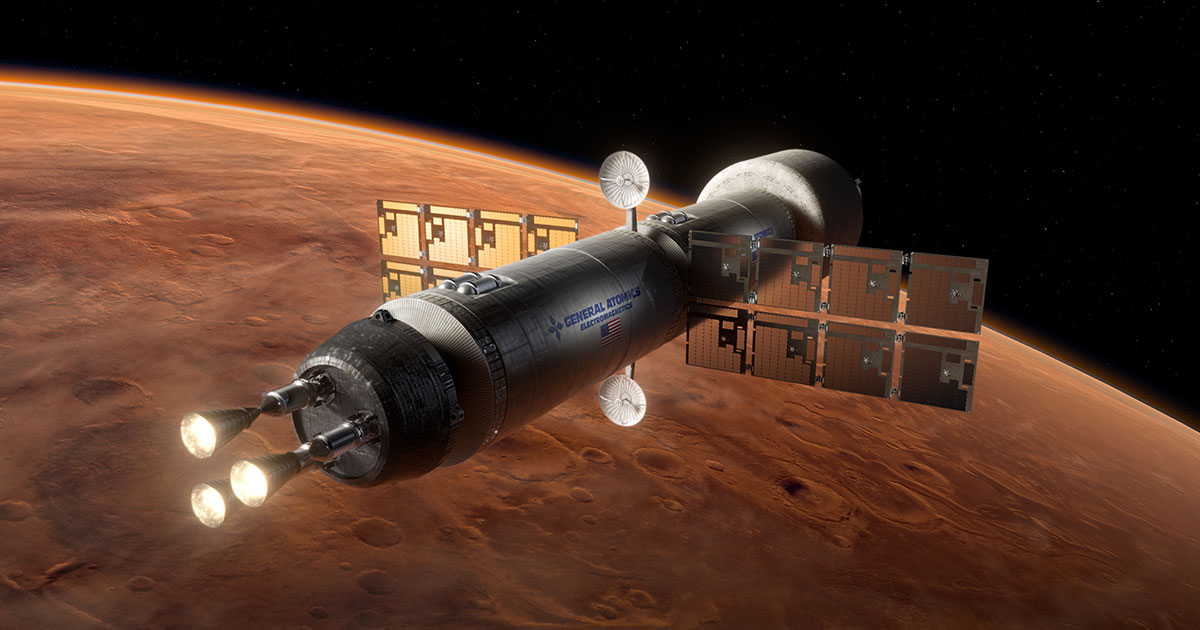
Costs Outweigh Benefits in Evolving Space Race
The Defense Advanced Research Projects Agency (DARPA) has decided to terminate its five-year-old DRACO (Demonstration Rocket for Agile Cislunar Operations) project, which aimed to develop a nuclear thermal propulsion system for spacecraft. According to a senior official, this decision stems from a reassessment revealing that the project’s costs no longer justify its benefits.
Launch Cost Reductions Diminish Nuclear Thermal Appeal
Rob McHenry, DARPA deputy director, explained during a Mitchell Institute event that the original premise for DRACO was based on high launch costs and the need for nuclear thermal propulsion (NTP) to support national security and deep-space exploration. However, with the dramatic decrease in launch costs—largely thanks to SpaceX’s capabilities and Starship advancements—these assumptions no longer hold as strongly. McHenry noted, “The efficiency gain from nuclear thermal propulsion… started to look like less and less of a positive ROI.”
From ROAR to Diminishing Returns
Launched in 2020 with a $10 million budget and initially called “Reactor on a Rocket” (ROAR), DRACO aimed to develop a High-Assay Low-Enriched Uranium (HALEU) nuclear thermal engine. NASA and DARPA collaborated on the project, with NASA focusing on engine development and DARPA on the space vehicle. But recent budget requests for fiscal 2026 revealed the program’s zeroing out, signaling its termination.
Nuclear Thermal Propulsion: The Promise and Challenges
NTRs (Nuclear Thermal Rockets) utilize nuclear fission—splitting atoms—to generate high-thrust propulsion, using low-enriched uranium-235. They offer significantly higher thrust-to-weight ratios and better efficiency than chemical propulsion, enabling missions to the Moon, Mars, and beyond. Traditionally, the perceived advantage was their ability to support long-range, deep-space missions, including potential Space Force operations in cislunar space or rapid counterspace maneuvers.
However, McHenry emphasized that despite their efficiency, the cost and technological uncertainties—exacerbated by SpaceX’s inconsistent Starship testing—make nuclear thermal engines less appealing at this stage. “If we can launch enough propellant cheaply… it may take too long to recoup the benefits,” he explained.
Next-Generation Solutions: Nuclear Electric Power
Looking ahead, McHenry suggests that nuclear electric propulsion (NEP)—using small nuclear reactors to generate onboard electricity—may represent a more cost-effective and operationally beneficial approach. This technology could power electric propulsion systems or replace large solar arrays, offering a cleaner, more reliable energy source for spacecraft.
Recent studies by NASA and other agencies support this pathway, with the Air Force Research Laboratory launching a program in 2022 to develop nuclear reactors for space. Contracts with Lockheed Martin, Westinghouse, and Intuitive Machines are underway to design reactors and spacecraft, with solutions expected by year’s end.
Emerging Opportunities and Future Directions
McHenry indicated that DARPA remains open to exploring nuclear electric programs as the agency shifts focus from nuclear thermal propulsion. “Are we exploring what the next nuclear electric program should look like? Absolutely,” he affirmed.
In summary, DARPA’s strategic pivot away from nuclear thermal engines reflects evolving technological, economic, and strategic considerations, favoring potentially more practical and versatile nuclear electric solutions for future national security and exploration missions.