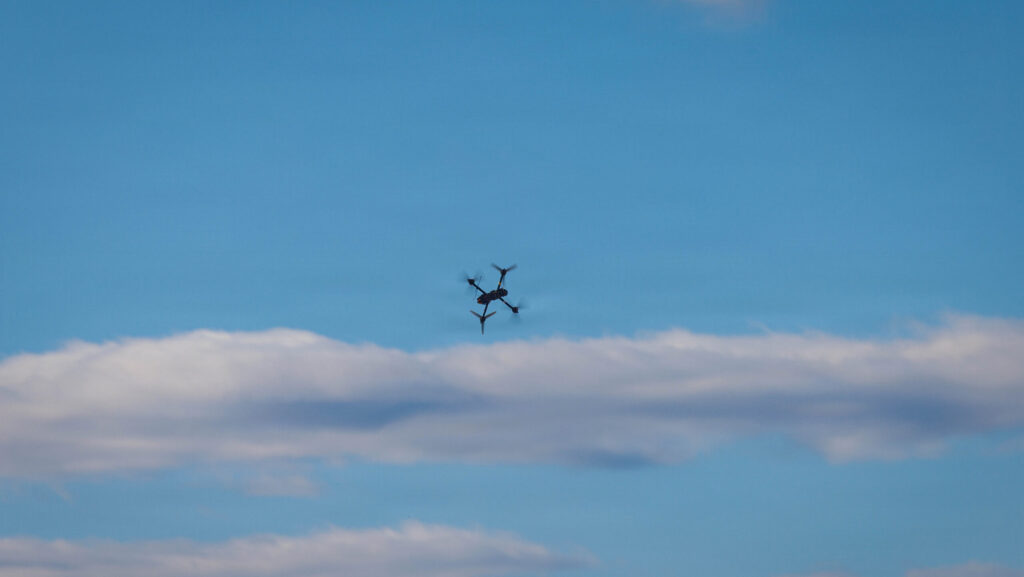
An abrupt airspace shutdown over El Paso, Texas, has ignited a political firestorm in Washington, raising serious questions about interagency communication and escalating risks in an era of drone threats and disinformation. What began as an alleged cartel drone incursion, involving the use of an anti-drone laser by Customs and Border Patrol, may have in reality been nothing more than party balloons. The incident is now being analyzed by experts and former officials as a potential „harbinger” of future challenges.
The El Paso Mystery: From Cartel Drones to Party Balloons
In the early hours of February 11, local and federal officials were caught off guard by the Federal Aviation Administration’s (FAA) decision to impose a 10-day flight restriction over El Paso International Airport and nearby areas along the Mexican border. The measure, reversed just hours later, was subsequently attributed to the use of an Army-loaned anti-drone laser by Customs and Border Patrol (CBP) officers. Federal officials initially cited a “cartel drone incursion,” yet later reports suggest the target may have simply been party balloons.
Interagency Breakdown: When Coordination Fails in US Airspace
Congress swiftly reacted. Representatives Rick Larsen, Bennie Thompson, and Adam Smith – the top Democrats on the House Transportation, Homeland Security, and Armed Services committees – demanded a classified briefing from relevant agencies, citing “conflicting reports” regarding the airspace closure. Their letter, addressed to the Secretaries of Defense, Homeland Security, and Transportation, expressed profound concern: “Even more concerning, we understand that the Department of Homeland Security and Department of Defense deployed this complex C-UAS [counter-unmanned aerial systems] technology without required coordination with the FAA. This lack of coordination and transparency with Congress on C-UAS missions introduces unnecessary and dangerous risk into U.S. airspace.”
The New Counter-Drone Doctrine: Pentagon Expands Authority on US Soil
The El Paso incident comes as the Pentagon begins to wield new counter-drone authorities on US soil. Following a series of mysterious drone incursions over Langley Air Force Base in 2023, Pentagon officials repeatedly emphasized that existing law restricted their ability to act. In response, US Northern Command (NORTHCOM) stepped up as an interagency “synchronizer,” while also experimenting with drone detection and defeat technologies, such as net capture and drone-on-drone ramming.
In 2025, a new interagency task force, JIATF-401, run out of the Pentagon, was created to address the threat posed by small drones (Group 1 through 3 systems) in American airspace. Subsequently, in December, Congress passed the Safer Skies Act, part of the 2026 National Defense Authorization Act (NDAA), which expanded state and local authorities and, crucially, those of the Department of Defense under Section 130i, concerning counter-drone operations on US soil. This expansion empowers top military service officials to designate facilities covered under Section 130i, potentially independent of the FAA, a decision that could significantly increase the number of military installations protected by counter-drone technology.
„Cowboy Behavior” and Expert Warnings: A „Harbinger of Things to Come”?
Experts warn that the potent mix of new regulations and emerging counter-drone technologies could make the El Paso incident more than a one-off event. Stacie Pettyjohn, director of the defense program at the Center for a New American Security, described the situation as problematic “cowboy behavior” stemming from a lack of coordination. She highlighted that the Pentagon’s “Drone Dominance” initiative would lead to more drones operating near military installations, a phenomenon further amplified by the burgeoning commercial drone industry. “So there are going to be more drones flying all over, and at the same time, there has been this pushing down of authorities to defend against potential drone threats,” Pettyjohn added, expressing concern about implementation.
Clayton Swope, deputy director of the Aerospace Security Project, noted that while Section 130i authorities are “aren’t particularly new,” the DoD will exercise them “a lot more,” given the perception that the drone threat is increasing. Houston Cantwell, a retired Air Force one-star, likened the situation to “just the tip of the iceberg,” emphasizing the complexity of the issues and the need for a whole-of-government effort. “We have not had to deal with these types of complex issues when it comes to homeland defense since 9/11,” Cantwell stated, urging more interagency exercises to prevent similar incidents.
Call for Dialogue: Congress Demands Coordination, Not New Legislation
While Democratic leaders are pushing for more information, they are not yet asking for an immediate legislative fix. The early focus is on coordination and ensuring that stakeholders are in communication. Senator Tammy Duckworth emphasized that agencies “should be talking to one another on a regular basis” and that “they have existing mechanisms. They just have to use them.” Even sponsors of expanded counter-drone authority legislation, like Senator Kirsten Gillibrand, express confidence that the Department of Defense will act responsibly, adhering to legal and policy coordination requirements.
Nevertheless, the El Paso incident highlights a broader “policy conundrum,” as Cantwell noted: sorting out a concrete plan for the protection of domestic critical infrastructure like power grids and dams, for which the military is largely not responsible. This strategic gap indicates that the challenge extends far beyond simple drones, touching upon the very foundation of national security.