The third and final day of the Unmanned Systems Exhibition (UMEX) and the Simulation and Training Exhibition (SIMTEX) in Abu Dhabi concluded with a resounding success. The closing day saw the allocation of three new defense contracts, collectively valued at approximately AED 1.26 billion ($342 million), exclusively to local UAE defense companies. These significant transactions not only underscore the economic prowess of the Emirates but also its firm commitment to fostering a robust and innovative indigenous defense industry.
A Strong Financial Close and the Rise of Local Industry
An official spokesperson for the Tawazun Council for Defense Enablement, the governmental entity overseeing defense procurement and development, confirmed that two of the final three contracts were awarded to EDGE Group, the UAE’s leading defense conglomerate. These agreements solidify EDGE’s strategic position and demonstrate confidence in the production and innovation capabilities of local firms. By the exhibition’s end, the total value of 11 contracts signed with Emirati companies reached $980 million, representing a 20 percent increase compared to the previous UMEX in 2024. This growth is a clear indicator of the progress and confidence within the UAE’s burgeoning defense sector.
EDGE Group: The Industrial Backbone of Emirati Defense
The first agreement with EDGE Group, valued at AED 385.717 million ($105 million), is for the development of jet-engine Unmanned Aerial Vehicles (UAVs). While specific models or quantities were not disclosed, EDGE Group has previously showcased a mockup of its jet-powered combat drone, the Adasi Jeniah, and also produces the jet-powered Shadow 25 loitering UAV.
The second contract, worth AED 525.21 million ($143 million), pertains to the purchase of the Tracked RCV (Remote Controlled Vehicle) and THeMIS systems. This acquisition could be a follow-on to the UAE military’s purchase during UMEX 2024 of 60 units of the 30-mm cannon-armed unmanned ground vehicle, built by Milrem Robotics, an Estonian entity within EDGE Group.
Furthermore, a press release issued by EDGE Group provided details on two other contracts previously announced at the show. These contracts stipulate that ANAVIA, a Switzerland-based EDGE entity specializing in advanced UAS (Unmanned Aerial System) design and manufacturing, will produce and deliver 76 HT-100 and 92 HT-750 rotary-wing UASs to the UAE Ministry of Defense. The HT-100 is a rugged, all-terrain, day/night, adverse-weather-capable unmanned helicopter designed for intelligence and data-gathering missions. The larger HT-750 is a multi-role unmanned helicopter tailored for logistics missions, capable of transporting heavy payloads with exceptional flight stability.
The final contract, valued at AED 345.33 million ($94 million), was signed with Caracal International, another EDGE subsidiary known for manufacturing pistols and rifles. This agreement covers the procurement of unspecified remote-controlled weapons, further expanding the armed forces’ autonomous systems portfolio.
The 3D Printing Revolution in Naval Warfare: Towards a Low-Cost Drone Fleet
A prominent theme at UMEX was the growing presence of high-tech maritime unmanned vessels (USVs), with numerous companies displaying both surface and underwater drone models. A significant innovation highlighted by industry executives is the increasing interest from many navies in platforms constructed using 3D printing technology.
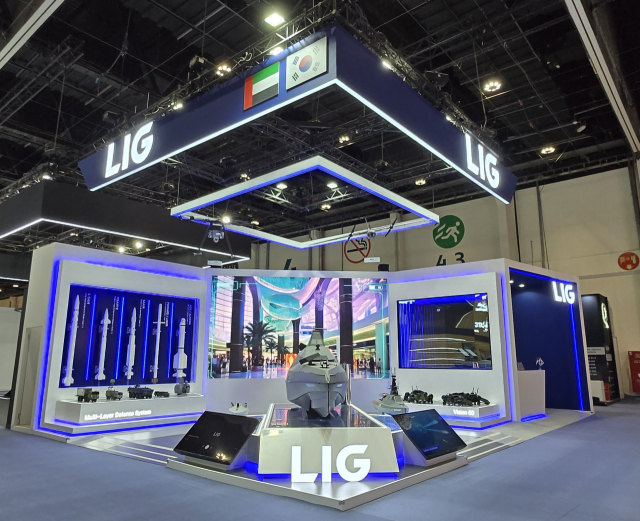
Wontaek Shin, the UAE business lead for South Korean defense company LIG, emphasized that the benefits of 3D printing are substantial, being „relatively cheaper and cost-effective.” Shin explained that platform configuration becomes much easier, allowing for 80% or 90% integration with other sensors and shooters readily. LIG already supplies the South Korean navy with various USV options for ISR, combat, and even „suicide missions.”
Piotr Zbigniew Targowski, head of boat building at Al Seer Marine, an Abu Dhabi-based maritime company, confirmed the UAE navy’s interest, inquiring whether their USVs could be 3D-printed. While 3D printing is not a new concept in this context, its large-scale integration into production lines remains complex and requires substantial investment. Nevertheless, Targowski noted that „3D printing is the best technology for building suicide USVs” because navies would demand large quantities, at low cost, and in a timely manner, especially during times of conflict. This trend suggests a strategic shift towards mass-producing affordable and effective autonomous systems for future naval engagements.