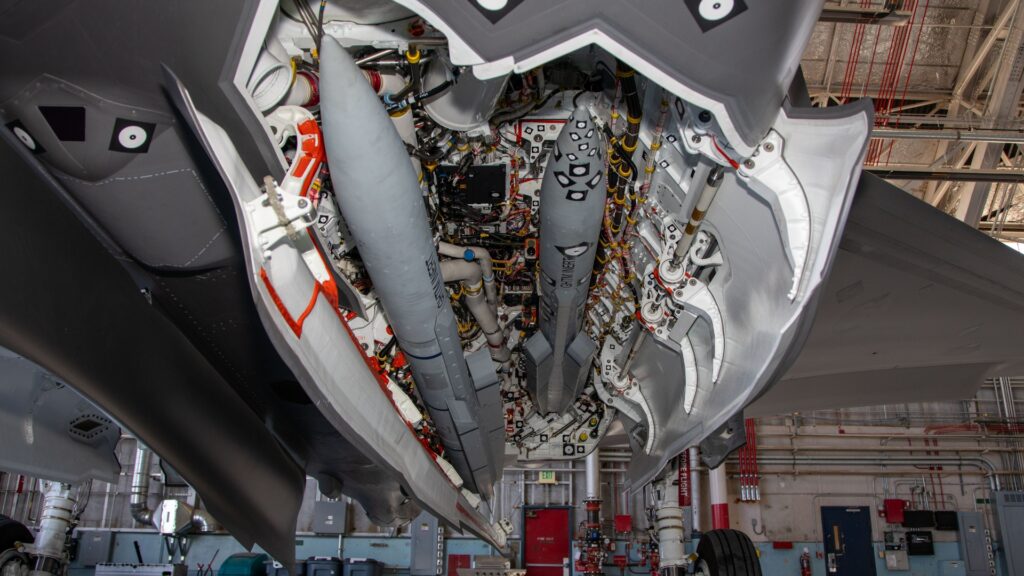
The F-35 program, at the forefront of modern air forces, is moving closer to integrating the European beyond-visual-range air-to-air Meteor missile. A series of ground-based integration tests, recently completed in the United States, have confirmed crucial compatibility between the 5th-generation fighter jet and the powerful ordnance. However, progress is overshadowed by significant delays, casting doubt on the operational timeline for some of its most important European users.
Progress Under the Stealth Hood: Meteor Nears F-35 Integration
Tests conducted at Edwards Air Force Base, California, included ground vibration checks and fit assessments, validating key hardware responses between the F-35A aircraft and the missile. This marks a pivotal step before airborne tests can begin. Engineers meticulously evaluated the collected data to confirm the safe stowage and deployment of the missile from the F-35A’s internal weapons bay, thus preserving the stealth profile essential for the aircraft’s missions.
Only one outstanding ground test remains for the Meteor missile, manufactured by European defense firm MBDA and envisioned for arming European F-35 customers, before clearance for the flight test phase is granted. Developers emphasize that, as a network-enabled capability communicating via data links, Meteor becomes a vital component, enabling F-35 aircrews to leverage the most flexible weapon system and capitalize on both the missile’s and the aircraft’s capabilities.
Italy and the UK, Pioneers of New Capability
Italy is sponsoring the integration of this ramjet-powered weapon on the F-35A model. In parallel, the UK is leading integration efforts for the F-35B Short Takeoff and Vertical Landing (STOVL) variant. A significant milestone was reached in March when, through UK and US government collaboration and with industry partner support, a US Marine Corps F-35B aircraft commenced initial Meteor flight tests from Naval Air Station Patuxent River.
Shadows on the Horizon: Critical Delays Threaten Plans
Despite these technical advancements, the in-service timeline for the Meteor missile has experienced a setback. According to statements from British officials, initial operational capability is now estimated for the early 2030s, a delay from the previous target of 2027. The exact cause of this postponement was not initially disclosed, but it raises questions about the pace of modernization. A UK Ministry of Defence spokesperson emphasized that, once integrated, the Meteor missile will significantly enhance the capabilities of the Royal Air Force’s F-35 Lightning aircraft.
The UK in Trouble: F-35 Fleet Lacking Necessary Punch
The situation with Meteor’s delays is compounded by the UK’s F-35 fleet lacking a standoff, long-range weapon to strike ground targets. This issue is considered „the biggest concern” linked to the fleet as a whole, according to an October UK parliamentary report. The MBDA-made Spear 3 missile is under contract to deliver such a capability. However, the report added that the Ministry of Defence wishes to equip its F-35s with the Spear 3 missile, but this is unlikely to be in place until the early 2030s, „partly because of problems with the supplier [MBDA] and partly because of global programme delays to the required software upgrades.”
A separate report from the UK’s National Audit Office indicated that delays to both Spear 3 and Meteor were caused by „poor supplier performance, the MoD negotiating commercial arrangements that failed to prioritize delivery, and low priority given to Meteor by the global program.” The UK has committed to acquiring 138 F-35 jets, with 48 currently under contract.