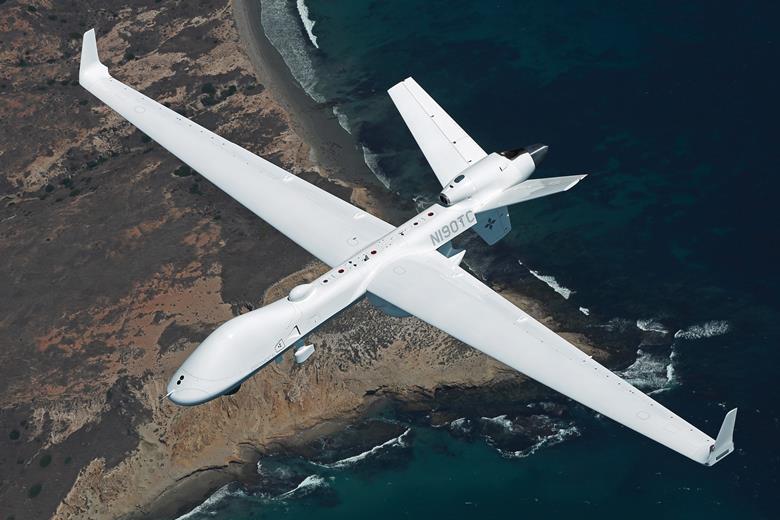
Berlin is making a significant stride in bolstering its maritime security and the collective defense capabilities of the North Atlantic Alliance. The German Armed Forces today announced a strategic order for eight advanced MQ-9B SeaGuardian drones, manufactured by General Atomics Aeronautical Systems, Inc. (GA-ASI), with deliveries slated to commence in 2028. This acquisition underscores Germany’s determination to protect its vital sea lanes and contribute to regional stability.
Eyes on the Atlantic and Baltic: The Imperative of Persistent Surveillance
The German Navy has emphasized the critical need for comprehensive situational awareness at sea, a prerequisite for safeguarding commercial shipping routes and vital infrastructure. „The navy needs to know what is happening at sea,” German officials stated. The new drones will complement the existing fleet, including the P-8A Poseidon maritime patrol aircraft, enabling coverage of vast oceanic expanses, from the depths of the North Atlantic to the Baltic Sea. This strategy aims for persistent and effective surveillance, capable of responding to evolving threats.
Advanced Technology for Complex Missions
The MQ-9B SeaGuardian distinguishes itself through its extended endurance capabilities, ideally complementing the P-8A Poseidon, which, while reaching speeds of approximately 900 kilometers per hour and boasting high sensor and weapon capacity, has a more limited time aloft. The SeaGuardian drones will be equipped with two multi-mode search radars, ensuring wide-area maritime surveillance, and possess the potential for anti-submarine warfare capabilities to be added. GA-ASI confirmed the drones’ ability to operate in cold climates, featuring „pole-to-pole” satellite control and de-icing capabilities.
NATO Synergy and European Interoperability
The acquisition is being conducted through the NATO Support and Procurement Agency (NSPA), a mechanism designed to expedite cooperation and procurement among member states. Germany thus joins a growing list of NATO nations, such as the UK and Belgium, that have opted for the MQ-9B platform. This standardization promises enhanced interoperability and efficient resource utilization. Linden Blue, GA-ASI’s chief executive, expressed enthusiasm, stating that „The proliferation of MQ-9B in Europe delivers commonality between NATO countries, and for Germany it will provide opportunities for interoperability with their fleet of P-8As.”
Nordholz Base: The New Operational Nerve Center
The new drone fleet and four certificated ground control stations will be operated by Naval Air Wing 3 „Graf Zeppelin” at the Nordholz naval station in Saxony, the same base that will host its P-8A aircraft. Prior to entry into service, personnel will undergo intensive training programs, and the necessary infrastructure will be introduced at the base. The Bundeswehr intends to draw upon the experience of allied armed forces, such as the British or Belgians, to ensure the smoothest possible transition to flight operations.
A Growing European Trend
Germany’s order for the SeaGuardian drones marks a strategic investment in its maritime surveillance and defense capabilities, solidifying its position within NATO and reflecting a global trend towards the deployment of autonomous systems for military purposes. With contracts already signed with Belgium, Canada, Denmark, India, Japan, Poland, Taiwan, and the US Air Force, the MQ-9B SeaGuardian is cementing its presence on the international stage.