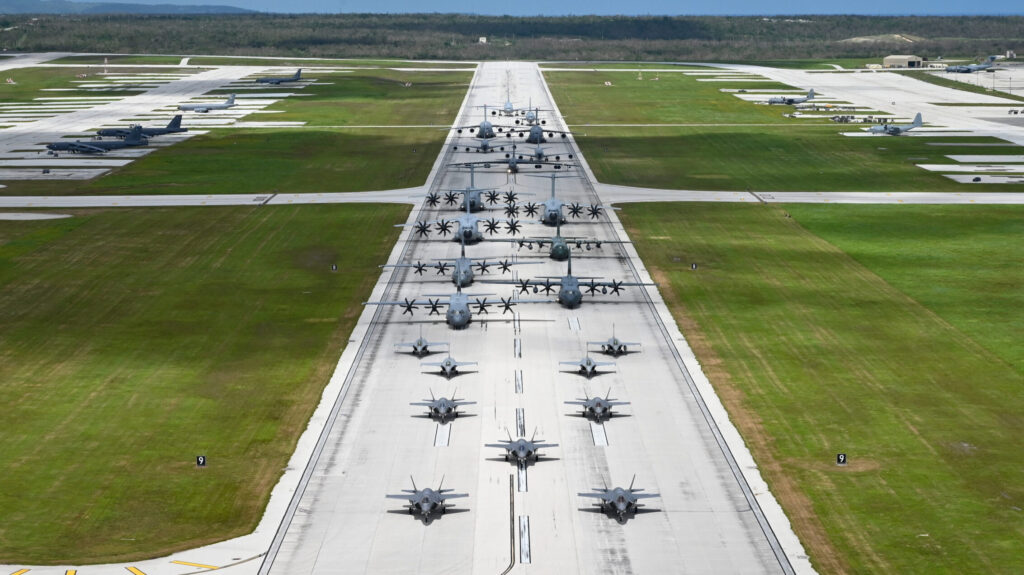
All eyes are now on General Mike Guetlein, who is set to deliver the full implementation plan in mid-November for the „Golden Dome” initiative – President Donald Trump’s signature defense program, valued at $175 billion. This follows Deputy Secretary of Defense Steve Feinberg’s first official briefing on the subject in mid-September. At a time of early momentum, it is crucial that Guetlein’s plan provides robust protection for Guam, and that Congress insists on this vital aspect.
Guam in Beijing’s Sights: A Growing Threat
Located only 1,800 miles from China’s coast, Guam’s military bases, along with the American citizens who live, work, and raise their families on the island, sit in the crosshairs of Beijing’s PLA Rocket Force. That force has tripled its missile inventory since 2020, which makes the need to increase Guam’s radar capabilities ever more essential.
Guam: Unequivocal US Homeland, Demanding Maximum Protection
In the last Missile Defense Review, Guam was described as “unequivocal homeland,” and its 170,000 US citizens are most deserving of the same protections afforded Americans on the continental United States. An attack on Andersen AFB or Tumon Bay would not be a proxy strike; it would be a direct assault on the United States, demanding the full spectrum of response, from THAAD intercepts to strategic retaliation.
It is therefore essential that, as the administration and the Department of Defense work the final plan for Golden Dome, they must not forget Guam. Getting its defenses right — especially via the radars necessary to see, sense and direct responses to incoming missile barrages — will inform the same mission over the homeland.
Current Efforts and Gaps to Fill
The solutions for integrating the protection of Guam into the emerging Golden Dome operational concepts are clear. Given its key strategic location, the US has already deployed advanced radars and missile batteries for midcourse ballistic tracking and interception. The Missile Defense Agency has also strived to keep pace with the evolving threat by supporting upgrades to Guam’s Aegis defense system to counter advanced ballistic and hypersonic missiles.
However, it’s clear more is needed. INDOPACOM leaders have consistently called for the deployment of capabilities for 360-degree, multi-mission coverage against simultaneous raids, with persistent surveillance over 1,000 miles. Further investment in advanced over-the-horizon radars and a networked architecture of battle command systems and synchronized interceptors are needed — and entirely doable.
Integration into ‘Golden Dome’: The Strategic Imperative
Should those additional defenses for Guam be rolled into Golden Dome? It’s hard to know exactly how it all fits without seeing the documents currently under development. But even if Guam does not get that full protection, it absolutely needs to be tied into Golden Dome and its network of sensors, space-based or terrestrial.
Defense of Guam is defense of the homeland. Thus, amid discussion among defense observers that US strategy might shift toward intensified focus on the Western Hemisphere — say, to counter missile threats from a revanchist Russia or narco-cartels in Latin America — the Indo-Pacific cannot be relegated to a strategic afterthought. Guam’s defenses must evolve into a self-sustaining fortress to strongly secure America’s Westernmost flank and her citizens there.
America’s most forward territory deserves a “Guam-First” integrated and layered posture with a recently demonstrated Aegis capability connecting the S-Band Homeland Defense Radar TPY-6 Transportable Array Units (TAU) with distributed Aegis, THAAD, Patriot, and IPFC missile launchers.
A Vision for the Future: Efficiency and Power Projection
With sensors and shooters connected, Guam’s defenses would benefit from several fire control systems tied together by a Joint Integrated Battle Management capability, one infused with AI-enhanced autonomy and tied to Golden Dome’s architecture. This would minimize troop footprints and reduce reliance on rotational carrier strike groups. It would deliver needed defensive coverage and maintain power projection without overstretching.
Washington must fortify Guam’s defenses, protecting the sailors, airmen, their families, and Guam’s citizens, keeping its Pacific shield raised – and ready.