At the International Flight Training School, the focus is less on aerobatics and more on information overload in fifth-generation warfare.
Decimomannu Airbase, Sardinia – Traditional flight training methods are leaving pilots unprepared for the cognitive challenges of flying advanced aircraft like the F-35 Lightning II. As defense expert Robbin Laird points out, the shift from hardware-based upgrades to software-defined capabilities necessitates a fundamental change in pilot training. The old system, designed for fighters with bolted-on upgrades, no longer works for planes whose capabilities can be altered with a software download between missions.
The Cognitive Battlefield: A New Breed of Fighter Pilot
Modern air combat isn’t about physical prowess anymore; it’s about cognitive capacity. Success hinges on a pilot’s ability to process vast amounts of information, make split-second decisions in contested electromagnetic environments, and function as a node within a networked combat system, explains Laird, drawing on his extensive defense expertise in the US and abroad.
IFTS: A Groundbreaking Approach in Sardinia
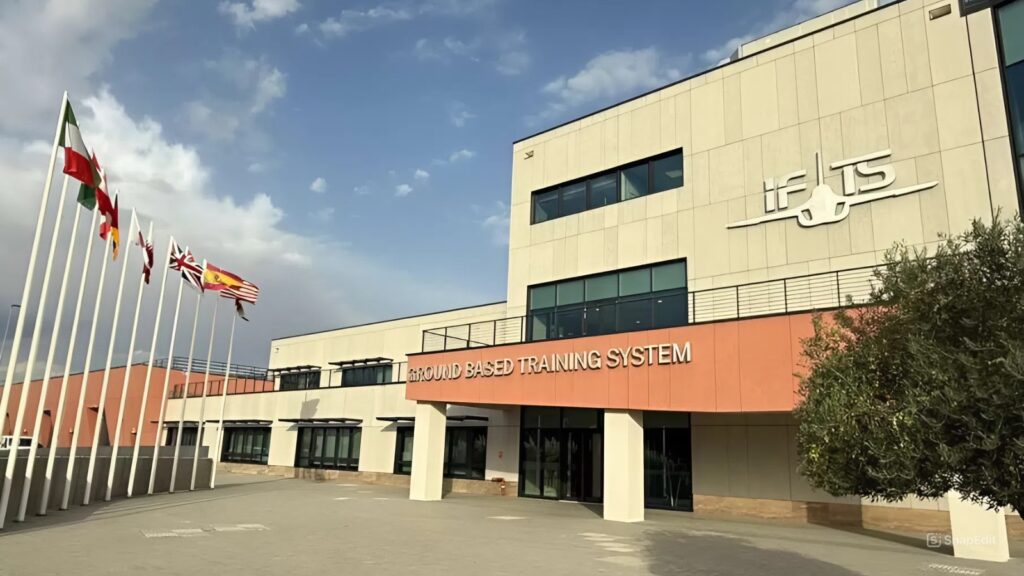
At Italy’s International Flight Training School (IFTS), in Sardinia, powered by Leonardo in collaboration with CAE, this transformation is actively being addressed. The IFTS leverages the M-346 advanced trainer, a software-centric platform mirroring modern combat aircraft architecture, to integrate operational concepts and tactics from frontline F-35 or Eurofighter squadrons directly into the training environment. Students encounter advanced combat scenarios during Phase 4 training, eliminating the need to develop these skills post-graduation, according to Laird’s recent visit to Decimomannu Airbase.
Beyond the Stick and Rudder: Mental Transformation
The goal isn’t simply to teach pilots to fly the M-346 but to reshape their „mental furniture,” establishing cognitive frameworks and decision-making patterns essential for modern air combat. Modern fly-by-wire systems automate basic aircraft control, freeing pilots’ mental bandwidth. IFTS directs that mental energy toward information management and decision-making, emphasizing simultaneous sensor data processing, situational awareness, rapid decision-making, and coordination with distant assets, according to Laird.
Downloading Expertise: Replicating Advanced Jet Challenges
The key lies in replicating the cognitive challenges of operating advanced jets within a trainer aircraft using live virtual constructive (LVC) systems.
IFTS employs a four-cluster LVC training ecosystem, seamlessly integrating synthetic and live flight operations:
- Cluster One: Provides unlimited simulation-based practice for mastering basic systems and procedures.
- Cluster Two: Introduces augmented and virtual reality in full-fidelity cockpits, developing cognitive skills and adaptive AI-enhanced training.
- Cluster Three: Advances students to mission-level training involving live aircraft, simulator-based pilots, and computer-generated forces.
- Cluster Four: Projects extended battlespace scenarios into live aircraft operations, injecting synthetic threats and adversary aircraft, reducing fuel consumption and costs.
The Pipeline Revolution: Harmonizing Fighter Pilot Training
A significant innovation is the harmonization of Italy’s fighter pilot training pipeline. Since 2016, the Italian Air Force has conducted comprehensive reviews of every training phase, eliminating duplication and building directly upon previous phases.
A unique feedback mechanism facilitates this process: instructors from the M-346 program, operational conversion units, and operational squadron pilots meet bi-annually to review procedures and adjust curricula based on real-world experience.
Measurable Results: Faster, More Efficient Training
The results are clear: graduates from Phase 4 now require thirty percent less training time at the Eurofighter operational conversion unit. They possess the same tactics, radio calls, and procedures used operationally. Italian students also consistently score at the top of their class at Luke Air Force Base’s F-35 training program.
Coalition Building Through Training
With twelve allied air forces, including the US Air Force, sending students to IFTS, it’s become a coalition-building engine. By maintaining transparency and hosting students from multiple nations, the Italian Air Force cultivates trust and interoperability, according to Laird.
The Italian Air Force tailors the curriculum based on each partner air force’s needs. Students are trained to think alike, process information using the same mental frameworks, and operate using compatible decision-making patterns, laying the foundation for effective coalition operations.
Looking Ahead: A Model for the Future
As air forces grapple with fifth-generation integration and constrained budgets, the IFTS model highlights crucial principles: military ownership of standards, harmonized training pipelines, continuous feedback from operations, and software-defined training systems, as explained by Laird.
The International Flight Training School isn’t just training pilots; it’s creating aviators whose cognitive abilities are prepared for an uncertain future where software drives capability, information dominance determines outcomes, and coalition integration defines success. That’s the revolution unfolding in Sardinia.