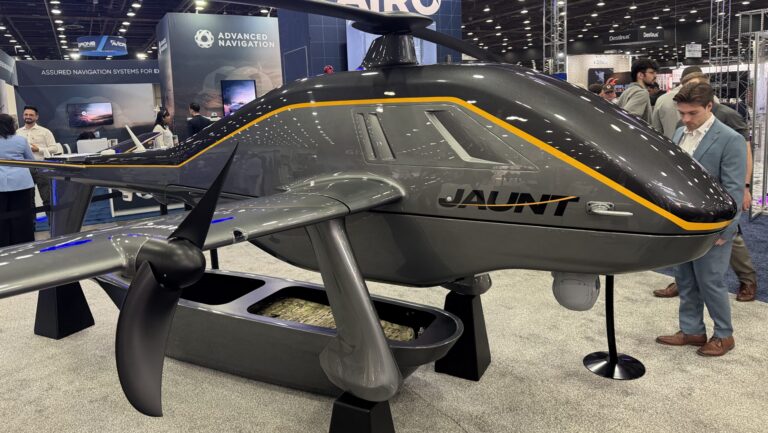
The aerospace landscape is witnessing a fundamental shift with the unveiling of AIRO and Jaunt Air Mobility’s latest dual-use vertical-takeoff-and-landing (VTOL) drones. The JC250 cargo variant and the JX250 ISR platform are designed to conquer the most persistent challenges in autonomous aviation: the lack of charging infrastructure in remote areas and the inherent range limitations of pure electric flight.
Rethinking Aerodynamics: When a Rotor Becomes a Wing
The core of these platforms’ superiority lies in their patented „slowed-rotor” architecture. While traditional VTOL designs struggle with the high power demands of forward flight, AIRO’s system utilizes a large, efficient rotor for vertical lift, which then slows down during horizontal transition. In forward flight, the rotor mimics the function of a secondary wing, drastically reducing drag and maximizing aerodynamic efficiency in a way that conventional helicopters cannot match.
Hybrid Power: 18-Hour Endurance for the Unreachable Frontlines
The integration of hybrid-electric propulsion provides a level of operational flexibility previously unseen in the drone sector. By pairing an electric motor with an internal combustion engine, these drones can operate independently of a power grid. The gas-powered component acts as an on-board charger, extending the aircraft’s range to a potential 1,000 nautical miles. For ISR missions, this translates to an astounding 15 to 18 hours of endurance—a capability that currently stands alone in the world of runway-independent aircraft.
Bridging the Middle Mile: From Battlefield Supply to Life-Saving Medevac
These drones are specifically engineered to dominate the „middle mile”—the logistical gap between major distribution hubs and final delivery points. In military terms, this targets the space between rear-area stockpiles and remote units, where ground convoys are vulnerable and manned assets are often overtasked or too expensive to deploy.
Beyond the battlefield, the „dual-use” nature of the JC250 and JX250 makes them ideal for civilian applications, including urgent medical transport, law enforcement surveillance, and resupplying remote rural communities. With flight testing expected by the end of the year and efforts underway to secure „Blue UAS” compliance, these platforms are positioned to become a staple in both government and commercial autonomous fleets.