Iraq is set to enhance its rotorcraft fleet through a new planned acquisition of French helicopters, a decision that could gain significance amid discussions about the eventual exit of American troops from the Middle Eastern nation.
Iraqi Major General and pilot Tahseen Al-Khafaji, spokesperson for the Joint Operations Command of various Iraqi forces, confirmed in a televised interview that Baghdad has signed a contract to procure French Caracal H225M helicopters, although he did not specify the number of aircraft or the contract’s value.
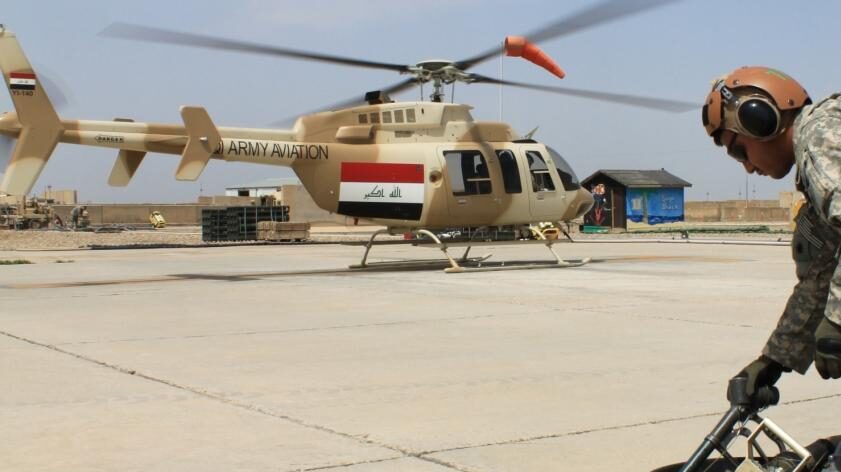
In addition to the French helicopters, Al-Khafaji mentioned earlier plans to buy 21 U.S.-made helicopters, including nine Bell 407s and 12 Bell 412s, which he stated is progressing as planned. His remarks came following Iraq’s recent delivery of seven Bell 505 trainer helicopters, with expectations for eight more to be delivered soon. “Our ambition is to have an air force fleet that covers all Iraqi operation zones,” Al-Khafaji said, noting that the priorities for the Iraqi armed forces currently include the army aviation command, air force, air defense, and land forces.
Former Lebanese Air Force Chief Brig. General Ziad Haykal told Breaking Defense that the Bell 407’s capabilities could address the gaps that may arise after U.S. troops depart, particularly in areas such as internal security, transport capabilities, long-range transport, light attack helicopters for escorting, and intelligence, surveillance, and reconnaissance (ISR) functionalities.
In January, Iraqi Prime Minister Mohammed Shia al-Sudani called for a rapid withdrawal of U.S. forces following the killing of a suspected militant leader in Baghdad. Analysts at the time indicated that Iraq was unlikely to pursue a hard push for the U.S. exit, given the significant support received from American forces.
However, an Iranian news agency, Tasnim, recently reported that Iraq’s foreign minister plans to visit Washington next month to formally announce the withdrawal of American military forces. White House National Security Communications Advisor John Kirby did not confirm the visit or the timing of any withdrawal plans. “We have been engaged appropriately with bilateral talks with Iraq on what the future of the counter-ISIS mission will look like there and how successful we’ve been with the Iraqi Security Forces, as well as what’s on the table for continued success in this vital mission,” Kirby stated in a press briefing earlier this week.
Ryan Bohl, a senior analyst for the Middle East and North Africa at the RANE Network, noted to Breaking Defense that an imminent U.S. withdrawal is unlikely, but the prospect of troop reductions adds urgency to Iraq’s interest in new helicopters, especially as these platforms play essential roles in comprehensive anti-terrorism efforts. “Should Iraq procure new transport, tactical, and attack helicopters, it would enhance the mobility and strike capabilities of Iraqi units against non-state actors like ISIS,” Bohl commented.
He added that these new helicopters would significantly enhance the Iraqi military’s flexibility in combating the resurgence of ISIS, albeit without fully replacing U.S. forces, particularly in terms of training and experience.
Furthermore, Bohl highlighted that relying on U.S. and French military platforms would decrease the Iraqi air force’s dependence on outdated Russian/Soviet equipment and diversify its arsenal away from the U.S. towards a friendly NATO ally like France. A 2023 report from the U.S. Department of Defense Inspector General noted that Iraq was acquiring additional Bell helicopters partly due to difficulties in sourcing spare parts for its Soviet-era airframes amid the ongoing conflict in Ukraine.
Haykal mentioned that the new Bell 407s are expected to replace older models already in Iraq’s fleet, while the Caracal H225M will provide long-range transport capabilities.
As of publication time, Airbus had not responded to requests for additional comments regarding the H225M deal with Iraq.