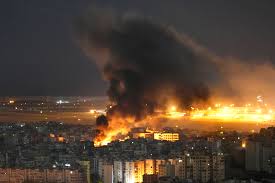
Tensions are exploding in the Middle East, transforming Israel into a central player in a multifaceted conflict. Just one week after launching concerted airstrikes alongside the United States against Iran, the Israel Defense Forces (IDF) find themselves in a complex situation, executing military operations both in Iran and against Hezbollah, the Tehran-backed militant group operating from Lebanon.
Historical Preparedness: The Anticipated Scenario Becomes Reality
For military experts and analysts, the current panorama, while intense, is not surprising. They emphasize that the IDF has always operated under the premise of the inevitability of a multi-front conflict. „The understanding within the IDF has always been that, in a war with Iran, Hezbollah would be involved,” states a recognized specialist, author of a work on Israel’s attack on Syria’s nuclear program. He adds that „this scenario has been extensively trained and prepared for, and is now materializing.” Israel’s ability to simultaneously manage campaigns in Iran and Lebanon is seen as proof of this meticulous preparation.
Escalation in Lebanon: From Rockets to Evacuations
Recent chronology highlights the intensification of the conflict. On March 2, the IDF retaliated with strikes on Hezbollah in Lebanon, after the group launched rockets towards Israeli territory. The situation rapidly escalated, and on March 8, the Chief of Staff of the Israeli Army, Lieutenant General Eyal Zamir, warned that Israel must be prepared for a fight of „considerable duration.” Subsequently, the IDF expanded its operations, warning residents of southern Beirut to evacuate the area. This offensive in Lebanon has not been without cost, with casualties already recorded: several Israeli soldiers were wounded, and two lost their lives.
Tactical Differences and the IDF’s Adaptable Force
Analysts observe that, although both fronts are active, the geographical and operational differences between Iran and Lebanon allow for efficient resource allocation. On March 8, the IDF reported using approximately 820 munitions and eliminating 190 Hezbollah members in Lebanon. In contrast, in the first four days of the conflict with Iran, the IDF used 5,000 munitions. A former IDF officer and founder of a research center emphasizes that the types of operations are distinct: in Lebanon, the IDF focuses on ground operations and border security, while in Iran, the emphasis is on long-range air operations. „I don’t think anyone is surprised and that’s why I don’t think it’s too much [for the IDF],” she states, referring to the IDF’s ability to manage both theaters of operations.
Hezbollah: A Weakened Force, Yet a Persistent Threat
Assessments indicate a significant weakening of Hezbollah since the last major conflict. „Hezbollah has been severely weakened since the last war and, therefore, will have a hard time doing real damage to Israel,” an expert explains. This reality allows the IDF to fight on two fronts simultaneously, with an aerial focus in Iran and a combination of air and ground operations in Lebanon. Israel’s northern air defense architecture, including Iron Dome and the emerging Iron Beam laser system, is specifically designed for this theater of war, being less critical against Iranian projectiles. This specificity allows for the redirection of Israeli aerial power northward, if necessary, also benefiting from the combined support of American and Israeli forces and weapon systems against Iran.
The Main Focus: Iran and the Window of Opportunity
Given the degradation of Hezbollah’s capabilities over time, the threat from Lebanon seems less acute than that posed by Iran. Therefore, Tehran will likely remain the IDF’s primary target. An analyst from a strategy and policy institute anticipates that „once the war with Iran wraps up, Israel may seek to expand operations in Lebanon to destroy Hezbollah capabilities and also to force a new ceasefire deal.” This situation is perceived as a „window of opportunity, without American restraint, allowing Israel to profoundly degrade Hezbollah’s capabilities.”