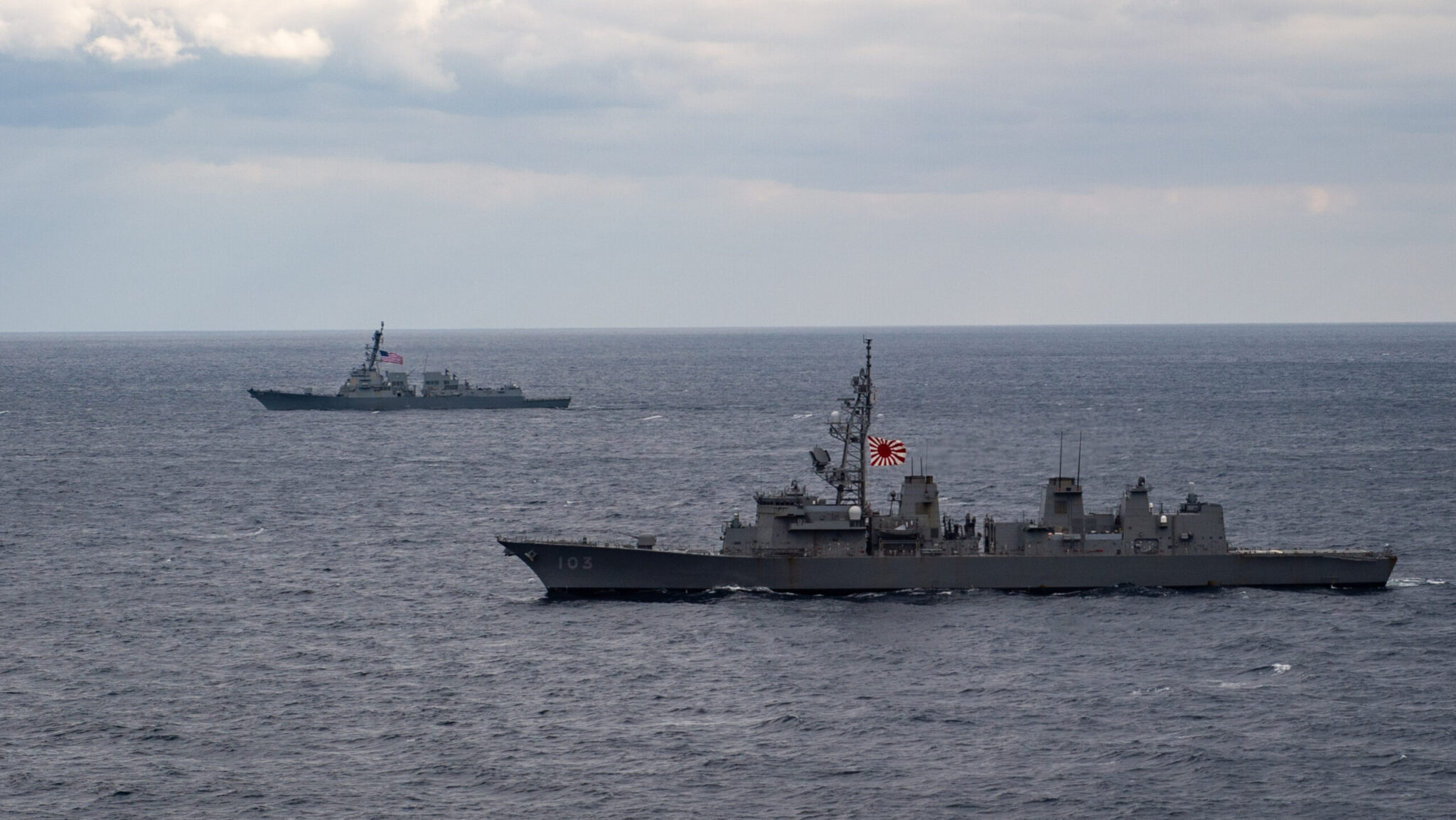
For the first time, the Japanese military will be equipping its vessels with Lockheed Martin’s electronic warfare anti-ship missile capability, thanks to a new $113 million contract announced today by the company.
According to Lockheed Martin, this purchase represents the first international sale of what is considered the premier shipboard electronic warfare system globally. “Japan is a critical ally in the Western Pacific,” the statement continued. “Equipping Japan with the Surface Electronic Warfare Improvement Program (SEWIP) provides the same advanced system for detecting and identifying threats that the U.S. Navy employs, thereby enhancing shipboard capabilities and increasing interoperability with the U.S. Navy.”
The SEWIP program incorporates the AN/SLQ-32 system — commonly referred to as “slick 32” — and is currently being installed on nearly every surface ship in the U.S. Navy fleet. Electronic warfare (EW) generally employs electromagnetic or directed energy to achieve one of three goals: conducting electromagnetic attacks or jamming adversary systems, implementing defensive measures to shield personnel and equipment from jamming, and providing electronic support focused on surveillance and identifying sources of electromagnetic energy.
As Lockheed Martin describes, “SEWIP enables sailors to protect the ship from visible threats, such as incoming missiles, as well as unseen dangers, like radar jamming.” The SEWIP program is divided into four blocks, each offering varying capabilities: General Dynamics manufactures Block I, Lockheed Martin handles Block II, Northrop Grumman is responsible for Block III, and Block IV is a future upgrade yet to be determined. Lockheed Martin’s Block II specifically enhances the system’s electronic sensing capabilities.
Lockheed’s Block II is installed on Arleigh Burke-class destroyers and both classes of Littoral Combat Ships, with plans for installation on the U.S. Coast Guard’s Offshore Patrol Cutter as well.
The sale to Japan aligns with the White House’s ongoing efforts to strengthen the U.S.-Japan relationship through defense technology cooperation and investments, among other initiatives. In April, Washington and Tokyo announced plans to “bilaterally upgrade our respective command and control frameworks to enable seamless integration of operations and capabilities, allowing for greater interoperability and planning between U.S. and Japanese forces in peacetime and during contingencies.”
The White House commented that “more effective U.S.-Japan Alliance command and control will strengthen deterrence and promote a free and open Indo-Pacific in the face of pressing regional security challenges.”
Additionally, the Navy disclosed last week that an American F-35B made history by landing on a Japanese destroyer for the first time during exercises off the coast of California.