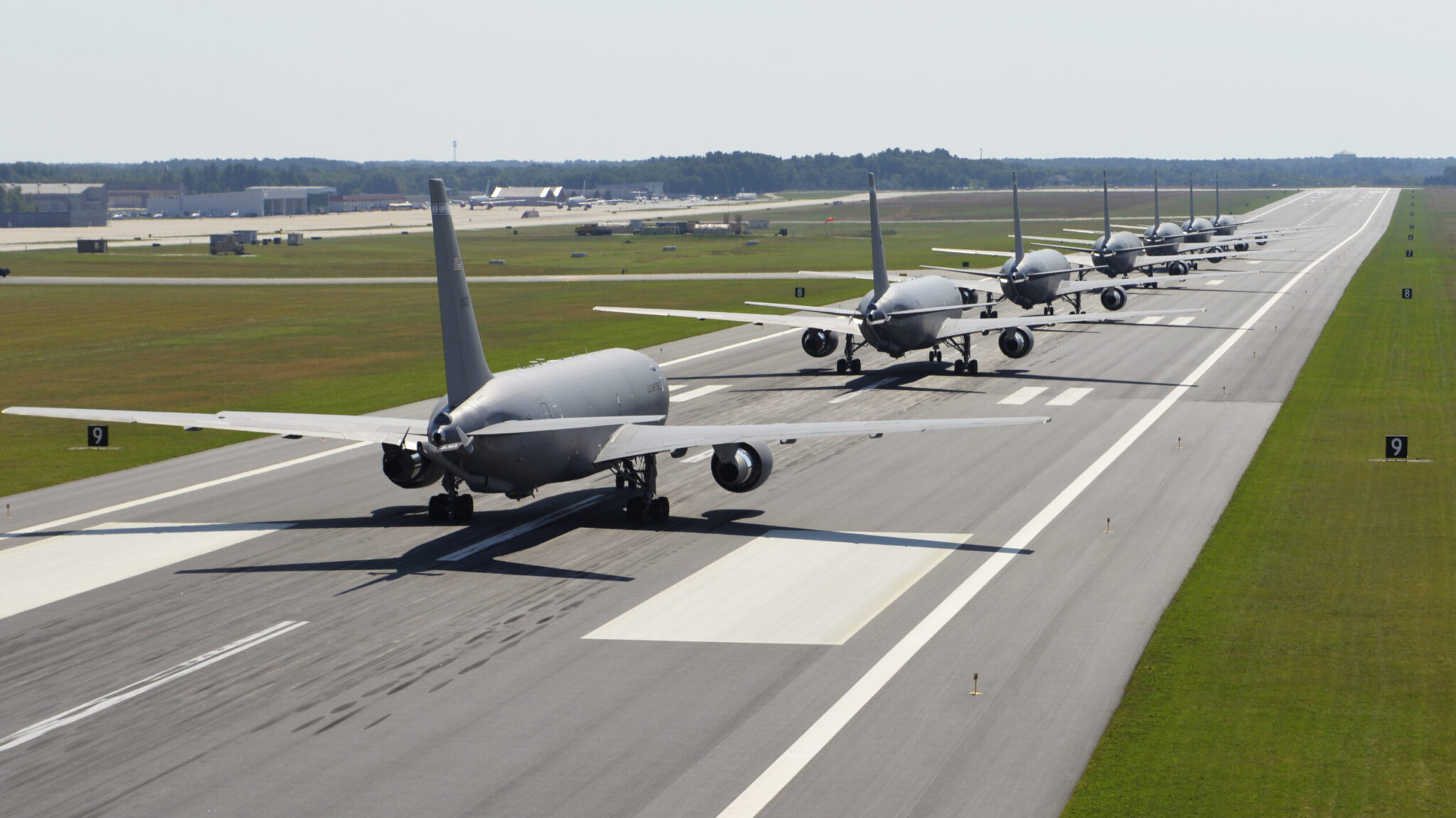
The U.S. Air Force and Boeing have identified a new “category 1” deficiency in the troubled KC-46 tanker, although the Air Force has stated that the manufacturer is swiftly addressing the issue. Known as the „bleed air duct deficiency,” the problem arises from vibrations caused by a fuel pump, which have been damaging the bleed air ducts. Kevin Stamey, the Air Force’s program executive officer for mobility and training aircraft, explained to reporters at the Life Cycle Industry Days conference that bleed air—compressed air extracted from the aircraft’s engine or auxiliary power unit (APU)—is essential for functions such as pressurization and cooling subsystems.
Stamey acknowledged Boeing’s prompt response in repairing the affected aircraft. Initial flight tests indicated that a mitigation technique aimed at reducing vibrations “looks very promising” as a temporary solution while working towards a permanent fix. This technique involves alternating the pump on and off to minimize vibrations. A Boeing spokesperson confirmed that “[a] long-term fix is in progress, and a short-term mitigation plan is currently under review by the U.S. Air Force to reduce fleet impact.” The spokesperson also emphasized that the new deficiency „is not an immediate safety concern.”
Category 1 deficiencies are defined by the Air Force as issues that could lead to aircraft loss, injury, or death. With the KC-46 now facing a total of seven category 1 deficiencies, officials stressed that many of these issues are on track to be resolved. For instance, Col. David Hall, Senior Materiel Leader for the KC-46 Division, mentioned that new flex coupling links to address a problem in the aircraft’s fuel manifold are being rolled out following final design approval, although a precise timeline for downgrading this issue remains pending. Additionally, new designs to tackle cracking on the APU drain masts are being implemented across half the fleet, moving toward a „near-term path to closure.” Recent design completions should also prevent cracks in the drain line of the aircraft’s refueling receptacle.
Among the remaining three deficiencies, two relate to the delayed redesign of the aircraft’s Remote Vision System, with deployment expected in spring 2026. The third involves a redesign of the boom actuator, which will enable refueling of the A-10 Warthog and has achieved FAA compliance, entering lab testing in May. The Air Force has indicated that this solution should be ready by fiscal year 2026.
To date, Boeing has incurred over $7 billion in losses related to the KC-46 program due to its fixed-price development framework. These ongoing issues have postponed the decision on full-rate production, with Stamey noting that no firm date has been established for reaching this milestone. Initially considered a viable solution for recapitalizing the aging KC-135 refueling fleet, there are growing concerns regarding the KC-46 project amid budget restrictions. The current agreement with Boeing anticipates 183 aircraft, with an option for an additional five units, according to Stamey. Echoing Air Force Secretary Frank Kendall, he noted that “no decisions have been made” regarding the recapitalization strategy. Furthermore, an analysis of alternatives for the Air Force’s future refueling fleet, referred to as the Next Generation Air Refueling System (NGAS), is expected to be completed in October.