L3Harris has formally protested the Army’s decision to award Sierra Nevada Corporation (SNC) a contract to develop a fleet of deep-sensing spy planes, an action that SNC claims will stall progress on the program.
An L3Harris spokesperson confirmed that the company has submitted a protest to the U.S. Government Accountability Office (GAO) for a review of the Army’s decision regarding the High Accuracy Detection and Exploitation System (HADES) contract. “We carefully reviewed the information during the Army’s debrief process, which led us to challenge the HADES decision and request further analysis to ensure the proposal received an equitable evaluation,” the spokesperson stated. They emphasized their goal of providing mission operators with the lowest risk and most capable solutions amid a complex security environment.
In an interview with Breaking Defense, Josh Walsh, SNC Vice President of Mission Solutions and Operations, refuted L3Harris’s claims as “inaccurate and incorrect.” He expressed confidence that SNC would ultimately prevail and noted that the protest’s impact would be temporary. Walsh indicated that the protest, filed on September 16, pertained to “a minor administrative issue that should not delay such a critical program for the Army.” He added, “We believe the protest has no technical merit.”
The GAO has set a deadline to deliver its verdict by December 26. By law, the Army is required to halt work on the program while the dispute is under review. The Army has yet to respond to requests for comment on the matter. Aviation Week was the first to report the protest.
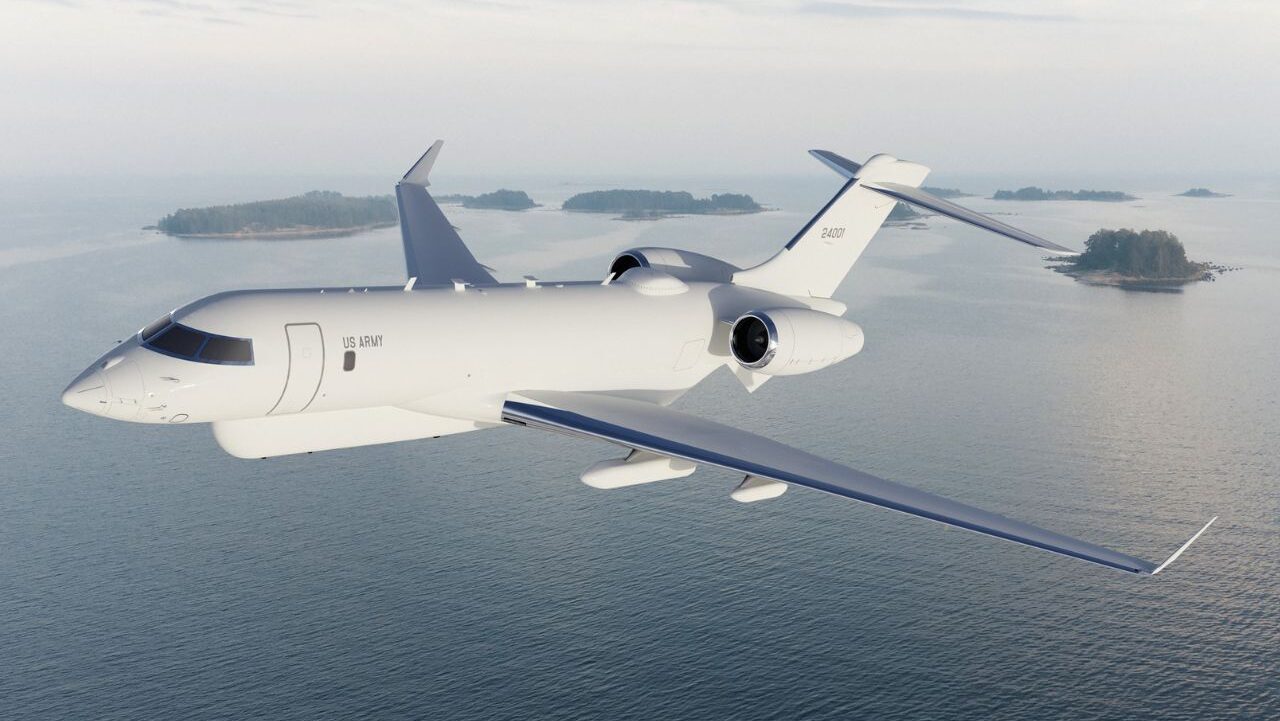
SNC’s successful bid for the 12-year HADES contract, valued at nearly $1 billion, came in August, outperforming a consortium that included L3Harris, Leidos, and MAG Aerospace. The HADES initiative aims to convert Bombardier’s Global 6500 business jet into an intelligence, surveillance, and reconnaissance (ISR) platform, intended to replace the aging fleet of RC-12 Guardrail turboprop aircraft. The Army plans to eventually field up to 14 of these jets equipped with capabilities such as moving target indication and signals intelligence.
In preparation for HADES, the Army has engaged various companies to produce “bridging” aerial ISR assets to inform its requirements. These efforts include:
- An ISR-as-a-service contract to SNC for the High Altitude Expeditionary Next ISR-Sensor (Athena-S), focused on two converted Global 6500s.
- Two additional converted Global 6500s by MAG Air and L3Harris under the Athena-Radar initiative.
- A Bombardier Challenger 650 owned by Leidos, known as the Airborne Reconnaissance and Targeting Exploitation Multi-Mission Intelligence System (ARTEMIS).
- The L3Harris Airborne Reconnaissance and Electronic Warfare System (ARES), which uses a Bombardier Global 6000.
Army officials expected a potential protest from a losing bidder and had aimed to deliver the first jet to SNC in the October-November timeframe after the protest window closed. “We must be cognizant that every performer that competes for work has the right to protest if they choose to,” noted Andrew Evans, director of the Army’s ISR Task Force. “If there’s a protest, we’ll get through that period, and the GAO will make a decision regarding the future of the award.”