Lockheed Martin and the 25th Infantry Division will incrementally test a prototype for the Army’s Next Generation Command and Control (NGC2) through a series of events called Lightning Strike.
$26 Million Agreement
In September, the Army awarded Lockheed a $26 million Other Transaction Authority to provide an integrated data layer for the 25th ID as part of the service’s NGC2 effort. The goal is to provide commanders and units with a new approach to manage information, data, and command and control using agile and software-based architectures.
Lightning Strike Series
Lightning Strike, scheduled to begin around February, is similar in concept to the Ivy Sting series being conducted by the 4th Infantry Division and its industry partner, Anduril and its team of vendors.
Aiming for Project Convergence
„We’ll do a series of Lightning Strike demonstrations which ultimately lead to participation in Project Convergence [Capstone 6] next year,” said Chandra Marshall, vice president and general manager of multi-domain combat solutions at Lockheed, at the annual AUSA conference. „We’re working through with the 25th ID right now on exactly what we’re going to demonstrate at each of those Lightning Strikes. Not completely defined yet, but we’re framing it out right now with them.”
Complementary Efforts
Army officials have stated that Lockheed’s and Anduril’s NGC2 prototypes are complementary, rather than competing, efforts. The Army aims to incorporate a diverse set of capabilities and vendors to prototype and inform the eventual NGC2 ecosystem.
Software Architecture Stack
Marshall explained that Lockheed is developing a software architecture stack, analogous to an operating system for an ecosystem of applications, including third-party ones. The goal of NGC2 is to consolidate disparate staff and warfighting functions into applications on a single architecture, providing greater situational awareness on the battlefield.
Army Ownership of Data
„Ultimately, I think where the Army is going is they want to own the data. Our job is to help them facilitate an architecture that allows them to do that and allows us to look across different applications and figure out what makes the most sense from incorporation in the future,” Marshall said.
Open and Scalable Tech
Richard Calabrese, director of strategic growth at Lockheed, said the Army wants the technology to be „open and scalable, to bring in new applications.”
Facilitating Integration
„One of the strengths of Lockheed Martin is to be able to facilitate, helping to bring disparate sources from small businesses, non-traditionals or other large primes into this architecture. That’s what we bring to bear. Is that pipeline, the DevSecOps pipeline and the ability to bring together and integrate,” Calabrese said.
Testing on C2 Fix Hardware
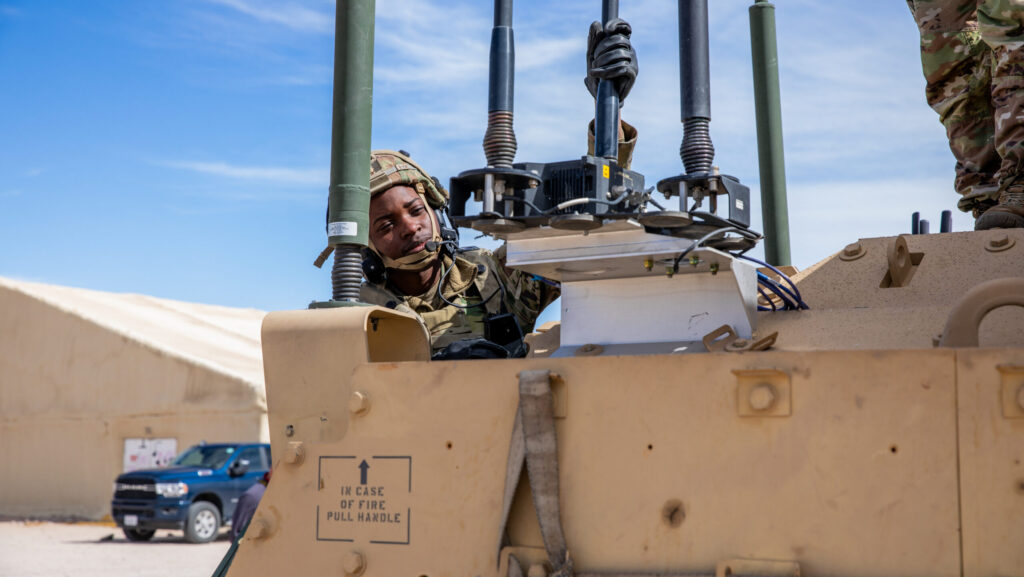
Part of the effort involves ensuring the architecture runs on the 25th ID’s existing modernized network equipment under C2 Fix.
Informing Architecture Needs
„Our job is to then verify, does the full stack architecture run on the C2 Fix hardware and we’re trying to demonstrate as many vertical slices through the stack as we can,” Calabrese said. „They’re looking for us to help inform them of what the architecture needs to be.”
Incremental Progress
The first iteration of Ivy Sting focused on new artillery fire command and control software. Calabrese suggested that a „fires app” might also be the initial focus for Lockheed, followed by a logistics capability, with additional capabilities added incrementally.
Testing in Challenging Environments
„The objective here is, through these Lightning Strike events, is to make incremental progress towards broadening and proving out that the full stack architecture works, including things like [denied, degraded, intermittent, and limited] environments and stuff computing at the edge,” he added.