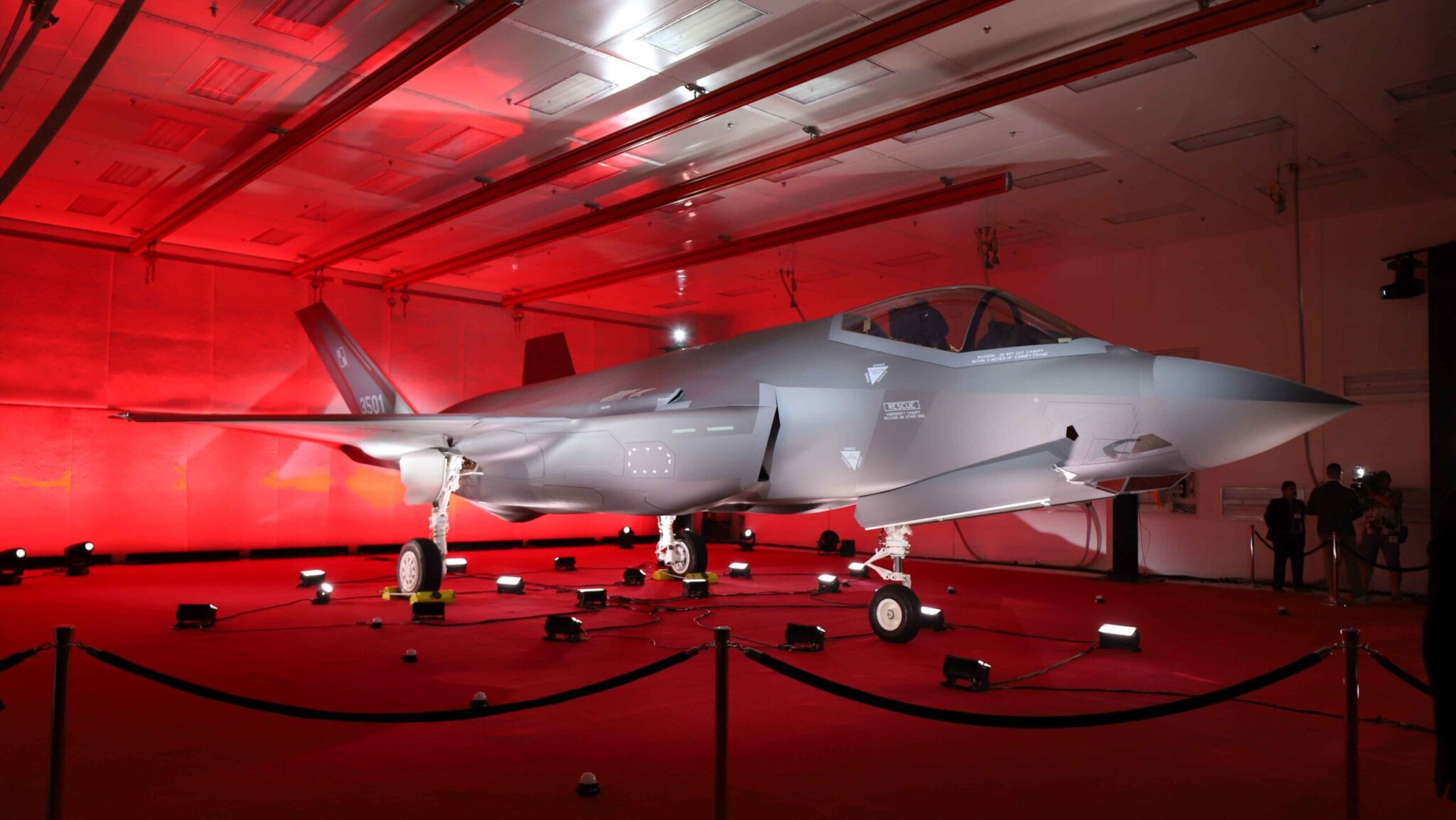
After a year dominated by challenges surrounding the program, Lockheed Martin celebrated a significant milestone for the F-35 today: the rollout of the first stealth fighter for Poland at the aerospace giant’s factory, attended by Polish military representatives, US officials, and other dignitaries.
“This aircraft is going to be a great contributor to Polish and, not only Polish, regional safety, as well as NATO credibility and deterrence,” said Maj. Gen. Ireneusz Nowak, general inspector of the Polish Air Force, during the ceremony. “So we are going to use it and we are going to achieve our goals.”
As he addressed the Polish pilots present, Nowak wished them luck along with “an equal number of take-offs and landings,” adding his hope that the jet would not need to be used in combat, “so let’s just use it for deterrence.”
The F-35 unveiled today is the first of 32 fighters for Poland, following a $4.6 billion agreement inked with Washington in 2020 for aircraft in the conventional takeoff and landing configuration. This order also includes 33 F135 engines produced by Pratt & Whitney, alongside necessary training and logistics services. The jets will be delivered gradually over several years from Lockheed’s busy international production line, with the Polish Ministry of Defence stating that all aircraft should arrive by 2030. The timeliness of Warsaw’s F-35 deliveries is a welcome sign for Lockheed and Poland after a challenging year in Fort Worth. The Pentagon only began accepting fighters equipped with the Technology Refresh 3 upgrade last month, a year after a delivery freeze was implemented due to software issues. TR-3 provides the hardware and software needed for a suite of new capabilities known as Block 4, and jets fitted with this upgrade, like the one revealed today, will be limited to training roles for at least another year as lingering software issues are resolved.
Poland is eager to commence training quickly. Polish Air Force officials have already visited Luke Air Force Base in Arizona to familiarize themselves with F-35 maintenance operations, and Polish pilots will inaugurate a new international training hub at Ebbing Air National Guard Base in Arkansas within months, utilizing their new jets. The first aircraft is expected to be delivered to Poland by 2026, according to Greg Ulmer, head of Lockheed aeronautics.
This upcoming fleet of F-35s arrives amid a significant increase in defense spending in Poland, driven by Russia’s invasion of Ukraine. Since the war began, Poland has taken proactive measures, including a substantial order for Apache helicopters and securing billions in loans from Washington to finance new weapon acquisitions, while also exploring further modernization initiatives.
As a key NATO ally on the eastern flank of the alliance, Poland is acutely aware of Russia’s potential next moves. Officials at today’s event reinforced the importance of being vigilant about national security.
“Poland is the only country in the world that shares borders simultaneously with Russia, Ukraine, and Belarus. To keep our borders unchanged, we need the best equipment, the best capability, and the best friends,” stated Deputy Minister of National Defence Cezary Tomczyk. US Representative Marc Veasey, a Texas Democrat representing parts of Fort Worth, echoed this sentiment, saying, “We absolutely do not want [the war in Ukraine] to spread throughout the rest of Europe. That is why celebrating this rollout today is crucial.”
Speaking to Breaking Defense on the sidelines of the rollout, Nowak expressed confidence that Warsaw’s F-35s would significantly impact national security.
“People in Poland felt threatened” following Russia’s invasion, which encouraged military modernization, he noted. “I feel much more confident right now having this jet in the background with the Polish chessboard on it,” he remarked, gesturing to the F-35 on display behind him. “And I believe this is going to be a game changer in the air domain.”
Poland will join a regional group of F-35 operators, as neighboring Germany and the Czech Republic have already signed onto the program, with other NATO allies looking to acquire the aircraft as well. This bolsters what officials like US Air Force Gen. James Hecker describe as a military scheme that is “integrated by design.” Hecker, who heads NATO’s air defense, estimates that Europe should see over 600 operational F-35s by 2030, with approximately 50 operated by the US.
“No one country can do this,” Hecker stated regarding NATO’s defense, speaking over the roar of jet engines at the Royal International Air Tattoo in July. “It’s going to take all 32 [NATO members] to make it happen.”