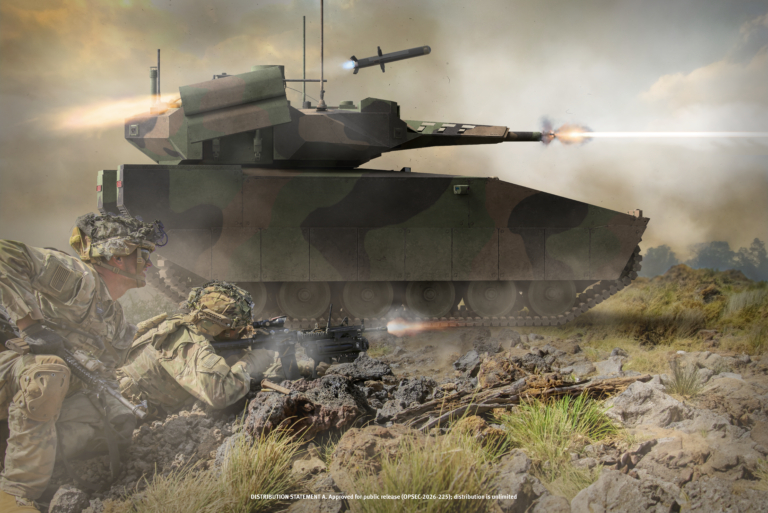
The U.S. Army is looking for a platform built for the next three decades
The U.S. Army’s decision to abandon another Bradley upgrade was not driven by a lack of firepower. The central problem was that the platform had exhausted much of its technical growth capacity after more than four decades in service.
The Bradley has undergone repeated upgrades, but its architecture can no longer easily accommodate new systems without major structural changes. For its replacement, the Army is seeking a vehicle capable of remaining relevant for at least 30 years in an operational environment where technologies, threats and battlefield requirements are evolving rapidly.
One of the main contenders is the Lynx XM30, developed by American Rheinmetall. The company’s case is built around three essential questions: can the vehicle be built, can it accommodate future upgrades, and can its crew fight effectively from inside it?
Build it, grow it and fight in it
According to the company, production of the vehicle has already begun, with the first examples delivered to the U.S. Army this year. The vehicles are being manufactured at facilities that would also support full-rate production if the program contract is awarded.
The second requirement is growth potential. The Lynx XM30 was designed with additional capacity in terms of weight, electrical power and computing performance, allowing future systems to be added without radically redesigning the platform.
The third factor is crew effectiveness. The vehicle is designed around a two-person crew, with special attention paid to information displays, control placement and coordination between the two soldiers.
The Bradley has reached the limits of its upgrade potential
The Bradley has been a capable infantry fighting vehicle and has been modernized repeatedly. However, the platform no longer has enough reserve capacity to integrate the systems likely to be required in the future.
The issue is not primarily its weaponry. It is the vehicle’s ability to generate electrical power, carry additional weight and accommodate increasingly complex equipment.
The engine compartment is already extremely crowded, with the power pack occupying most of the available space. Enlarging the engine would affect the vehicle’s overall configuration and complicate its cooling requirements.
An armored vehicle must operate inside a protected enclosure, which limits the ability to remove heat. As more electronic systems and power-hungry equipment are added, cooling and energy distribution become increasingly difficult challenges.
For that reason, the Army concluded that a clean-sheet platform would provide better prospects for future upgrades than another Bradley variant.
Weight and power reserves for future conflicts
The Lynx XM30 was designed on the assumption that it could remain in service for 30 years or longer. It is impossible to predict precisely what systems the Army will require in the 2040s or which threats will dominate the battlefield.
The alternative is to design the platform with sufficient reserve capacity to adapt to changing conditions.
One of those reserves is structural capacity. The vehicle’s chassis, suspension and overall structure are designed to support more weight than the initial production configuration will carry.
That would allow the Army to add systems that cannot be anticipated today. If a future requirement called for an additional system weighing roughly two tons, the vehicle should be able to maintain its mobility without requiring a complete structural or suspension redesign.
The powertrain is also sized to meet mobility requirements at a higher weight than the vehicle is expected to have when initially delivered.
Additional electrical power for weapons and sensors
Modern armored vehicles increasingly need advanced electronics, sensors, electronic warfare systems and weapons with high power demands.
The Lynx XM30 is designed to generate more electrical power than its current subsystems consume. Just as important, its electrical architecture is designed to distribute that power throughout the vehicle.
That reserve could eventually support the integration of an active protection system or a laser weapon designed to intercept missiles and drones. Such a system could be mounted on the turret and would require a substantial power supply.
Generating additional electricity is not enough if it cannot be delivered to the required location. The vehicle therefore includes power-distribution units and interfaces intended to support the addition of future subsystems.
Computing capacity reserved for future systems
The platform also includes room for future upgrades in its computing architecture. Several major processing units have empty card slots that were deliberately left available for later additions.
This could allow the integration of new sensors, algorithms, command systems or software applications without replacing the entire electronic architecture.
In a future conflict, a vehicle’s effectiveness will depend not only on armor and weapons but also on how quickly it can process information, identify targets and exchange data with other platforms.
Lessons from the wars in Iraq and Afghanistan
Operational experience in the Middle East demonstrated the importance of maintaining weight and power reserves.
During the early stages of the Iraq War, Abrams tanks and Bradley vehicles benefited from enough growth capacity to receive equipment that had not been anticipated in their original designs.
Those additions included protection cages against rocket-propelled grenades and electronic systems designed to counter radio-controlled improvised explosive devices. The new equipment improved survivability but consumed a substantial portion of the vehicles’ available weight and power margins.
The lesson for the next generation of armored platforms is straightforward: the vehicle must be designed with sufficient reserve capacity from the beginning to respond to threats that cannot yet be predicted.
Open architecture could accelerate modernization
Another central element of the XM30 program is the use of an open systems architecture. The Army established a common infrastructure standard for ground combat vehicles, known as GCIA.
By defining common interfaces and rules for data exchange, the Army retains greater control over how new equipment is integrated.
In theory, a third-party manufacturer could develop a new subsystem and connect it to the vehicle without requiring the original platform manufacturer to perform all the integration work.
That approach could reduce modernization timelines and costs. If the Army wanted to add a missile-defense laser two decades from now, the laser manufacturer could design the system according to the published standards or use an interface layer to communicate with the vehicle’s architecture.
An American vehicle shaped by the Lynx design philosophy
The Lynx XM30 traces its conceptual origins to the broader Lynx family, but the version intended for the U.S. Army has been extensively adapted.
An American engineering team redesigned the vehicle to meet the specific requirements of the XM30 program. Changes include the number of infantry soldiers carried, the crew configuration, the weapon system and the protection requirements.
What remains from the earlier design is primarily the philosophy of modularity and the way components are arranged throughout the vehicle. The platform is otherwise presented as an American vehicle designed in the United States for the operational needs of the U.S. Army.
Soldier feedback shaped the displays and controls
The interior was designed with input from former military instructors and specialists, including experienced master gunners.
They evaluated how information should be displayed and which data needed to be immediately visible during a mission. They also examined the placement of controls, access to frequently used functions and the crew’s ability to react quickly.
Controls used regularly were placed within easy reach, while less frequently used functions could be positioned farther away. Software changes allowed the interface to be adjusted early in the program, before the vehicle entered final production.
Practical issues were also examined, including how soldiers could enter and exit the vehicle while wearing full combat equipment. Testing led to changes in hatch dimensions and ramp configuration to improve both safety and evacuation speed.
Maintenance and reloading were tested in practical exercises
Feedback did not come only from vehicle crews. Maintenance personnel examined how easily they could reach components requiring repair or replacement under field conditions.
Training missiles with realistic weight were also used to test whether the weapon system could be reloaded efficiently and safely.
Those exercises resulted in changes to equipment placement and to the way certain components could be accessed.
A two-person crew supported by redundancy
One of the program’s major requirements is operation by a two-person crew.
To improve coordination, the two crew members sit side by side in a configuration resembling the pilot-and-copilot arrangement found in aircraft. This layout allows direct communication and faster coordination during missions.
A shared display is positioned between the two crew stations, and both positions provide the same essential functions. Either crew member can drive the vehicle or operate the main weapon.
This redundancy allows the Army to distribute tasks flexibly and provides a backup capability if one crew station becomes unavailable.
A bet on flexibility and service life
The Lynx XM30 is being presented not only as a vehicle for today’s requirements but also as a platform designed to adapt to technologies and threats that do not yet exist.
Its weight capacity, electrical reserves, computing headroom and open architecture are intended to prevent the vehicle from reaching the same modernization limits that now constrain the Bradley.
The program’s success, however, will depend not only on its stated technical characteristics but also on test results, production costs, reliability and the industry’s ability to deliver vehicles on schedule.
For the U.S. Army, the stakes are high. It needs a platform capable of transporting and protecting infantry on a battlefield dominated by drones, sensors, precision-guided weapons and increasingly complex electronic systems.
The XM30 decision will ultimately show whether a vehicle designed with sufficient growth margin can avoid the limitations that have made the Bradley progressively more difficult to modernize.