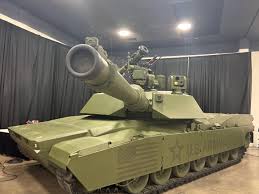
In a significant strategic pivot, the U.S. Army is set to deploy four prototypes of its M1E3 next-generation tank, the successor to the venerable M1A1 Abrams, to a platoon this summer. This move marks a dramatic acceleration, occurring five years earlier than initially planned, showcasing the Pentagon’s new philosophy of rapidly integrating innovation into battlefield operations. Army Chief of Staff Gen. Randy George confirmed that the service will no longer wait until every single requirement is met before allowing soldiers to field-test equipment under real-world conditions.
- Battlefield Agility: Testing Ahead of Perfection The previous paradigm, which dictated, „Don’t do anything until you’ve wrung every possible risk out,” has been discarded. Now, soldiers will have the opportunity to test various hardware and software components, enabling them to „plug in and play” with new solutions, whether it’s a superior active protection system, a better engine, or a lighter transmission, as Gen. George explained at the Detroit auto show, where the prototype was first unveiled. This agile approach prevents delays, sidestepping a scenario where „it’s 2031 and there’s no reason to do that,” referencing the original target year for prototypes.
- The „Teams of Teams” Model: Commercial Innovation Drives Defense The acceleration of the M1E3’s development is also attributed to a novel acquisition model adopted by the Army, a „teams of teams” approach. This means that instead of a single lead on the initiative, multiple vendors, predominantly non-traditional and commercial suppliers, are collaborating. Alex Miller, the Army’s Chief Technology Officer, highlighted that, unlike the past when „everything below [a prime vendor] would be a black box,” the new model fosters continuous innovation. „If we’re going to use commercial mindsets, and we’re going to use commercial best practices… we expect there to be a cycle of changes and updates over time that we can take advantage of.” Col. Ryan Howell, the M1E3’s project manager, added that the Army is leveraging existing marketplace standards rather than imposing its own military specifications. Over 10 companies are involved, including Caterpillar (engine), SAPA (transmission), Recaro (seats), General Dynamics (exterior), Roush (cockpit and overall development), American Rheinmetall (lightweight track features), and Moog (slip ring).
- Brain and Brawn: Cutting-Edge Tech and Open Architecture The new tank is designed to be software-defined with an open systems architecture, allowing for continuous updates and „plug and play” functionality with different software. This enables rapid information sharing at the platoon and company level, and software updates can be pushed out in days or weeks, as opposed to a year under the old system. „The same way that your iPhone updates every couple months, or your Android updates every couple months, we can now update our main battle tank,” Miller illustrated.
- Lighter, Greener, Faster: The Next-Gen Features Among other innovations, the M1E3 will be significantly lighter (exact weight undisclosed) and will incorporate a hybrid-electric engine. This hybrid technology is expected to reduce fuel requirements by 50%, a major step towards efficiency and sustainability. While Gen. George acknowledged it wouldn’t boast the „fastest quarter mile time,” he emphasized its rapid combat capability: „it can knock out a target at a quarter mile in about a tenth of a second.” The timeline for full operational fielding across the service remains under development, with Brent Ingraham, the Army’s acquisition czar, noting further work to „figure out the exact timeline,” though Gen. George anticipates it could happen „very quickly.”