Norwegian project targets interceptor capable of engaging threats at up to 80 kilometers
Norwegian defense company Nammo has begun preliminary work on a new rocket motor prototype intended for a future long-range version of Germany’s IRIS-T air defense system.
The engine is expected to power the IRIS-T SLX interceptor, which is being developed by German defense company Diehl. The project remains at an early stage, with Nammo aiming to build the first prototype as soon as possible.
“This is a completely new development project for us,” a Nammo program manager said on condition of anonymity. According to the official, the effort is not relying heavily on technologies or programs developed by the company in the past.
Static-fire testing planned at Raufoss facility
Nammo plans to conduct the initial development and testing activities at its production site in Raufoss, more than 100 kilometers north of Oslo. Engineers are expected to carry out static-fire tests to validate technical analysis and computer simulations.
The design could then be modified depending on the test results.
The motor will use a “dual-pulse” configuration designed to provide two separate propulsion phases. The propellant will be engineered to deliver a specific thrust profile, while the motor itself will be divided into two distinct sections. The arrangement could allow the interceptor to manage its energy more efficiently during flight and improve performance at longer ranges.
Diehl preparing first SLX firing test
Diehl is planning the first development or safety-integrity firing test of the ground-launched IRIS-T SLX in 2027.
Serial production of the extended-range missile is currently expected to begin in 2029.
The SLX is designed to intercept targets at ranges of up to 80 kilometers, roughly twice the reach of the IRIS-T SLM. The new version is intended to engage fighter aircraft, bombers, long-endurance drones and support aircraft.
Diehl first unveiled the extended-range interceptor at the 2024 Berlin Air Show.
Ukraine reports 95 percent hit rate
According to Diehl representatives, Ukrainian forces have used the IRIS-T SLS and IRIS-T SLM systems to destroy more than 1,000 Russian targets since the beginning of the invasion in 2022.
The two short- and medium-range variants are said to have achieved a hit rate of approximately 95 percent during the conflict. Reported targets include Kh-101 and 3M14 Kalibr cruise missiles, as well as Shahed-136 drones.
Potential alternative to Patriot systems
Diehl Chief Executive Helmut Rauch said in July that the SLX could reduce Europe’s reliance on US-made Patriot missiles.
Patriot systems are currently in short supply, prompting Ukraine to repeatedly ask Western allies to urgently transfer available stocks to reinforce its air defenses.
The development of a European long-range interceptor could help ease pressure on American missile inventories while strengthening the strategic autonomy of European nations.
Common launcher for SLM and SLX missiles
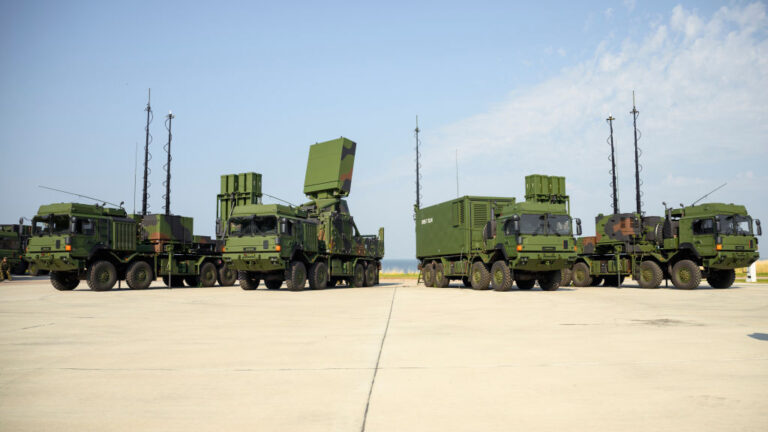
The new interceptor could be deployed from a common launcher capable of carrying both SLX and SLM missiles. This would allow operators to configure mixed missile loads tailored to different types of threats.
The SLX will also rely on a significant portion of the infrastructure already used by the SLM system. Shared elements include the radar, tactical operations center and software.
This compatibility could simplify training, logistics and the integration of the new interceptor into units already operating the IRIS-T system.
IRIS-T remains central to Europe’s air defense plans
Germany, Estonia, Latvia, Bulgaria, Sweden, Denmark and Switzerland are among the European countries that have acquired the IRIS-T SLM variant.
The system is also a core component of the European Sky Shield Initiative, which aims to strengthen the continent’s air and missile defense capabilities.
While work on the SLX continues, Nammo is increasing production of rocket motors for the SLS and SLM variants, which are considered critical to Ukraine’s ground-based air defense. The Norwegian company says it plans to significantly raise output for both programs.