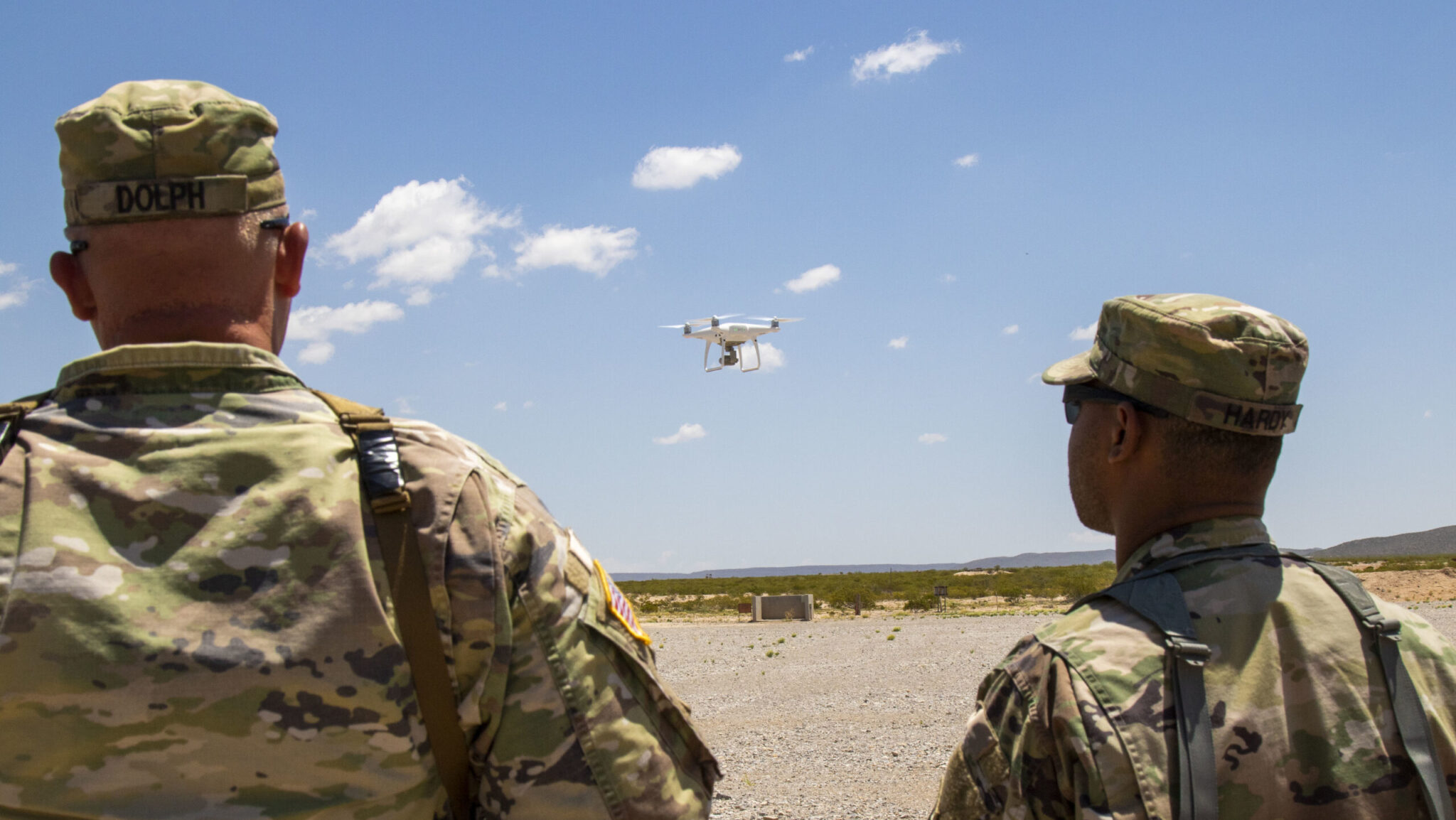
The U.S. military has recorded hundreds of drone flights over Pentagon installations in recent years, with the count representing only those incidents that U.S. Northern Command (NORTHCOM) is aware of.
During a roundtable discussion with reporters at Peterson Space Force Base, Gen. Gregory Guillot, commander of NORTHCOM and the North American Aerospace Defense Command (NORAD), expressed concerns about these unmanned aircraft system (UAS) sightings, particularly over sensitive military locations. Locations such as Langley Air Force Base, home to F-22 aircraft, have seen perplexing incursions, as reported by the Wall Street Journal. NORAD’s data revealed that there were 250 drone sightings in 2022, a number that decreased to 202 in 2023, and has further declined to 163 reported sightings so far this year.
Gen. Guillot noted that the increased scrutiny of these sightings stems from advances in technology that enable better detection and tracking of UAS. While some incidents are linked to highly classified programs, Guillot stated that he has yet to see evidence of any foreign involvement in these drone activities. He suggested that, “the overwhelming majority of them are probably local hobbyists that are just flying too close to the base.”
He acknowledged that many reported incidents could be duplicates, resulting from multiple servicemembers witnessing the same event, or mistaken identities where a service member misidentifies distant objects, such as lights on a civilian airplane, as drones. He highlighted that some reports may even pertain to a single drone repeatedly flying over a base.
The challenge of addressing UAS incursions domestically is compounded by regulations designed to protect civilian air travel, which limits the military’s options for countering potential threats, such as shooting down drones.
“The threat, and the need to counter these threats, is growing faster than the policies and procedures that are in place can keep up with,” Guillon remarked.
One potential solution he mentioned involves disrupting a drone’s position, navigation, and timing capabilities, commonly referred to as GPS jamming or spoofing. However, as evidenced by conflicts in Ukraine and the Middle East, such interference could inadvertently endanger civilian aircraft if implemented carelessly. He emphasized the necessity of close coordination with the Federal Aviation Administration (FAA) to ensure that counter-UAS methods are used responsibly.
With established connections to the FAA, NORTHCOM aims to enhance its role in countering drone incursions by creating preset approvals for UAS engagements under defined criteria, thereby streamlining the current lengthy process required to obtain FAA authorization.
Guillot also indicated that NORTHCOM could facilitate the distribution of essential systems to counter drone flights, fast-tracking their approval for use, ideally within hours.
Ultimately, he proposed that NORTHCOM could act as a “clearing house” for counter-UAS capabilities, serving as a “lead synchronizer” among various government agencies.
Detecting and tracking smaller UAS systems pose additional challenges, with Guillot expressing confidence in tracking larger drones but noting that smaller Group 1 and Group 2 systems are more difficult to distinguish amid the airspace clutter. (The Pentagon categorizes drones into five “groups,” with Group 1 being the smallest and Group 5 the largest.)
As the discussion came to a close, an aide called Guillot away, marking an abrupt end to the roundtable. “I’m sorry, I’m going to have to run for a second,” he said before quickly exiting the room.