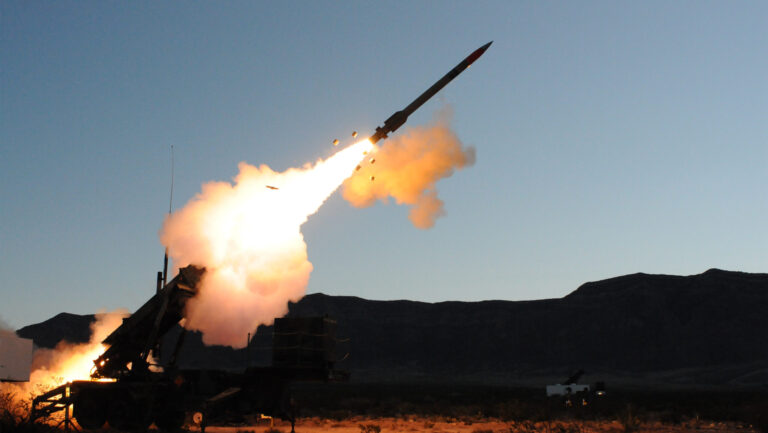
Company discusses participation in eight weapons programs and expands production for PAC-3 and THAAD missiles
Northrop Grumman is seeking to expand its role as a supplier to weapons manufacturers and is negotiating increased participation in approximately eight separate weapons programs.
The company is discussing a larger share of work with several prime contractors. The opportunities include solid-fuel rocket motors, guidance systems, missile bodies, nozzles and fuzes.
“We have 10 agreements under discussion, covering about eight weapons,” Northrop Grumman CEO Kathy Warden told investors at a conference.
Pentagon prioritizes higher munitions output
The U.S. Department of Defense has made increased munitions production a major acquisition priority. At the same time, the Pentagon is encouraging industry to invest in factories, equipment and infrastructure capable of supporting a rapid expansion of weapons manufacturing.
To encourage those investments, the department has entered into roughly a dozen framework agreements with defense contractors.
Northrop Grumman announced its first such agreement with the Pentagon in August. Under the arrangement, the company is expected to become a second source for solid rocket motors used by the PAC-3 Patriot missile while also expanding component production for PAC-3 and THAAD systems.
PAC-3 rocket motor completes qualification
Northrop Grumman’s version of the PAC-3 rocket motor has completed technical qualification. The company is also well advanced in contract negotiations with Lockheed Martin, the system’s primary integrator.
Once the contract is finalized, Northrop Grumman will begin increasing production rates and meeting progressively higher delivery targets.
The company says the work is advancing as planned while commercial and contractual negotiations continue in parallel.
B-21 could receive additional missions
Beyond munitions, Northrop Grumman expects the B-21 Raider program could also expand.
The U.S. Air Force is examining whether to increase the program of record beyond the planned purchase of 100 aircraft. The assessment is expected to conclude this year and includes a review of additional missions beyond the bomber’s original strategic role.
The B-21 was designed to contribute to the air component of the U.S. nuclear triad. Officials, however, believe that the aircraft could perform a broader range of missions.
The aircraft is being evaluated as a multifunctional platform capable of supporting conventional operations, long-range strike missions and other forms of airpower.
Budget uncertainty has not slowed Northrop programs
A significant portion of Pentagon funding for munitions, as well as funding for initiatives such as Golden Dome, the Drone Dominance program and part of the planned fiscal 2027 F-35 procurement, is included in a roughly $350 billion reconciliation package.
The package has not yet been approved by Congress. However, Northrop Grumman’s leadership says the uncertainty has not materially affected the company’s operations.
Most of the company’s programs are supported through the Pentagon’s base budget, while reconciliation funding is viewed as potential upside rather than a requirement for continued work.
The company nevertheless believes that additional reconciliation and supplemental funding is unlikely to be approved in the near term.
Budget agreement could be delayed
Northrop Grumman’s leadership believes Congress may fail to reach a budget agreement before the continuing resolution expires on Dec. 11.
In that case, the temporary funding measure could be extended again. Prolonged reliance on continuing resolutions increases government costs and can delay the launch of new programs.
For Northrop, the immediate effect is limited. The company says it has sufficient funding to continue work into the beginning of next year.
Lockheed seeks full multiyear funding for missile production
Lockheed Martin CEO Jim Taiclet also played down the potential impact of budget delays. He said the company’s large backlog of orders reduces the effect of when Congress ultimately approves the budget.
However, Lockheed Martin still needs congressional approval for the full funding of its multiyear weapons-production agreements.
The programs include:
- PAC-3 missiles;
- THAAD interceptors;
- the Precision Strike Missile;
- the AIM-260 Joint Advanced Tactical Missile.
Multiyear agreements allow industry to invest in production capacity, reduce supply-chain risks and provide the Pentagon with a more predictable flow of deliveries. To secure those benefits, Congress must approve funding for the full duration of the agreements.
GM Defense delivers first PAC-3 components
GM Defense, the military subsidiary of American automaker General Motors, has delivered its first mission-critical components for the PAC-3 missile.
The deliveries occurred less than one month after the companies signed their contract. The partnership was announced in June at a conference focused on rebuilding U.S. industrial capacity.
The speed of the first delivery highlights the defense industry’s effort to integrate new suppliers into production networks and rapidly expand missile manufacturing capacity.
Lockheed funds initial production of GRIZZLY launcher
Lockheed Martin has begun using its own funds to finance initial production of the GRIZZLY launch system, a low-cost containerized platform designed for rapid deployment.
The company plans to build hundreds of the systems before the end of the year. The launchers could be sold to the U.S. government or other customers, or made available through leasing arrangements.
GRIZZLY is designed as a scalable solution that can be produced quickly and adapted to multiple missions. Lockheed Martin is already testing the system aboard autonomous Saildrone vessels to evaluate its use within distributed launch-and-strike networks.