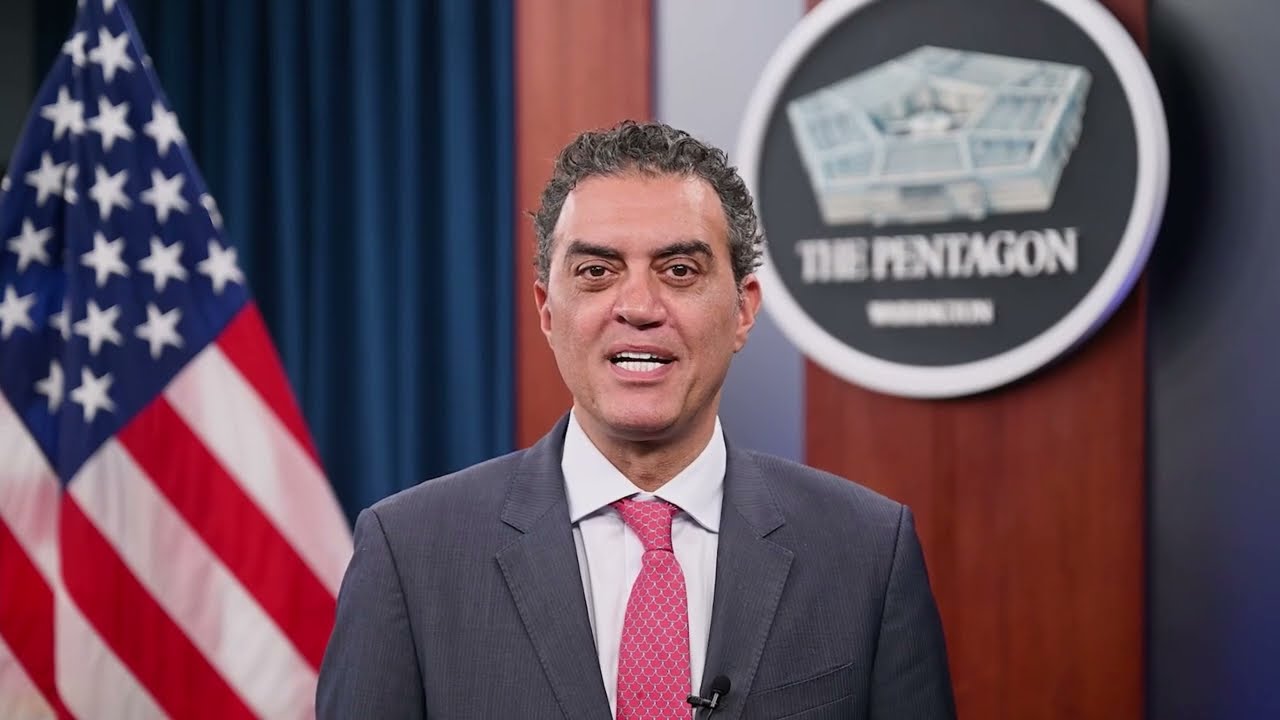
In a sweeping strategic move, Secretary of Defense Pete Hegseth initiated a fundamental overhaul of the Pentagon’s technological approach Monday evening. Through the release of three major policy memos, the department aims to accelerate innovation and reshape its tech landscape, acknowledging the urgency of a global arms race.
A Manifesto for Speed and Action
„The old era ends today,” Hegseth proclaimed during his latest „Arsenal of Freedom” tour stop at SpaceX’s Brownsville, Texas, factory. „We’re done running a peacetime science fair while our adversaries are running a wartime arms race.” This declaration signals a dramatic shift in mindset, geared towards speed and efficiency.
The memos unveil a battery of new Artificial Intelligence (AI) initiatives, from the breakup of the sprawling Advana database system to the creation of a new AI simulation „foundry” named „Ender’s Foundry,” in homage to the iconic sci-fi character. The plan also continues an ongoing consolidation of independent innovation organizations—which proliferated during previous administrations—under the strict control of Emil Michael, the Under Secretary for Research & Engineering and Chief Technology Officer (CTO) for the Department of Defense.
One Commander for the Innovation Ecosystem
One of Hegseth’s crucially important memos declares unequivocally: „Our innovation ecosystem remains a tangle of overlapping organizations and confused authority — workarounds built to bypass now-obsolete systems. Multiple organizations fight for the same mission. Industry faces a maze of competing front doors. Councils proliferate while accountability diffuses….Today, we end the confusion. The intent and policy are simple: unify the innovation ecosystem led by a single Chief Technology Officer.”
In his Texas speech, Hegseth pointed to Emil Michael, seated in the front row, making it clear he was the new „sheriff” in tech town. „Emil will set the technical direction, lead the innovation ecosystem that will welcome progress from anywhere it resides, and he’ll tell me face-to-face every day, and frankly, whether we are gaining or losing the technology and innovation competition,” Hegseth stated. „He’ll have the decision authority and will lead through rigorous evaluation with a focus on real measurable outcomes.”
Michael’s Vision: Six Key Priorities
Back in August, Michael had already announced his big six tech priorities and took control of both the Silicon Valley-based Defense Innovation Unit (DIU) and the Pentagon-based Chief Digital AI Office (CDAO). Hegseth’s reorganization plan reinforces these changes, reestablishing DIU and the formerly independent Strategic Capabilities Office (SCO) as departmental “Field Activities” under the CTO’s “overall supervision.” These join, as per the memo, the „Department of War (DoW) innovation ecosystem” alongside three other organizations already reporting to the CTO: the Office of Strategic Capital (OSC); the new Mission Engineering and Integration Activity (MEIA), created just last August; the obscure Test Resource Management Center (TRMC); and the world-famous DARPA.
The plan also moves additional innovation offices under Michael’s supervision and dissolves three overlapping oversight bodies – the Defense Innovation Steering Group, the Defense Innovation Working Group, and the CTO Council – in favor of a single “Action Group,” also led by the CTO. Hegseth also announced the appointment of Owen West, the assistant secretary of defense for special operations and low-intensity conflict from 2017 to 2019, as DIU director come March, and Cameron Stanley will serve as the next Pentagon Chief Digital and Artificial Intelligence Officer.
Key Figures and Bureaucratic Hurdles
Some bureaucratic question marks remain, however. By law, DIU reports directly to the Secretary of Defense and SCO to the Deputy Secretary, and—as both Hegseth’s memo and an official Pentagon press release acknowledge—the Secretary cannot change that; only Congress can. However, these reporting chains are a residue of long-gone personal relationships, with both offices having been created and championed by the late Ash Carter. While DIU and SCO can still try to bypass Michael, at least on paper, in practice, Hegseth and his deputy Steve Feinberg are unlikely to be sympathetic to such initiatives.
“The changes look pretty good on paper, [but] I have concerns,” said Jack Shanahan, a retired Lt. Gen. and founding director of the Pentagon’s Joint AI Center. “I remain cynical about execution, given how the building operates. Are commercial companies with good ideas supposed to go to the CAG, the CTO, one of the six organizations, all of the above?” Mike Groen, Shanahan’s successor as director of JAIC, added: “The day we stop writing org charts and start writing code will be one to celebrate.”
New AI Frontiers: From Simulations to Countermeasures
Two additional memos released late Monday provide at least part of the purpose behind Hegseth’s reorganization: to jumpstart an ambitious array of AI programs while streamlining an older one. The broader of these documents is a six-page „Artificial Intelligence Strategy for the Department of War,” centered on seven high-priority „Pace-Setting Projects (PSPs)” to be spearheaded by the CDAO.
One of these priority projects was already public: GenAI.mil, launched last month to bring secure versions of popular Large Language Models to all three million of the Department’s military, civil service, and contractor personnel. Even here, the memo adds a new wrinkle, explicitly stating that GenAI.mil’s models, currently cleared only for “sensitive but unclassified” data, will ultimately be available “at all classification levels.”
The six previously undisclosed projects receive only brief and broad descriptions:
- Swarm Forge will develop “novel ways of fighting with and against AI-enabled capabilities,” including field experiments where Silicon Valley innovators work alongside elite units.
- Agent Network will develop semi-autonomous algorithmic “agents” for “battle management and decision support, from campaign planning to kill chain execution.”
- Ender’s Foundry, a reference to the Orson Scott Card classic Ender’s Game, will develop “AI-enabled simulation capabilities.”
- Open Arsenal will link intelligence collection to the development of military capabilities, “turning intel into weapons in hours not years,” suggesting rapid weapon software updates.
- Project Grant, the most mysteriously described initiative, will “enable the transformation of deterrence.”
- Enterprise Agents will develop AI agents for the Department’s back-office “enterprise” systems.
The Advana Challenge: The Split of Success
While these seven new programs race ahead, Hegseth is breaking up an older Pentagon AI project that became a „victim of its own success.” What is now called Advana—short for “advancing analytics”—began in 2019 as an effort by the Pentagon comptroller’s office to wrangle incompatible databases into a coherent whole to conduct a proper fiscal audit. While the Pentagon still hasn’t passed an audit, Advana’s data-management proved so useful that more and more officials began using it for more and more purposes, ultimately causing it to strain under the weight.
Hegseth’s third Monday night memo divides Advana into three, separating the core financial management functions from other Defense Department data—now called the „War Data Platform (WDP)”—and from underlying, widely applicable „application services.” Even as he „trifurcates” Advana, Hegseth is putting new teeth into Biden-era “data decrees” requiring defense organizations to share their data with the CDAO. „Effective immediately,” the memo states, „denials of CDAO data requests must be justified to the USW(R&E) [i.e., Michael] within seven (7) days, who will remediate or escalate to the Deputy Secretary.”