The Pentagon must continue essential investments to enhance the nation’s defense industrial base, particularly in the submarine industry, munitions production, and prototyping projects, according to a newly released National Defense Industrial Strategy Implementation Plan.
The implementation plan, published today, follows the Pentagon’s first National Defense Industrial Strategy released in January. This strategy called for improvements in resilient supply chains, workforce readiness, flexible acquisition, and economic deterrence as four strategic priorities aimed at enabling the defense industry to rapidly increase weapons production.
The COVID-19 pandemic and the war in Ukraine exposed vulnerabilities within the global defense industry’s supply chain, underscoring the need for the U.S. industrial base to become more agile and resilient, capable of quickly producing weapons in response to crises when called upon by the Defense Department.
With nearly three months remaining before a new president takes office, the implementation plan can be seen as the current Pentagon’s appeal to the next administration to maintain momentum on key industrial initiatives — a list that includes the Defense Production Act, the Office of Strategic Capital, the Replicator initiative, and multi-year procurement of missiles and munitions. It also warns of risks that could arise if new leaders abandon these efforts.
“Our aim is not merely to maintain America’s edge, but to sharpen it and lay the foundation for continued U.S. leadership in critical technologies and capabilities that will define the battlespace of the future,” wrote Pentagon acquisition executive Bill LaPlante in a foreword to the report. “Most importantly, this implementation plan will serve as a guiding framework for resource decisions and investments in the coming years. It will inform our budget priorities, shape our research and development focus areas, and drive our engagement with industry.”
During a roundtable this morning, Laura Taylor-Kale, assistant secretary of defense for industrial base policy, emphasized that defense industrial policy has enjoyed bipartisan support, with the department collaborating with both Republicans and Democrats in Congress to shape the strategy and implementation plan.
“We are confident in the feedback we’re receiving that this will be a priority regardless of who wins next week’s elections,” she said.
The implementation plan outlines six key initiatives the Pentagon sees as critical for improving the stability of the defense industrial base, along with current funding lines and the risks associated with vulnerabilities in those areas:
- Indo-Pacific Deterrence: Investments in the submarine industrial base and the ramp-up of key munitions and missiles.
- Production and Supply Chains: Investments aimed at building a more resilient supply chain, increasing U.S. stockpiles, and onshoring the production of critical components and materials.
- Allied and Partner Industrial Collaboration: International collaboration and coproduction initiatives, including AUKUS.
- Capabilities and Infrastructure Modernization: Nuclear modernization and improvements to the U.S. military’s organic maintenance depots.
- New Capabilities Using Flexible Pathways: Rapid prototyping and fielding efforts, such as the Replicator initiative to deploy thousands of unmanned systems by summer 2025 and the Rapid Defense Experimentation Reserve (RDER) program.
- Intellectual Property and Data Analysis: Investments related to protecting the intellectual property of U.S. companies and safeguarding against adversarial investments in American startups.
Overall, the Pentagon’s FY25 funding request of $849.8 billion includes $37.73 billion connected to implementation initiatives, slightly down from $39.42 billion in FY24, with more than three-quarters of that funding earmarked for missiles and munitions, and $4 billion requested for the submarine industrial base in FY25.
The plan notes that it does not contain initiatives under consideration during FY26 budget deliberations, labeling those efforts as “predecisional.” Both Taylor-Kale and Carla Zeppieri, deputy assistant secretary of defense for industrial base resilience, refrained from commenting on whether current plans call for increased funding for the defense industrial base in FY26. However, Taylor-Kale highlighted that the FY26 budget was the first built with the National Defense Industrial Strategy in mind.
“I believe there’s a clear understanding of the importance of building capacity in the defense industrial base and incorporating nontraditional companies into collaborations with the Department of Defense,” she stated. “There’s significant concern around supply chain vulnerabilities and adversarial sources in our supply chains, as well as single-source components.”
Zeppieri added that “some of the topics that continue to be emphasized in the FY26 budget build on what we’ve seen in FY24 and FY25 concerning munitions and the organic industrial base.”
Much of the implementation plan acts as a comprehensive list of tools and projects the Pentagon has initiated to strengthen the industrial base. For example, it details how $393.4 million in Defense Production Act funding will address shortages in critical chemicals, casting and forgings, the hypersonics industrial base, and microelectronics.
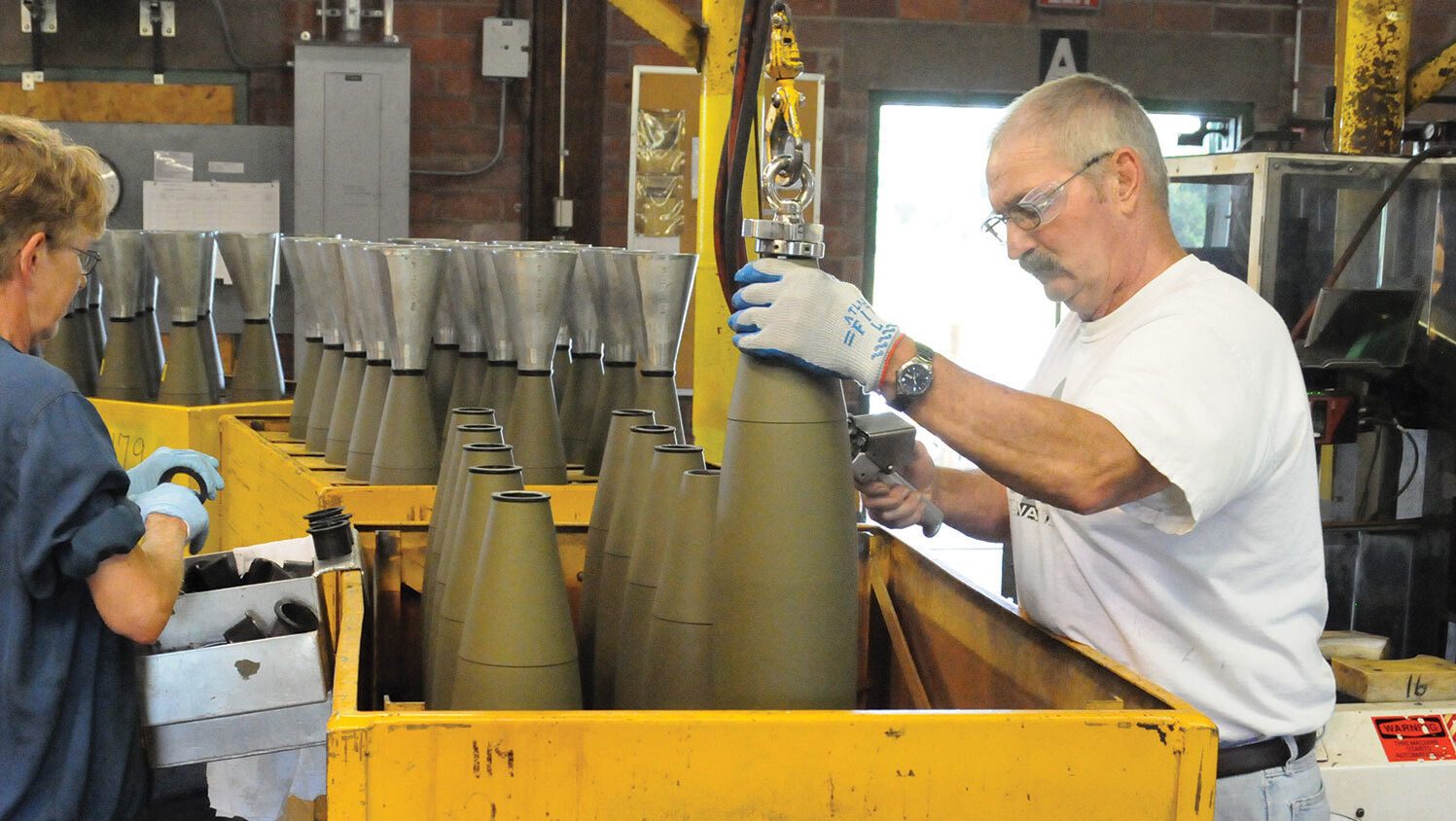
The plan highlights the U.S. Army’s multibillion-dollar initiative to enhance domestic 155mm artillery munition production, as well as the service’s ongoing efforts to modernize its ammunition plants and depots. The plan also outlines current initiatives to improve cybersecurity for defense contractors.
While there were no major announcements regarding high-profile Pentagon projects like Replicator or RDER, the plan included some interesting insights about how the department hopes to enable these programs to come to fruition. For example, the plan states that the department “intends to commission various projects, studies, and white paper reviews to identify vendors who can accelerate solid rocket motor production,” an effort that Zeppieri described as separate but complementary to the Replicator initiative.
The Pentagon is also working on a classified annex to the implementation plan, which will provide more details on vulnerabilities and outline its mitigation strategy in greater depth. The department hopes to finalize that document by the end of the year, Taylor-Kale said.