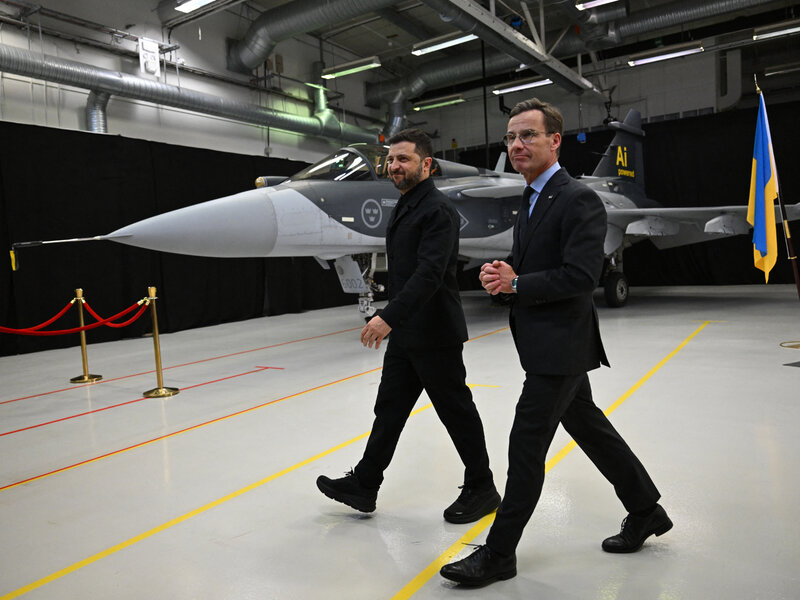
Regardless of what a potential deal to end the war in Ukraine ultimately looks like, it is unlikely to alter the timeline for the delivery of Saab Gripen-E fighters to Kyiv. However, Sweden is actively exploring the option of sending older C and D models to meet Ukraine’s urgent need to bolster its air capabilities as quickly as possible.
Gripen-E: A Three-Year Horizon for Cutting-Edge Tech
Swedish Defense Minister Pål Jonson recently stated that, regarding the Gripen-E aircraft, speeding up the delivery process would be difficult once the contract is signed by Kyiv. An initial agreement, reached in October, could see Ukraine procure between 100 to 150 Gripen-E models. However, Swedish officials have clarified that first deliveries of the E variant, which only entered Swedish service in October, would take approximately three years after the contract is inked. „Industrial capacity” dictates this timeline, Jonson emphasized, with production being the guiding factor.
The Quicker Path: Gripen C/D Models Offer Faster Delivery
In contrast to the E model, Sweden is „looking into” the potential of sending either Gripen-C or Gripen-D variants, which could lead to a „transition that could be done, possibly quicker than three years.” While stressing that „no decision” has been made, Minister Jonson added that Sweden is in a close dialogue with Ukrainians to identify their needs and understand their experiences with the implementation of F-16 and Mirage aircraft. The idea of taking C and D variants out of Swedish service to send them to Ukraine, with Sweden backfilling with more advanced E models, is „an option,” but hinges on the Ukrainians signing a contract and its specific structure. Jonson reiterated that if the Gripen-E acquisition is decided, the Charlie and Delta models could serve as an „entry point” into the Gripen family.
Diversifying Ukraine’s Air Fleet: F-16, Mirage, and Rafale in the Mix
Ukraine has long lobbied for the delivery of Gripen C/D combat aircraft to push back against Russian forces but has yet to acquire them. This is partly because NATO allies asked Sweden to hold back on sending them, so Kyiv could first focus on flying F-16 jets and to avoid overloading pilots with a variety of different aircraft types. A month after news of the potential Gripen-E purchase, Ukrainian President Volodymyr Zelenskyy announced that Ukraine also intended to buy up to 100 French Rafale fighters, highlighting a strategy of fleet diversification.
Global Demand Soars for Gripen Performance
Overall, 2025 has seen a surge in global interest for Gripen aircraft. In addition to the potential Ukraine deal, Saab locked in a $550 million deal with Thailand in August to purchase four jets. Colombia signed a $3.6 billion deal in November for 17 E and F models. Meanwhile, ongoing talks continue with Peru, and Minister Jonson recently visited Canada as part of a push to get Ottawa on board, as Canada reassesses its F-35 plans.
The Future of Defense Collaboration: Sweden as Partner, Not Just Provider
Pål Jonson insisted that he has not had conversations with Germany over a sixth-generation fighter but did note: „I can just say, on a general basis, we are always open for cooperation with all countries.” His comments came just hours before it was reported that Saab and Airbus are teaming up to develop an unmanned aerial vehicle. „Partnership is in our DNA,” Jonson affirmed. „I always say when we engage into these matters that we’re not looking for clients, we’re looking for partners. Because for us to maintain this strong defense industrial base… it’s based on sharing cost, on further development and enhancement of it.”