The Unyielding Rise of Unmanned Technology
In an era defined by complex threats, the necessity for innovative combat strategies is more pressing than ever. Recent military engagements underscore the indispensable role of unmanned systems in both delivering munitions and refining targeting accuracy. The U.S. military is making significant investments in advanced weaponry that seamlessly integrates into battle networks, enabling extended loitering and precision strikes over vast distances. The consensus among defense experts is clear: unmanned systems are crucial to modern warfare’s success.
Pioneering Advances for the MQ-9B SeaGuardian®
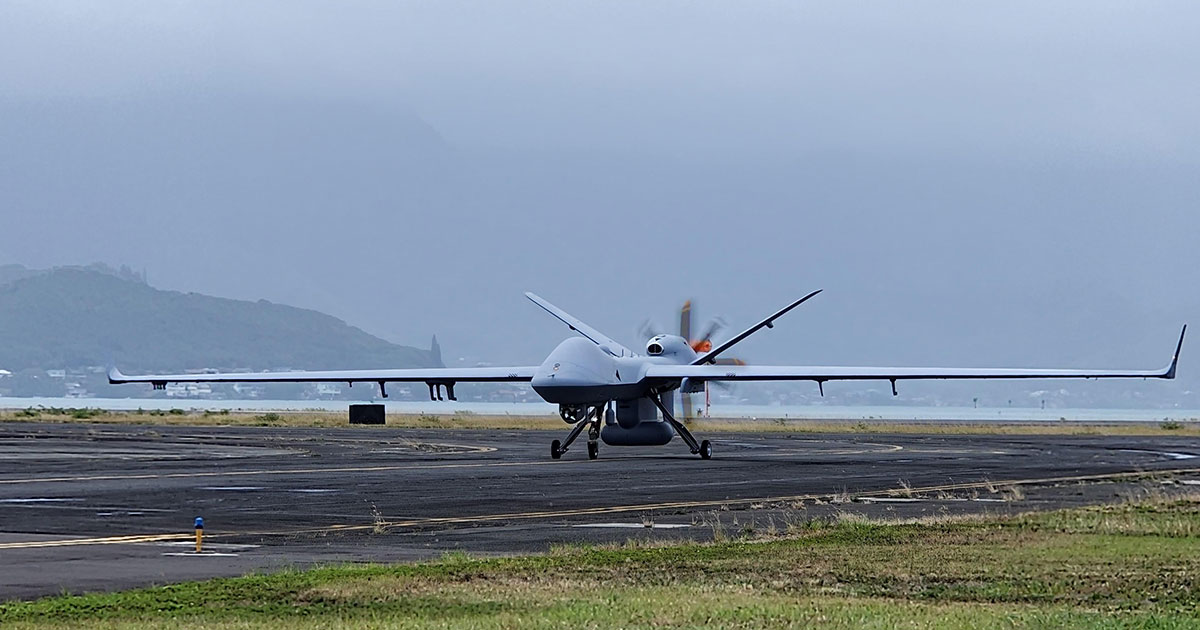
General Atomics Aeronautical Systems, Inc. (GA-ASI) recently announced a groundbreaking advancement for the MQ-9B SeaGuardian. This development redefines operational concepts and boosts the effectiveness of joint forces, permitting naval and aerial platforms equipped with network-enabled weapons to engage adversaries on land and at sea alike.
In a press release dated April 7, GA-ASI revealed successful real-time in-flight target updates for net-enabled weapons in a lab setting, achieved in collaboration with an unnamed industry partner. The company is also preparing to showcase a live demonstration later this year.
David R. Alexander, President of GA-ASI, remarked, “We continue to build on the innovative capabilities of SeaGuardian for the U.S. Navy.” He emphasized that the advanced targeting capabilities demonstrated will be vital in contested environments, allowing unmanned platforms like SeaGuardian to undertake high-risk missions, thereby sparing manned assets from potential danger.
Precision Targeting at a Distance
Network-enabled weapons, capable of receiving targeting data from off-board sensors such as the SeaGuardian, offer a significant advantage when engaging mobile targets like ships. Imagine an archer, launching an arrow toward a hidden bullseye, while a distant observer directs it to the precise point of impact. This is the essence of network-enabled weaponry.
Consider a hypothetical scenario:
An MQ-9B SeaGuardian departs from a friendly air base in the Pacific, commencing a 20-hour patrol. Utilizing onboard sensors and electronic support measures, the SeaGuardian detects enemy electronic emissions. Five hours into its mission, it identifies a hostile naval strike group threatening allied forces.
Simultaneously, three F-35C Lightning IIs from a nearby carrier strike group stand ready, 200 nautical miles from the enemy vessels. Each fighter carries two net-enabled weapons. With real-time targeting information relayed by the SeaGuardian’s operators, the Navy commander authorizes the F-35s to fire.
Despite the enemy’s evasive maneuvers, the SeaGuardian transmits in-flight updates, allowing the missiles to adjust course for optimal impact, achieving mission kills on the adversary. The SeaGuardian then continues its patrol, seeking further targets.
A Versatile Asset for Modern Warfare
The successful demonstration of in-flight target updates builds on previous achievements. Peter Yelle, formerly a naval officer now with GA-ASI’s Strategic Development Group, noted that last summer’s training exercise had already proven the functionality of this capability. High-quality tracking data was transmitted to a network-enabled weapon using Link 16 messages generated from SeaGuardian’s standard avionics bay, powered by General Atomics’ Quadratix software environment.
“The remarkable aspect of this innovation goes beyond real-time updates,” Yelle stated. “It complements SeaGuardian’s existing capabilities, positioning it as a truly multi-mission platform.”
In this scenario, the same SeaGuardian could redirect its focus to anti-submarine warfare, effortlessly transitioning to new mission requirements without landing for a refit.
Redefining Operational Efficiency
Central to the MQ-9B’s game-changing potential is the Quadratix software suite, which streamlines in-flight operations by synthesizing inputs from multiple sensors into a cohesive operational picture. Instead of needing specialists for each payload, a single operator can manage an entire intelligence, surveillance, and reconnaissance (ISR) sensor suite.
The Quadratix environment also enables operators to control multiple aircraft concurrently, leveraging advancements in autonomy, artificial intelligence, and machine learning for target correlation.
For instance, operators can configure several aircraft to scan designated areas and report back only when a potential threat—like a military vehicle or suspicious vessel—is detected. This functionality allows ground crew to concentrate on other priorities until alerted to a target of interest.
The overarching benefit of these enhancements is a richer operational picture and a more efficient experience between flight operations and sensor management—ultimately resulting in a system that demands less training and smaller crew sizes.
As Yelle noted, “MQ-9B is already the most capable medium-altitude, long-endurance system available, but our commitment to continual improvement ensures that both the platform and the Quadratix software will only enhance.”
„From innovative systems like last year’s sonobuoy dispensing technology to the real-time targeting capabilities we’re unveiling this year, General Atomics is dedicated to advancing this platform for the warfighter.”