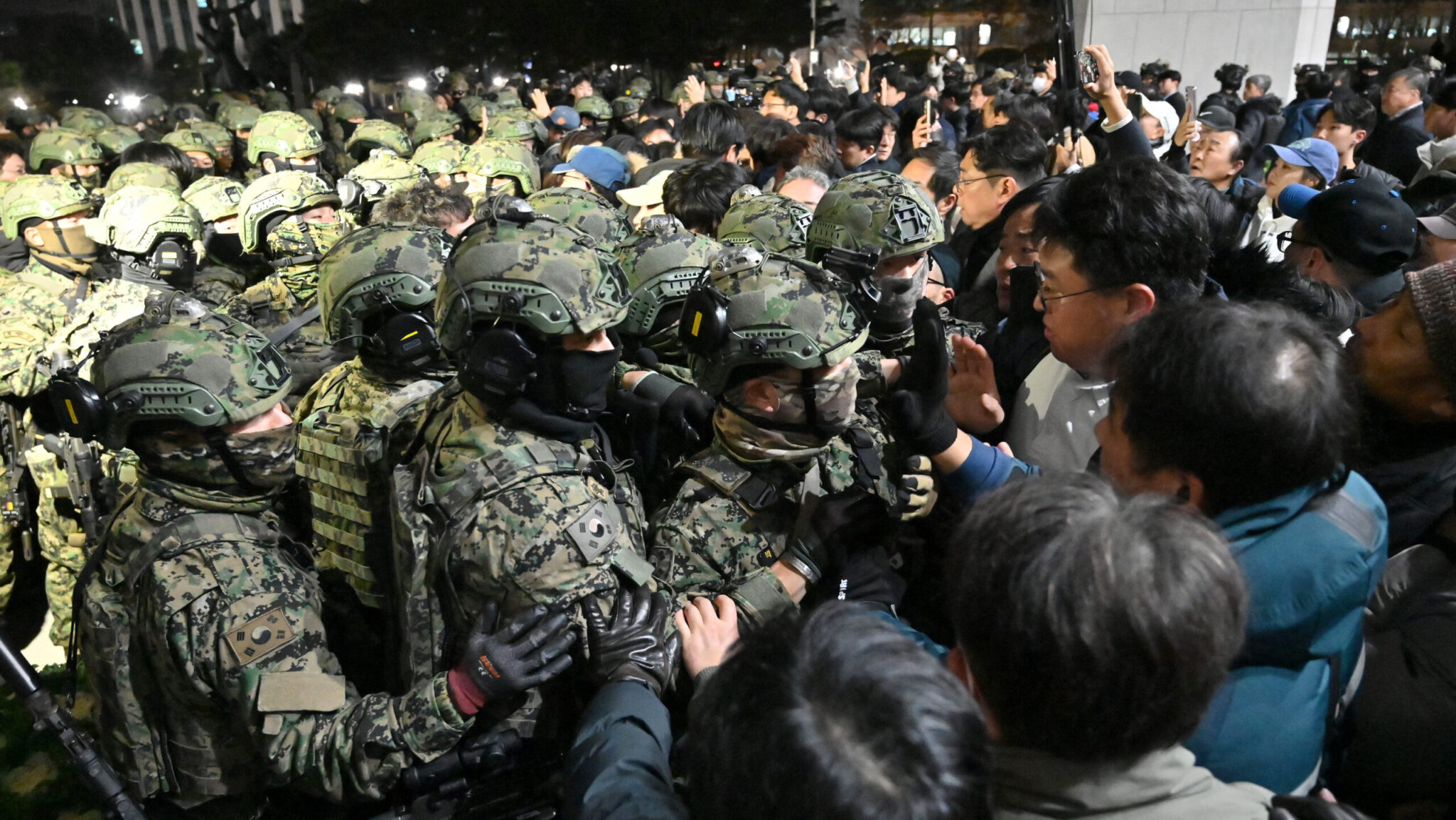
South Korea appears to have narrowly avoided significant turmoil following a brief but startling attempt by President Yoon Suk Yeol to impose martial law. However, analysts suggest that the repercussions of this incident may inflict lasting damage on the nation’s relationships with allies, including the United States.
Yoon has framed his foreign policy around a tougher stance on North Korea, tighter relations with the United States, and, controversially, closer defense ties with Japan, including the revival of a major intelligence-sharing agreement with Tokyo.
The fallout from his attempt to enforce martial law—which quickly unraveled within 24 hours, with his defense minister offering to resign and the initiation of impeachment proceedings—could have profound implications for these foreign policy objectives, as pointed out by Chun In-bum, a former deputy commander of South Korea’s First Army.
“The entire ordeal lasted only six hours, yet its implications are profound. It was bizarre, embarrassing, and politically damaging for the Yoon administration. The fleeting declaration of martial law raises significant questions about the president’s judgment, the advice he received, and the decision-making process within the government,” Chun stated in correspondence with Breaking Defense, adding that the political fallout will be severe and long-lasting.
The potential fallout from this incident may have global implications, according to Euan Graham. “If Yoon is impeached and the progressives come to power, I believe the outlook for bilateral relations with Japan and the trilateral relationship with the US will darken,” Graham, a regional expert with IISS, told Breaking Defense.
However, immediate changes are not expected.
“Yoon is unlikely to resign, but there is considerable public outcry and growing political support for his impeachment. The National Assembly is already moving forward with impeachment bills, which are likely to pass quickly,” stated Jenny Town, an expert on the Korean Peninsula at Washington’s Stimson Center. “Yoon will likely be removed from duty, with Prime Minister Han Duck-soo stepping in as interim president.”
According to South Korean law, Parliament has the authority to impeach the president. If the impeachment is upheld by the Constitutional Court, a successor must be elected within 60 days, during which Yoon would remain in an interim role.
“It should be noted that Lee Jae-myung, the leading opposition figure, is currently ineligible to run for president due to his own legal troubles,” Town mentioned in her remarks to Breaking Defense, raising questions about potential candidates to replace Yoon.
Chun expressed concerns about the future political climate and leadership’s ability to navigate complex challenges, describing the situation as a cautionary tale regarding the delicate balance of power, risks of executive overreach, and the resilience necessary to uphold democratic principles.
Consequences for Relations with Japan
Once Yoon is ousted, analysts warn of a potential retrenchment in closer relations with Japan. His intentions to strengthen ties with Tokyo, while supported by national security officials in Washington who view Japan and South Korea as natural allies, have faced domestic pushback due to lingering historical grievances from World War II.
The impeachment resolution introduced in the National Assembly explicitly cites Yoon’s Japan-centric foreign policy as a factor in the call for his removal, with accusations of adherence to such a policy.
Chun warned that if Yoon is removed and a more liberal administration takes over, “Japan-Korea relations will deteriorate significantly.”
A potential area of reversal concerning cooperation with Japan could involve the General Security of Military Information Agreement (GSOMIA), an intelligence-sharing mechanism initially established in 2016, paused in 2019, and then revived by Yoon and Japanese Prime Minister Fumio Kishida in 2023.
Both Chun and Leonid Petrov, a Korean expert at the Australian National University, noted that the next government could easily freeze participation in GSOMIA, signaling serious concerns among Japanese officials about the stability of South Korea’s leadership.
Regarding the essential relationship between South Korea and the United States, Town highlighted that much will depend on who is elected as the next leader. Regardless, they will likely start on a disadvantage with President-elect Donald Trump.
“This reminds me somewhat of 2017 in that no matter who the next president of South Korea is, they will be late to the game with Trump. The South Korean leadership was in flux during Trump’s initial term, meaning others had the upper hand in making a strong first impression,” Town explained. “Although there were speculations that Trump and Yoon would work well together, the chance to establish a strong initial rapport has vanished.”
The degree to which these dynamics will change hinges heavily on how Trump—who has shown skepticism toward alliances—approaches his relationships with both South Korea and Japan.