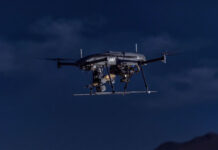







Sikorsky, a Lockheed Martin company, has officially launched its Nomad drone fleet, a versatile family of vertical take-off and landing (VTOL) unmanned aerial systems (UAS) featuring a twin-proprotor design. The announcement signals Sikorsky’s ambition to address critical needs across defense, national security, and civilian sectors.
Adaptable Aircraft for Diverse Missions
According to a company announcement, the Nomad drones will range in size from medium-sized Group 3 UAS to the size of a Black Hawk helicopter, classified as Group 5. They are engineered to excel in challenging environments, undertaking missions ranging from reconnaissance and „light kinetic” operations to cargo transport. Sikorsky emphasizes the Nomad’s autonomous capabilities, powered by the company’s MATRIX technology and an open-systems architecture.
Rich Benton, Sikorsky vice president and general manager, stated that the Nomad family of drones will be adaptable, go-anywhere, runway independent aircraft capable of land and sea-based missions across defense, national security, forestry and civilian organizations.
Targeting Army’s Future UAS Needs
While currently focused on developing its Group 3 UAS, Sikorsky is also planning a Group 4 model. These systems, powered by hybrid-electric technology, are being funded through internal company investments and are also part of DARPA’s EVADE program. Erskine “Ramsey” Bentley, director of strategy and business development for Sikorsky Advanced Programs, told reporters that the Group 3 variant could potentially fulfill the role previously held by the Army’s RQ-7 Shadow fleet. The Army is actively seeking a replacement for the Shadow by 2026, as reported by Breaking Defense.
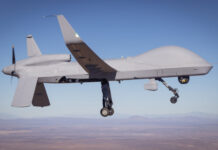
Bentley also suggested that the Group 4 Nomad could serve in a capacity similar to the Army’s Gray Eagle drone, purchases of which have been halted as part of the Army’s Transformation Initiative.
Multi-Service and Civilian Applications
Sikorsky envisions a broad range of applications for the Nomad fleet, extending beyond the Army to other military branches and civilian government agencies.
“We see these aircraft as being multi-role, but also multi-service, and we also see civilian applications, or commercial applications for these aircraft also being vertical takeoff and landing. They would be ideal for shipboard operations with the Navy or the Marine Corps,” Bentley said. “We could use these for spotting wildfires, for wildfire suppression operations, or they could be used for humanitarian assistance operations.”
Nomad 100 Set for Flight Testing
Prior to the official Nomad family announcement, Sikorsky had been developing the „Nomad 50,” a smaller rotor blown wing VTOL UAS. The company has now shifted its focus to Group 3 systems and unveiled the Nomad 100, a Group 3 UAS slated for flight testing later this year. Sikorsky Innovations Director Igor Cherepinsky told reporters last week that the company has begun preliminary design review on a Group 4 Nomad, with plans to build and demonstrate a prototype within a year.