In a high-stakes demonstration of modern warfare, soldiers from the 3rd Mobile Brigade Combat Team stood back as drones and unmanned ground vehicles executed the most dangerous maneuver in infantry history: the combined arms breach.
This spring, the proving grounds of Fort Polk, Louisiana, witnessed a tactical revolution. For the first time, soldiers of the 101st Airborne Division didn’t lead the charge into the enemy’s fortified trenches. Instead, they watched from a distance as a fleet of robots and expendable drones took the lead, proving that the most lethal zones on the battlefield can be cleared without spilling a single drop of American blood.
The Lethal Threshold: Clearing the Breach with Artificial Reinforcements
The „breach point”—where infantry must overcome minefields, wire obstacles, and entrenched defenses—is notoriously the place where brigades suffer their heaviest casualties. Colonel Ryan Bell, commander of the 3rd MBCT, posed a radical question for this exercise: „Can we, with robots, make this uncontested for the rifleman?”
The mission was to ensure that by the time a human soldier reached the breach, the enemy defense was already neutralized. The exercise was a resounding success, proving that uncrewed systems can take the „uncontested” role, shielding infantry until they are absolutely needed to secure the objective.
Abe-101s and Explosive UGVs: The Architecture of an Unmanned Assault
The assault was carried out by waves of „Abe-101” drones—purpose-built, attritable systems constructed by the soldiers themselves. The operation began with „carrier drones” deploying munitions to take out electronic jammers. This was followed by five waves of drone strikes, some dropping smoke to disorient the enemy, while others targeted bunkers and vehicles with surgical precision.
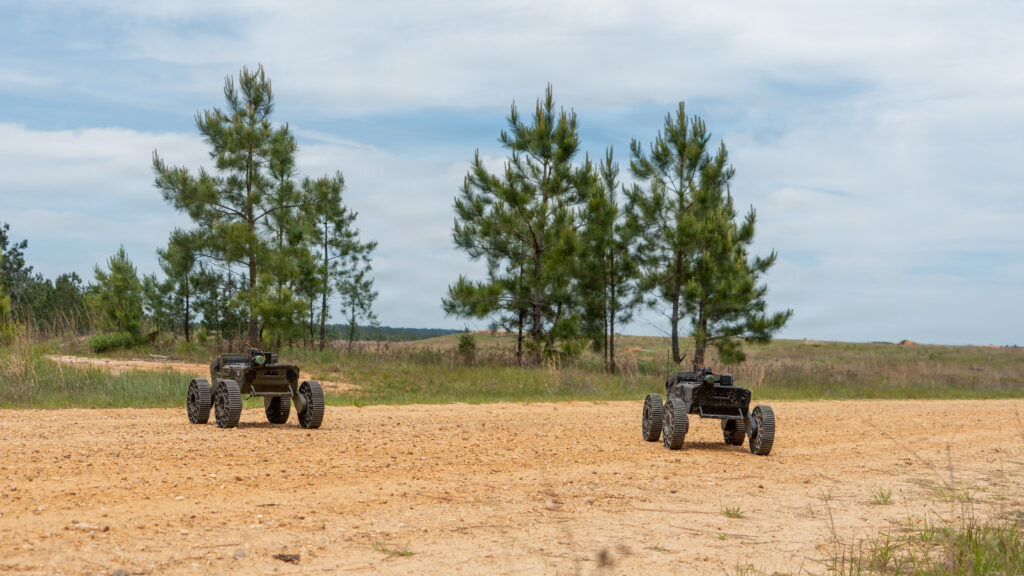
The finale involved Unmanned Ground Vehicles (UGVs) carrying 28-pound explosive charges. These „robotic sappers” crawled into the heart of the mined obstacles, detonating their payloads to create wide openings for the infantry to enter safely. This success mirrors recent combat reports from Ukraine, where autonomous systems are increasingly being used not just for supply, but for direct assault missions.
The Million-Unit Challenge: Scaling Swarms for Future Wars
Despite the tactical victory, the U.S. Army faces a staggering industrial hurdle. Colonel Bell noted that for this strategy to be viable on a global scale, the production numbers are immense. If one division requires tens of thousands of drones monthly, the total Army requirement could soar to 2 million drones per year—a volume that far exceeds current in-house military capabilities.
Furthermore, the technology must shift from individual operation to „one-to-many” swarming. The goal is for a single operator to control 20 to 30 drones simultaneously, a capability currently undergoing rigorous testing. Finally, cost is king: at a price point of roughly $750 per unit, these drones must be treated like artillery shells—expendable, mass-produced, and cost-effective. In the future of conflict, the U.S. Army is betting that silicon is far easier to replace than soldiers.