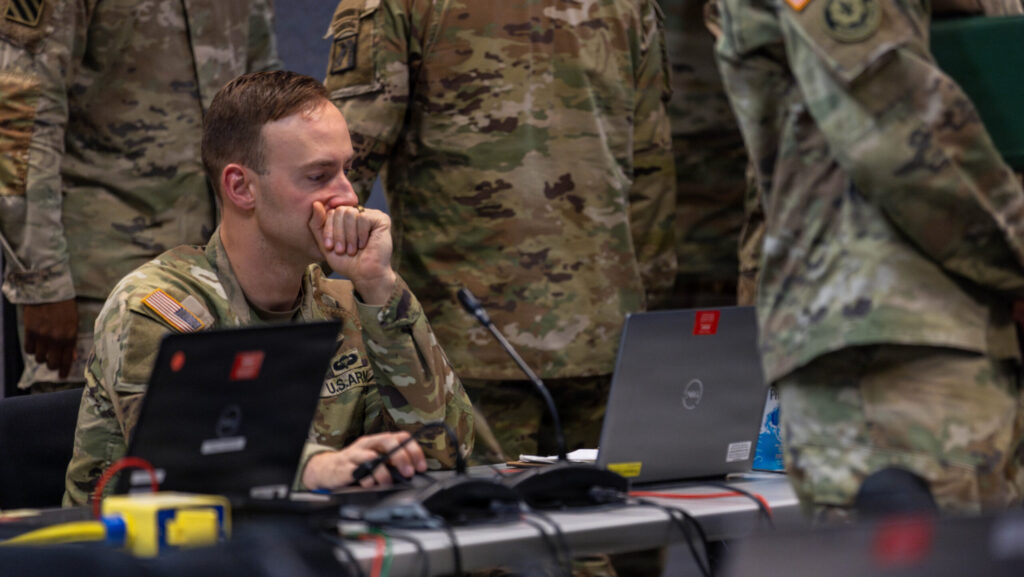
In an era increasingly defined by technological supremacy, the modern battlefield is undergoing a profound transformation. What might appear as the mundane technicalities of battlefield data transfer are rapidly becoming the decisive factors that will determine victory or defeat in future conflicts.
Major Brandon Rose, G-3/5 with the XVIII Airborne Corps, articulates this shift with stark clarity. He emphasizes that the agility to manage data effectively, rapidly inform commanders, and leverage advanced tools – freeing them from the laborious task of sifting through spreadsheets and PowerPoint slides – is quickly becoming the ultimate competitive advantage. This critical insight is the driving force behind the XVIII Corps’ rigorous Scarlet Dragon exercises, designed to hone the army’s adaptation to data-centric warfare.
Scarlet Dragon: Forging the Digital Edge
Since 2020, the XVIII Airborne Corps has conducted quarterly Scarlet Dragon iterations, each meticulously crafted to refine operational capabilities and optimize data-sharing processes. A primary focus lies in shortening the „kill chain” – the entire cycle from intelligence gathering to targeting – a cornerstone of contemporary data-driven combat.
The latest iteration of the exercise, held the week of March 30, introduced a significant evolution: the incorporation of commercial datasets alongside traditional military-only information. Soldiers were tasked with planning for sustained combat operations exceeding 14 days, a rigorous test of systems and resilience. „Much of our effort is dedicated to examining the commercial data landscape, comparing it with existing tools available to the corps. The viability and integration potential are major considerations for us,” Major Rose elaborated.
The impetus for exploring commercial data was a direct outcome of lessons learned from the corps’ engagement with Ukraine during the early stages of Russia’s invasion. It became evident that the military was lagging in this domain, with existing policies and U.S. code imposing limiting factors on what commanders could achieve with purchased datasets. Chief Warrant Officer 4 Sean Benson, the senior GEOINT technical officer for XVIII Airborne Corps, highlighted that „adjustments were made, observations were documented, and then the lawyers began critical dialogues about what was permissible and legal. This underscored the urgent need for changes in data architecture and structure.”
While specific details of the classified Scarlet Dragon exercises remain undisclosed, both Rose and Benson affirm that each iteration provides invaluable opportunities to solve emerging problems. This involves relentless experimentation with diverse Application Programming Interfaces (APIs) and cross-domain solutions to identify the most reliable data pathways.
Navigating the Data Minefield: Transfer in Contested Spaces
Scarlet Dragon’s scope extends beyond mere data sharing; it rigorously tests the ability to execute these transfers under hostile scrutiny, where adversaries are actively seeking to exploit and target technical emissions. „We’ve embraced the concept of data-centricity and data-driven decisions, but we must also acknowledge the potential cost of a large digital footprint. How do we minimize that while retaining access to vital information?” Major Rose pondered. The overarching goal is to develop methods characterized by low probability of intercept and low probability of detection, acknowledging that the electromagnetic spectrum is a perpetual battleground.
Officials explained they are exploring optimal data pathways, akin to a PACE (Primary, Alternate, Contingency, Emergency) plan for communications. „That is precisely what we’re testing with the DIL (Denied, Disrupted, Intermittent, and Limited) architecture – a PACE plan for ingesting large streaming datasets,” Benson confirmed. This also includes stress-testing nascent systems like TITAN (Tactical Intelligence Targeting Access Node), the Army’s next-generation ground system, to identify and rectify data flow bottlenecks.
The Commander’s Dashboard: A Unified Vision for Victory
As the corps continues to refine data pathways, a core, enduring effort of successive Scarlet Dragon exercises is to enhance the quality of data collected from all directorates. The ultimate aim is to feed this information into a unified, intuitive visualization for the commander. A predictive logistics dashboard and comprehensive visualizations, critical for boosting combat power, are entirely reliant on high-quality data – a significant challenge in the current landscape.
Logistics reporting, originating from the lowest echelons of the battlefield, often reaches corps level with an 18 to 24-hour delay, and frequently, with inaccuracies. A crucial aspect Scarlet Dragon consistently explores is the flow of information from „low to high” – meaning from small units operating in unclassified environments all the way up to corps-level elements utilizing highly sensitive systems.
The corps is actively investigating how to leverage secure, yet unclassified-encrypted devices at the company level to more rapidly feed systems like the Maven Smart System, thereby providing more accurate information and accountability. „When considering how to share or pull logistics and location data from a host nation or partner force not operating on our networks, these cross-domain solutions – bridging the gap between high and low classification levels – remain a continuous and critical issue,” Major Rose concluded, underscoring the relentless pursuit of digital supremacy.