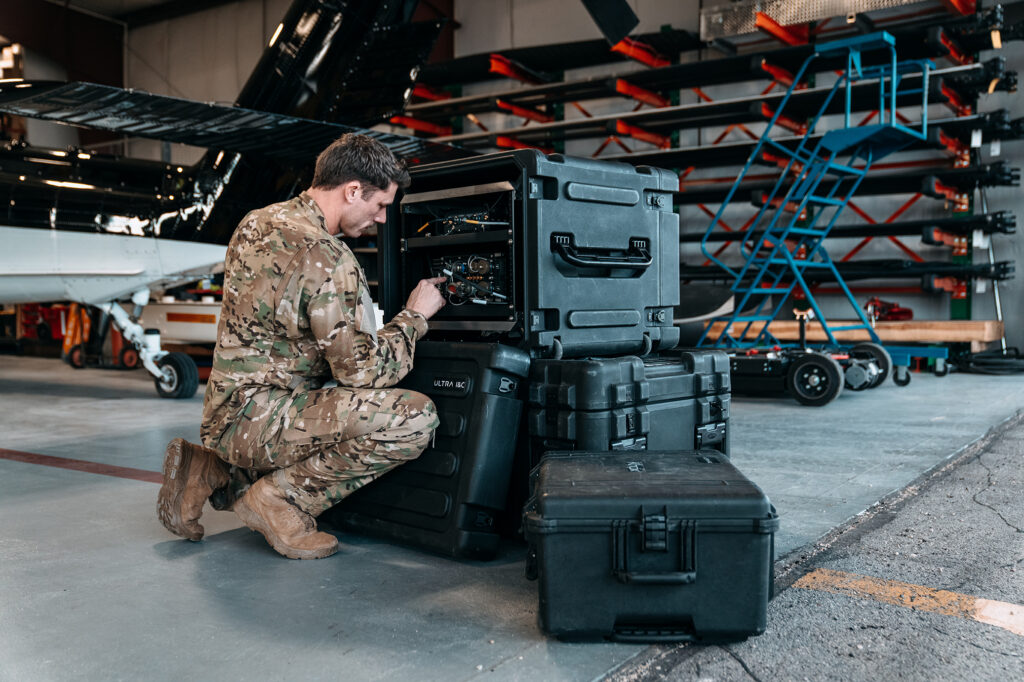
Across the modern battlespace, the hunger for edge computing power is moving in only one direction: exponentially upward. From maritime depths to high-altitude corridors, operators demand AI-enabled tools and rapid software updates at the tactical edge. However, a legacy problem persists—the „hardware boxes” inside air, ground, and naval systems were built for a bygone era of slow-motion upgrades. To bridge this gap, Ultra I&C has unveiled the Knox family of processors, designed not just for more speed, but for an entirely new kind of computing architecture that defies obsolescence.
Breaking Vendor Lock: Innovation at the Speed of Need
The primary obstacle to modernizing legacy platforms isn’t a lack of ingenuity; it’s the rigid hardware architectures that keep nations „vendor-locked.” Randy Fields, CTO and Edge Compute GM at Ultra I&C, notes that these legacy systems force costly and time-consuming redesigns every time a new capability is identified.
The Knox family breaks this cycle by utilizing a Modular Open Systems Approach (MOSA). By modernizing the internal „backplane” while leaving the external platform connections intact, Knox allows for seamless tech insertion. This means processing, communications, and mission applications can be upgraded in the field without the need for expensive chassis replacements or aircraft re-cabling.
The MQ-9B Success: Recovering Space for Weapons and Sensors
The real-world impact of this modularity is already being felt by the U.S. Marine Corps. Earlier this year, the USMC ordered Knox-5 processors to enhance edge processing for its MQ-9B Reaper fleet. These unmanned platforms are size-constrained, making the Knox-5’s optimization of size, weight, and power (SWaP) a mission-critical advantage.
Traditionally, maintaining multi-level security required separate boxes, switches, and power supplies, adding significant weight and logistical burdens. Knox compresses these functions into a single flight-certified unit. „Giving back space inside these airframes is what the warfighter needs right now,” says Fields. By reducing the physical footprint of the „brain,” the military gains room for what truly wins battles: more weapons and more advanced sensors.
Speed as a Weapon: A Foundation for Tomorrow’s Conflict
In the Pentagon’s current strategy, speed is considered a weapon—not just in terms of compute cycles, but in the rapid sourcing and field-deployment of new tech. Whether it is integrating Starlink capabilities or the latest AI autonomy stack, the Knox architecture is designed to absorb change indefinitely.
By building Knox on a foundation of commercial products and a diversified industrial base, Ultra I&C ensures supply chain resilience, avoiding the bottlenecks of single-source solutions. For the government, this represents a shift from buying a static piece of hardware to investing in an adaptable foundation. In an increasingly volatile global security landscape, the ability to upgrade in-theater, rather than returning to the factory, provides a sustained edge that traditional architectures simply cannot match.