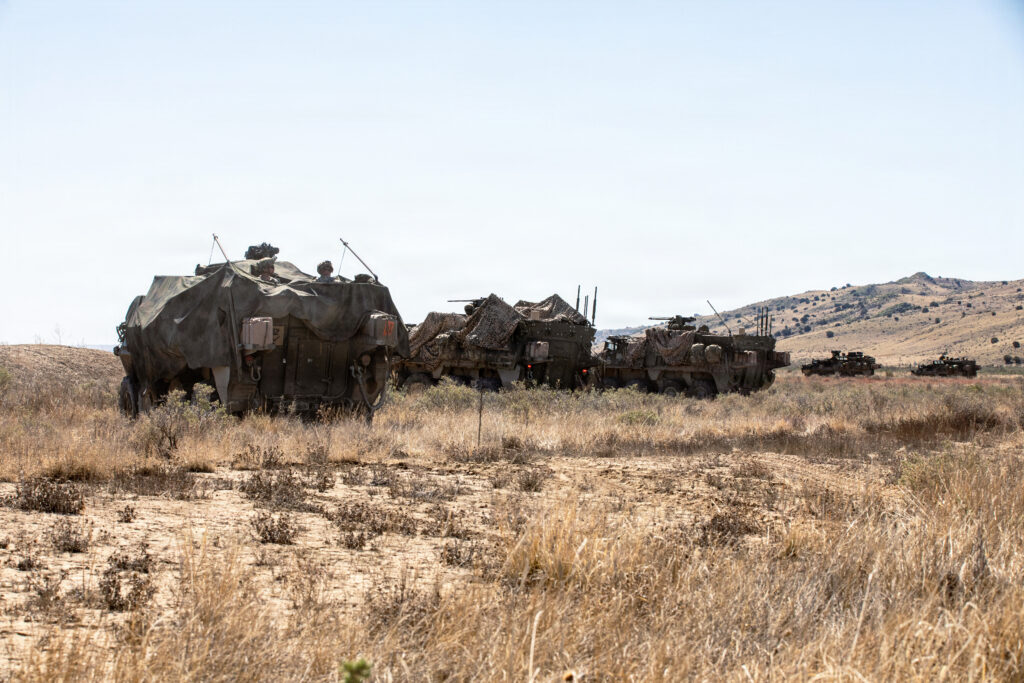
In an unprecedented exercise in the American desert, the 4th Infantry Division faced a stark reality: on the modern battlefield, the most dangerous enemy is not the one who cuts your lines, but the one who makes you believe your equipment is simply „broken.”
Surrounded by the vastness of the empty desert, a group of soldiers faced a dangerous choice. Their communication equipment was failing, but the causes seemed mundane: bad weather, satellite glitches, or user error. As the unit desperately sought technical workarounds, the „enemy” just a few miles away was celebrating. It wasn’t a malfunction; it was a subtle electronic attack, specifically calibrated to avoid triggering counter-jamming alarms.
The „Almost Functional” Trap: When Signal Degradation Becomes a Psychological Weapon
The primary lesson of the massive „Ivy Mass” exercise was a surprising one: total jamming is less effective than partial degradation. When a radio dies completely, a soldier knows they are under attack and activates countermeasures. However, if the signal is merely weak or intermittent, they waste vital time trying to „fix” the device, leaving the unit vulnerable and indecisive.
This tactic of creating doubt proved to be a massive strategic advantage for the opposing forces. „If the soldier thinks it’s the system’s fault, they won’t go all-in on finding a combat solution,” commanders observed. In a real fight, this confusion could have had fatal consequences.
Replicating the Pacific Threat: A High-Stakes Stress Test
The exercise was far from routine; it was a large-scale simulation of a high-intensity conflict in the Pacific theater. The Army deployed its full electronic arsenal: from cyber units capable of spoofing WiFi passwords to high-powered jammers like the new MAMBA-E—a massive unit based on the latest intelligence regarding near-peer adversary technologies.
For the first time, none of the effects were merely simulated on paper. Soldiers felt the real-time impact of jamming on GPS systems and data networks, forced to maneuver in a hostile and unpredictable electronic environment. The goal was to stress-test the Next-Generation Command and Control (NGC2) architecture before its official deployment to future units.
„Uncomfortably Dispersed”: The Ukrainian Lesson Applied in Colorado
Drawing inspiration from the dynamics of the Ukrainian front, the exercise enforced a new survival philosophy: extreme dispersion. The concept of being „uncomfortably dispersed” has become the new norm. If a commander feels secure near the rest of their unit, they are likely too easy a target for enemy drones and artillery.
Units were forced to operate at much greater distances than in the past, communicating through data nodes positioned far from the front lines to avoid detection. This ability to command troops from a completely fragmented configuration is seen as the only way to survive on a battlefield saturated with enemy sensors.
Beyond the Tech: The Need for Tactics over Gadgets
While new equipment, such as man-packable jammers, is essential, military leaders warn that technology is not a silver bullet. „We are not going to tech our way out of this problem,” emphasized the 4th Infantry Division commander. Instead, a radical shift in tactics, techniques, and procedures is required.
The generals’ conclusion is clear: the Army must learn to fight in „electronic darkness” not just at major training centers, but at home stations. Training for electromagnetic warfare must become as common as marksmanship, transforming every soldier into a warrior capable of navigating the invisible chaos of the radio spectrum.