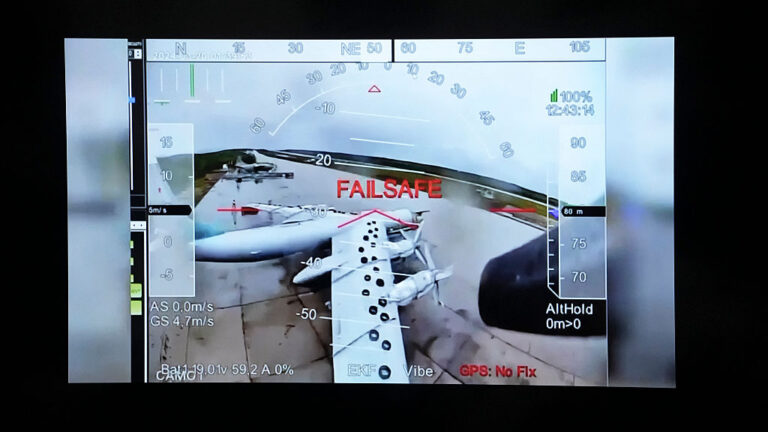
Since Russia’s full-scale invasion began, governments, defense firms, and military leaders have traveled to Ukraine to study how unmanned systems are transforming warfare. Most leave with the same questions: Which drone performs best? Which has the longest range? Which artificial intelligence is the most advanced? These questions are understandable, but they miss the point.
Every generation mistakes the most visible technology for the actual military revolution. Today, the risk is repeating that mistake with drones.
The Network Matters More Than Any Single Platform
Ukraine’s drone industry is not defined by one breakthrough aircraft. It is defined by the realization that no individual drone can solve battlefield challenges on its own. Ukrainian forces increasingly rely on families of unmanned systems that function as an integrated network: reconnaissance drones, communication relays, electronic warfare assets, interceptors, and strike platforms. None is decisive alone, but together they create a flexible, layered system.
The real advantage lies not in the number of designs, but in the speed with which battlefield feedback reaches manufacturers and improvements return to the front within days or weeks.
Full Autonomy Is Not the Objective
Much of the Western debate assumes the future belongs to fully autonomous drones. Combat experience suggests otherwise. Soldiers prefer to remain in the loop because fully autonomous systems struggle, over time, to reliably distinguish friend from foe. The goal is not to remove humans, but to reduce their workload while preserving judgment where it matters most. Even Ukraine’s most advanced systems keep meaningful human control over target selection and mission abort.
Resilience Outweighs Scale
Western discussions often focus on production numbers and costs. Ukraine highlights a different priority: in an environment of long-range strikes and industrial sabotage, the ability to sustain innovation under attack is more valuable than sheer volume. Distributed manufacturing and rapid software updates allow capabilities to evolve even when production sites are threatened.
Drones Do Not Replace Soldiers
Unmanned systems extend human reach, compress decision cycles, and improve situational awareness. Over time, they are likely to become embedded infrastructure, similar to radios or navigation systems, rather than a separate capability. Success depends on integration that military personnel trust and adopt.
Buying Drones Is Not Enough
The hardest challenge is not acquiring new equipment, but changing how large institutions absorb technology. Faster procurement processes, updated doctrine, effective training, and adaptive industrial partnerships are all required. Without these, new systems quickly become outdated.
The Advantage Worth Copying
Western governments are purchasing Ukrainian drones, which is logical. However, the more important question is what enabled Ukraine to field new capabilities at a pace that larger, wealthier defense establishments struggle to match. The answer is not a specific technology. It is an innovation ecosystem that connects operators, engineers, and decision-makers in a continuous cycle of learning and adaptation. This ability to absorb, integrate, and evolve technology faster than the adversary is the real lesson—and the hardest one to replicate.