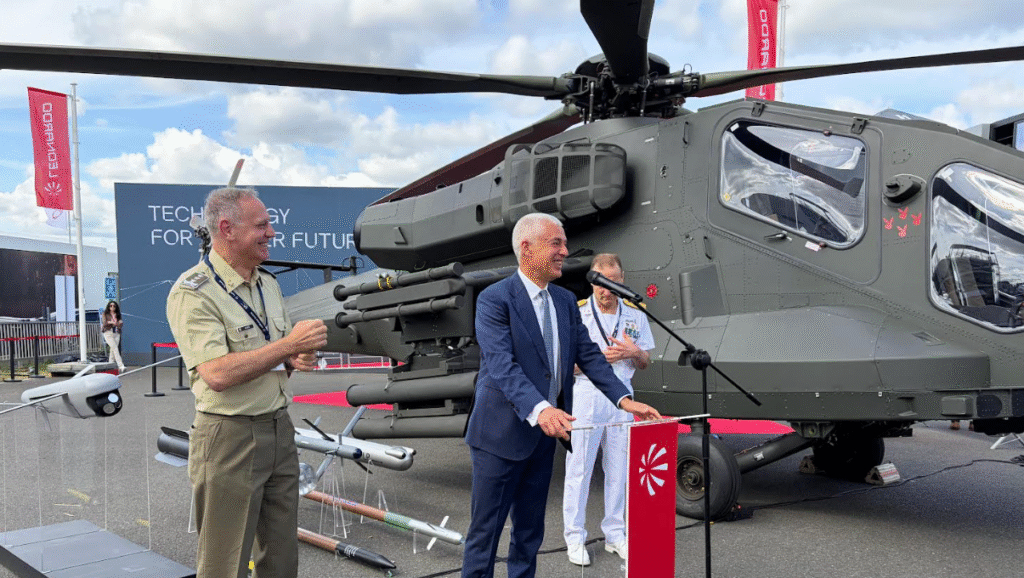
Leonardo and the Italian Ministry of Defense are locked in „advanced” negotiations to significantly expand the Italian Army’s AW249 combat helicopter fleet. Far more than a traditional attack platform, the AW249 is emerging as a digital command node, envisioned to serve as the strategic heart of a sophisticated network capable of orchestrating simultaneous drone operations in high-threat environments.
A Strategic Build-up: The Race for a 48-Ship Fleet
The industrial momentum is building rapidly, with Leonardo aiming to deliver 17 units to the Italian Army by 2029. To date, 19 aircraft have been officially procured, with talks for an additional 14 currently underway to meet the total requirement of 48 helicopters. As the AW249 enters its final qualification phase, series production is already gaining speed, signaling Rome’s commitment to replacing its aging AW129 fleet with a platform built for the 21st-century battlefield.
Mastering the Swarm: The AW249 as a Digital Battle Manager
At the core of the AW249’s lethality is its pioneering „crewed-uncrewed teaming” (MUM-T) capability. This technology transforms the helicopter into a mobile command center, allowing pilots to control multiple tactical UAS (Unmanned Aircraft Systems) directly from the cockpit. By integrating platforms like the Jump 20 drone, the AW249 can extend its reconnaissance and strike envelope well beyond the horizon, utilizing an open-architecture interface designed to stay compatible with a wide array of future autonomous assets.
Deep Penetration: Stealth Tactics and Next-Gen Firepower
Drawing critical lessons from the war in Ukraine, where traditional air superiority is constantly challenged by advanced air defenses, the AW249 is designed for high-speed, low-level penetration. Its mission profile focuses on „flying under the radar” to strike deep into contested territory. Armed with a formidable array of European-made weaponry—including Brimstone, Akeron LP, and the Italian-developed Fulgur missiles—the AW249 is being positioned as the premier choice for the European and Middle Eastern markets, where the demand for survivable, high-tech attack helicopters is at an all-time high.