Hormuz on the Brink: A Subsea Threat Demands Action
As global tensions escalate and the Strait of Hormuz faces a de facto closure due to the looming threat of Iranian missiles and drones, a cutting-edge technological solution is coming into sharp focus. While the world watches screens with growing apprehension, maritime security experts are highlighting a potential answer, already field-tested globally: the Triton Autonomous Underwater and Surface Vehicle (AUSV) built by Ocean Aero. Its creators view the unfolding events with anticipation, convinced their autonomous drones can provide immediate and crucial assistance.
Triton: A Force Multiplier in Maritime Security
Already armed with minesweeping payloads and proven in theaters like the Black Sea, the Tritons are poised to play a pivotal role in maritime security. „Triton is an ideal mine counter-measure device,” affirms Kevin Decker, Ocean Aero’s CEO. „It already has vetted mine counter-measure payloads. It has more endurance than other unmanned assets, can home in underwater for detailed views, and doesn’t require humans to travel out to sea to launch. We need to find and clear those mines in the Strait of Hormuz. We can deploy them right now. America has the technology. We should use it.”
Stealth, Endurance, and Unmatched Versatility
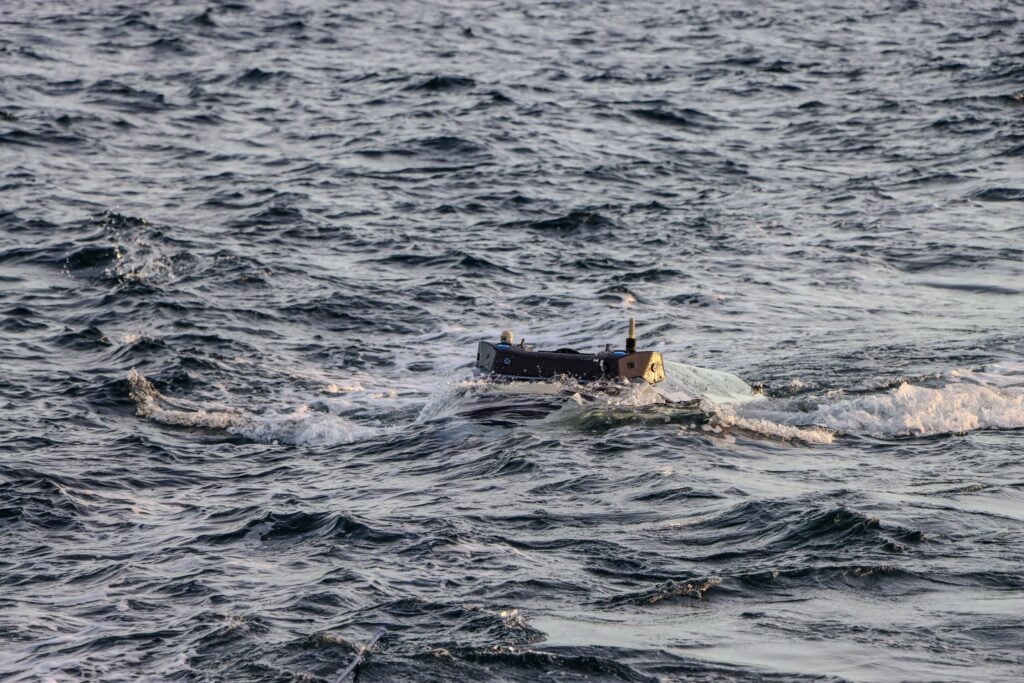
The Triton is the world’s only wind and solar-powered AUSV. This nearly 15-foot-long, 1,500-pound (680 kg) craft can autonomously sail and submerge while carrying payloads ranging from intelligence, surveillance, and reconnaissance (ISR) to communications, anti-submarine warfare (ASW), maritime strike, and mine counter-measures (MCM). Capable of launch and recovery from shore, ship, or air, the Triton can patrol on the surface for 30 days or more. When needed, it can retract its sail, dive down to 328 feet (100m), and remain submerged for over 10 days.
Once underwater, it can deploy a comprehensive mine-detection sensor suite, including high-resolution video cameras, thermal imaging, and side-scan sonars, all to develop a detailed visualization of the seafloor and water column, inclusive of mines. An additional payload, currently in the final stages of testing, will then enable the neutralization of mines via onboard effectors, mini-UUVs, and wireless detonation gear.
Field-Proven: From the Persian Gulf to the Black Sea
Triton is not a theoretical capability. The U.S. Navy has been evaluating and operating it since 2023, including in the very waters Iran is now disrupting. Tritons are ready to deploy today and could be autonomously, persistently, and stealthily working the mine clearance problem in the Strait of Hormuz within a week. The U.S. Navy’s previous experience with Tritons has been consistent and growing. In 2023, several Tritons operated with Task Force 59 in the Persian Gulf as part of maritime situational awareness experiments.
At the time, Ocean Aero’s President of Global Operations, Oscar Rojas, was an active-duty Commodore in command of Task Force 52, the unit responsible for the U.S. 5th Fleet’s mine countermeasures mission. He recalls that the then-5th Fleet commander, VADM Cooper (now CENTCOM commander), had a clear vision for unmanned technology in the Persian Gulf: „He saw the value in unmanned systems closing gaps where traditional assets were not readily available.”
Safeguarding Ports and Critical Undersea Infrastructure
Such a gap exists right now. Two of the three Littoral Combat Ships previously assigned to Middle Eastern minesweeping duties left the area some time prior to the current tensions, taking their MCM capability with them. It’s a capability void that Rojas says Tritons could „absolutely” step in to fill. Rojas, who is currently in Eastern Europe supporting Triton operations in the Black Sea, adds a crucial point regarding the AUSV’s potential in the Strait of Hormuz: Triton is survivable.
„The current operational picture in the Middle East, the Black Sea, and, really, everywhere, is that anything on the surface is at risk from being neutralized by adversaries. We’re seeing it with the ships Iran has destroyed. The fact that Triton is a surface/subsurface vessel brings down significant risk from adversary activity. [By diving] it is still able to complete its task, being able to search, identify, and neutralize sea mines.” The ability to dive allows Triton to evade detection and fast-moving pop-up threats from Iranian small boats, staying in the hunt for mines when other systems (surface ships with towed MCM payloads, mine-hunting helicopters, shallow-depth sonar cylinders) may have to be pulled back or put at risk.
Even on the surface, Tritons would prove difficult for Iran to detect and target. A ten-foot span from the waterline to the top of its sail presents a minuscule radar cross-section which effectively vanishes at distances greater than a quarter-mile, while Triton’s small visual signature adds to its stealth. Its autonomous navigation capability, using a hybrid of acoustic, visual, and other systems, also allows it to avoid detection before adversary sensors or platforms get too close.
Triton-enabled mine location and clearance could open safe passageways in the Strait. It could also provide CENTCOM the data to share with commercial shippers/insurers and the media to prove the Strait is navigable—an assurance worth hundreds of billions to the global economy. Sam Adcock, executive vice president of Washington D.C.-based advisory firm, Crossroads Strategies, has followed Ocean Aero’s Triton development for over five years. He asserts that in the current crisis, it’s time to put the platform to work: „World events disrupt the best laid plans. In this instance, TRITON is the answer to the most pressing world problem!”
The Gulfport Precedent: Securing the Home Front
From his satellite office in Houston, Kevin Decker observes that the Port of Gulfport, Mississippi, is currently safe from surface and underwater security threats. „I can say with certainty that there is not espionage or sabotage placed at the bottom of the Port of Gulfport,” he affirms, „because I checked this morning and I’ve checked twice a week for the past nine months. I can’t say the same thing for the ports of New York City, Los Angeles, Houston, or Seattle. In an era of conflict and sea mining, that needs to change.” Decker has been able to remotely monitor Gulfport via live video and data feeds from the Triton now stationed there.
In May 2025, Gulfport became the first Port in the world to implement continuous autonomous subsea surveillance with the advent of Triton operations. One AUSV performs a full, three-sensor scan of the port twice a week, ensuring the harbor is secure and ready to operate, free of waterborne threats or spying. The Triton assigned to Gulfport carries bathymetry, side-scan sonar, and magnetometer payloads to produce high-resolution comparative data sets for real-time change detection. It offers the ability to spot irregularities in both port traffic and infrastructure, a feature that Port CEO and Executive Director, Jon Nass, says has the potential to save the Port millions.
Infrastructure at Risk: A Global Imperative for Triton
The same long endurance, low-profile, surface/subsurface, and modular payload qualities that make Triton a potential mine-warfare game-changer in the Strait of Hormuz also address the growing threat to undersea infrastructure there and globally. „One of the things that hasn’t gotten much airtime, and maybe for good reason,” Oscar Rojas points out, „is the [risk to] critical underwater infrastructure in the Persian Gulf area.”
While Rojas commanded the Task Force, CTF-52 conducted extensive hydrographic surveys of the Gulf, the Strait of Hormuz, and the Bab al-Mandeb Strait. „There is so much critical infrastructure in that area,” he observes. „You can’t just go blow up sea mines that may be in these zones because you could potentially sever vitally important lines of communication. It’s not as easy as blow-and-go to get rid of sea mines.” Tritons could simultaneously detect mines in the Gulf and quickly map spots where neutralization has to be delicately undertaken. The AUSVs’ persistent underwater and surface capability would aid greatly while providing awareness of possible Iranian infrastructure sabotage efforts in the waterway and surrounding ports.
Decker and Rojas refer to Ocean Aero’s Triton as an „unblinking eye.” The time to focus it on the Persian Gulf is now.