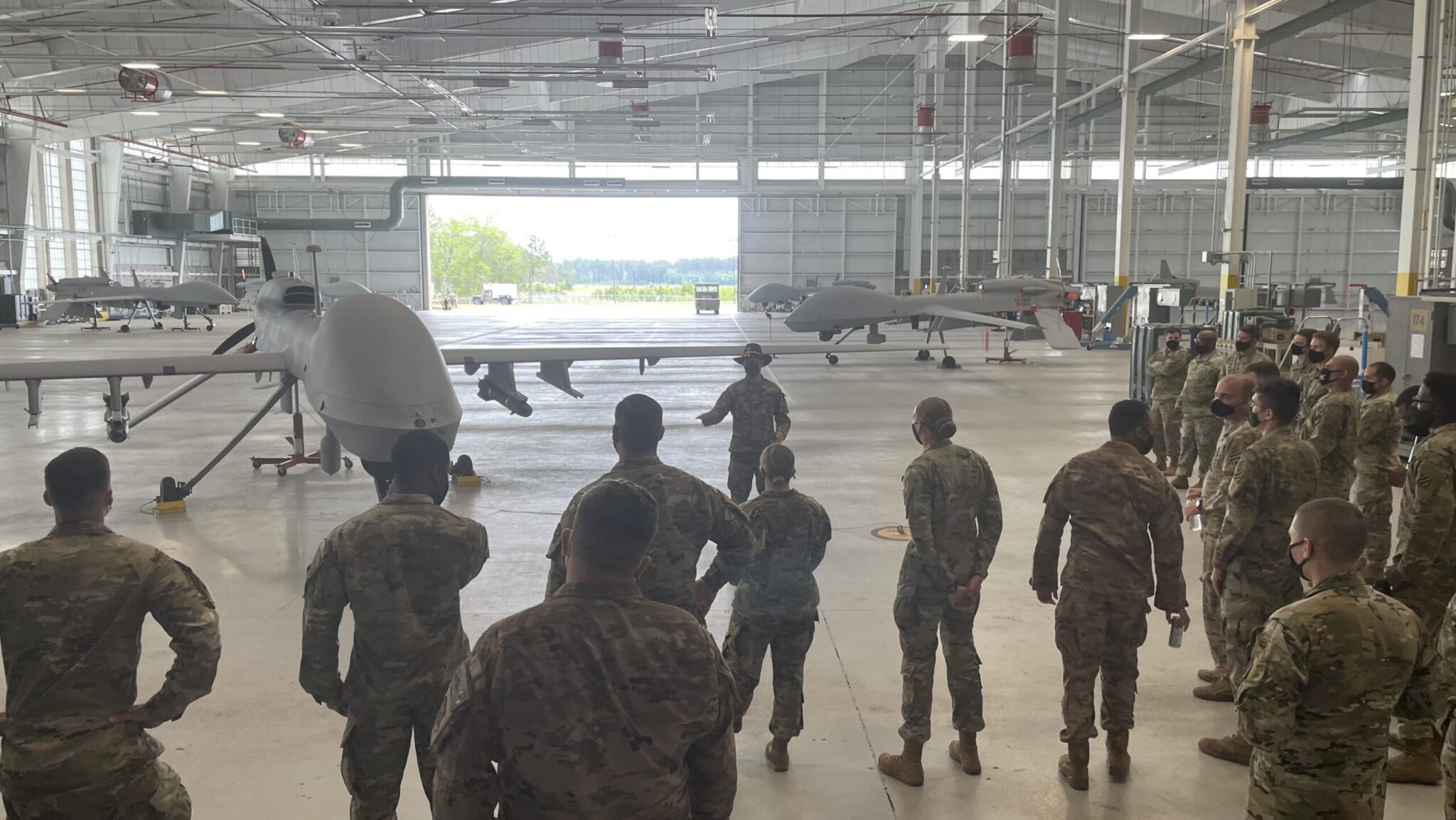
As the U.S. Army explores its options for operating larger unmanned drones for surveillance and attack missions in remote areas, it aims to finalize an acquisition plan within the next year, according to key service leaders.
In early June, the Army issued a request for information (RFI) targeting group 4 or 5 unmanned aircraft systems (UAS), which are defined as drones weighing over 1,320 pounds. The Army is particularly interested in platforms capable of flying 500 nautical miles at an altitude of 20,000 feet, supporting multiple payloads, and enabling short takeoff and landing (STOL) capabilities.
“This initiative aims to assess the current market landscape and advancements in technology over the past several years. We have been closely monitoring this space,” said Brig. Gen. David Phillips, the program executive officer for aviation, in an interview with Breaking Defense. Following the early summer solicitation, the Army received over 10 responses and is in the process of consolidating the feedback, according to Col. Joshua Ruisanchez, director of the Aviation Capability Development and Integration Directorate. Ruisanchez anticipates that the analysis will be ready by October, paving the way for the Army to develop various options for senior leadership.
While the Army currently operates the MQ-1C Gray Eagle drone, Ruisanchez and Col. Nick Ryan, director for the Army Capability Manager-Unmanned Aircraft Systems, are focusing on enhancements to this platform as well as considering other suitable options for use at corps and division levels.
“In our assessment, the corps level requires extended sensing capabilities and likely needs an extended-range UAS,” Ruisanchez noted. “At the division level, operational needs may involve more dynamic maneuvers in unsanctioned areas, suggesting the need for vertical takeoff or STOL capabilities on unimproved terrain. Therefore, we are exploring a formation-type structure for the future.”
When asked if the new initiative represents a replacement for the Gray Eagle, Ryan clarified, “Absolutely not. This is about determining the right mix of drones for each echelon and different theaters of operation, which could lead to a diverse array of options.”
Ryan further emphasized the importance of assessing which drone might be best suited for various theaters of operation: “Is one [drone] more appropriate for a specific theater than another? That’s part of the analysis we’re conducting.”
Once the initial assessment is completed, it will be forwarded to senior leaders for review, which could potentially result in a final requirements document by the start of fiscal 2026.
“We will brief senior leaders on the identified capabilities and subsequently inquire about the desired technologies,” Ruisanchez elaborated. “Should we continue with the Gray Eagle, or should we pursue an alternative option?” He also mentioned that potential cost implications and the need for additional airworthiness certification work could factor into the decision-making process.
In response, General Atomics spokesperson C. Mark Brinkley expressed the company’s readiness to compete and provide options. “We were excited to see the RFI and are eager to present details on our Gray Eagle 25M and Gray Eagle STOL aircraft,” Brinkley said in a statement to Breaking Defense. “General Atomics envisions the Gray Eagle 25M and Gray Eagle STOL as a powerful 1-2 punch for Army aviation in the coming years.”
The Gray Eagle 25M, also known as the Mojave demonstrator, serves as a proof of concept for testing new capabilities that can be integrated into future products. It shares design elements with the extended-range version of the Gray Eagle and boasts enhanced capabilities, including short takeoff and landing functions and the ability to carry up to 16 Hellfire missiles—double the capacity of the standard MQ-1C. The first flight of the Gray Eagle 25M took place in December 2023.
The Gray Eagle STOL is designed to build upon the advancements made with the 25M, offering increased operational flexibility in austere environments.
While the specific companies that responded to the RFI have not been disclosed, it is anticipated that a range of traditional defense primes and drone-focused startups are preparing to compete if a formal competition is initiated.