A revamped acquisition structure, a mass-production interceptor and expanding autonomy on land and at sea are shaping a new phase in the modernization of U.S. military capabilities.
Streamlining acquisition and strengthening accountability
The U.S. Army is restructuring its acquisition system, removing an administrative layer between portfolio acquisition executives and program managers. Under the new arrangement, former Capability Portfolio Executives have been renamed Program Manager Executives and will work more closely with program managers.
The changes are intended to simplify decision-making and bring acquisition priorities closer to operational needs. Portfolio acquisition executives will be required to hold acquisition certification, while their deputies will come from operational Centers of Excellence. The aim is to ensure that equipment development better reflects the requirements of the forces that will use it.
Steelfin targets mass production at a lower cost
Anduril has unveiled Steelfin, a modular interceptor designed to counter large numbers of aerial threats, including drones, missiles and hypersonic weapons. The company is targeting a price of roughly one-third that of a PAC-3 MSE interceptor.
Its modular design is intended to accommodate different rocket motors and seekers depending on the mission. The system is being developed for integration with Patriot and Common Autonomous Multi-Domain Launcher (CAML) systems.
Full-rate production is targeted for late 2028 or early 2029. Projected annual output could range from several thousand to hundreds of thousands of units.
Robotic systems take on dangerous maritime missions
In mine-countermeasure operations, robotic systems use sonar to detect and identify mines, reducing the need to expose personnel to dangerous areas. Current procedures can require multiple passes before a mine is located and neutralized.
The next step is to process data onboard and transmit information more quickly. These capabilities could enable near-real-time detection and neutralization, replacing slower, multi-stage procedures.
Autonomous vehicles designed for austere terrain
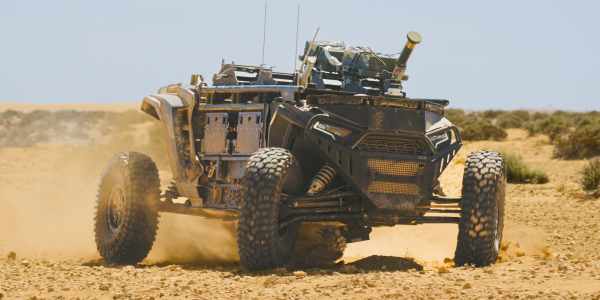
On land, Overland AI has received a $20 million APFIT contract to provide fully autonomous ground vehicles for the Marine Corps in support of the MADIS system.
Unlike remotely controlled vehicles, these platforms are designed to navigate difficult environments independently, without a constant communications link or continuous human teleoperation. Their use could reduce the number of personnel exposed to danger in high-risk missions, including breaching operations.