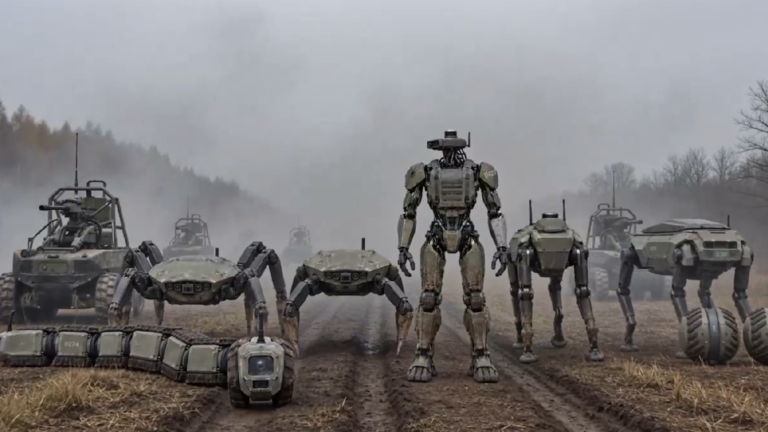
Ukraine’s former defense minister, Mykhailo Fedorov, has unveiled an ambitious project to build an “Army of Robots,” potentially including humanoid soldiers. Its stated goal is to send robotic platforms into the most dangerous missions instead of troops.
Fedorov presented the initiative at the IT Arena conference, held September 25–27. A polished computer-generated video showed armed humanoid robots aiming rifles, fighting in trenches and marching in large formations. He was controversially dismissed as defense minister by President Volodymyr Zelenskyy in July.
“In 2022, we launched the Army of Drones. […] Today, drones account for more than 95% of strikes,” Fedorov wrote on social media on September 26. “But technological warfare does not stand still. We need the next breakthrough. Our bet is on the robotization of warfare. The mission of the Army of Robots is to save lives.”
In Fedorov’s vision, sensors would detect threats first, followed by the deployment of robots. He said robotic platforms “should fight instead of people.”
An ambitious timeline, with feasibility still unproven
Fedorov set a goal of achieving the first “confirmed battlefield result using a humanoid robot” within six months — a phrase that appears to mean the first enemy combatant killed by a bipedal robot. Within the following 12 months, the initiative is expected to enable an “assault operation” in which robotic platforms independently carry out the deadliest parts of the mission, without infantry.
Ukraine has used wheeled and tracked unmanned ground vehicles extensively for tasks ranging from evacuating wounded soldiers to carrying out attacks. But these vehicles are rarely fully autonomous: they generally rely on Starlink connections and human operators. As of 2026, humanoid robots have not been used in active combat, leaving their battlefield effectiveness untested.
In August, Fedorov announced that he was launching his own defense company, with Palantir CEO Alex Karp as its first major investor. At IT Arena, he did not explain what role the company would play. Instead, he said the project would rely on an “ecosystem” of defense investment, research and development, testing alongside the military, and scaling up systems that prove effective.
Cost and reliability pose major challenges
Borys Drozhak, founder of Ukrainian unmanned ground vehicle manufacturer Rovertech, questioned the practicality of humanoid robots. Military systems, he argued, need to be inexpensive, quick to scale and durable enough for extended use on the battlefield. Bipedal robots are less stable and more costly than wheeled or tracked platforms, he warned.
Kateryna Chernohorenko, Ukraine’s former deputy defense minister for digital transformation, said the project’s launch surprised her. Building an army of robots, she argued, would be more difficult than scaling the drone program and would require trained operators, infrastructure and coordination centers — all of which should be developed immediately.
Chernohorenko said she believes Ukraine has the research and engineering base to build such systems, but questioned whether humanoid robots are an urgent priority. She pointed instead to the need for cheaper cruise missiles and air defenses. Scaling production would also require a robust supply chain for components, she added.
A technological project with political stakes
Federico Borsari, a fellow with the Center for European Policy Analysis’ Transatlantic Defense and Security Program, said the initiative should also be viewed in the context of Fedorov’s dismissal. The announcement may draw attention to his work and signal that he remains an influential figure in Ukraine’s political and economic landscape. Borsari added that the technology could have civilian applications and commercial prospects beyond defense.
Militarily, Borsari agreed that Ukraine’s immediate need is for reliable, validated robotic systems that are easy to operate and repair. Humanoid robots may eventually have a place on future battlefields, he said, but that prospect remains distant: militaries are still adapting their doctrines to the current generation of uncrewed systems, even after years of intensive use.