Two weeks into Ukraine’s operation in Russia’s Kursk region, involving the deployment of an estimated 10,000 troops, the strategic advantage of Kyiv’s newly-claimed 480 square miles of territory remains uncertain. However, this tactical move could significantly influence messaging to NATO nations, which have previously restricted Ukraine from using Western-made weapons for strikes into Russian territory, outside of limited retaliatory actions across the border due to concerns of escalatory repercussions.
NATO allies believe that if Ukraine were to utilize weapons supplied by Washington, London, Berlin, or other capitals to attack Russian territory—except Crimea, viewed by those governments as Ukrainian territory—Moscow might interpret it as an act of war by NATO, potentially resulting in retaliatory actions, including invasion of NATO territory or nuclear strikes.
Yet, if Ukraine can successfully occupy and hold Russian land using Western-provided equipment without provoking a conflict with NATO, it undermines the rationale behind restricting long-range strikes. “The argument that they [Ukraine] were effectively making is, ‘look, the front line is the same as the front line in eastern Ukraine, the same in the north and it’s the same in the south,’” noted Matthew Savill, director of military sciences at the Royal United Services Institute, a British defense think tank. “The fact that the front line has now moved into Russia is a product of war… and it has allowed them to kind of crack open that discussion about [deep strikes] on Russian territory.”
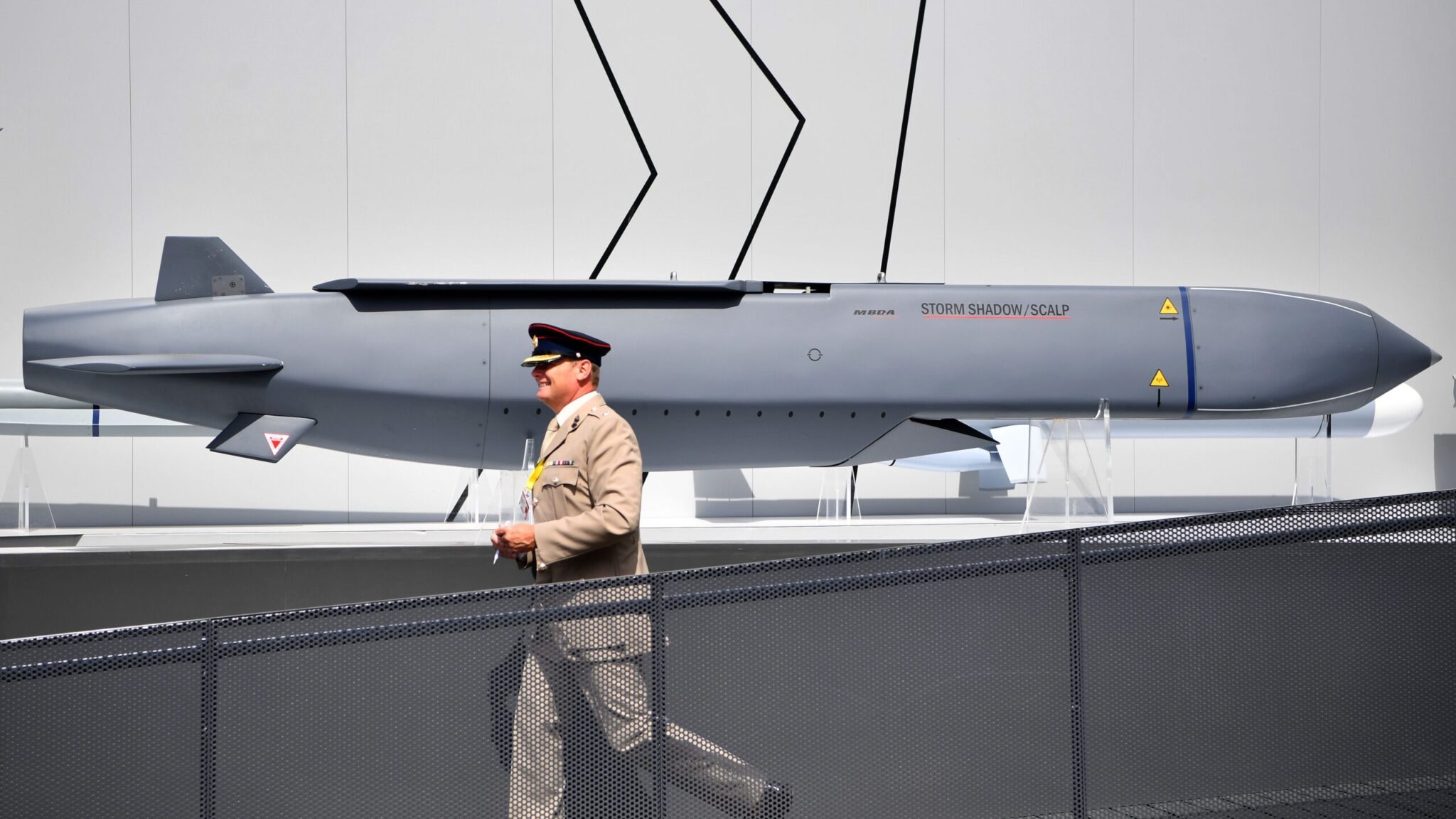
Although no single weapon would guarantee victory, Savill highlighted that MBDA’s Storm Shadow long-range air-launched cruise missile and the cluster variant of the U.S. Army’s Tactical Missile System (ATACMS) would be ideal for targeting hardened installations and aircraft at Russian airbases. Both the previous and current UK governments, along with the Biden administration, have refrained from approving attacks on Russian territory using these systems, although both weapons are permissible for use against targets in occupied Crimea.
Ukraine President Volodymyr Zelenskyy publicly criticized the UK’s hesitance on social media on Saturday but suggested that discussions might yield progress. “Throughout this war, we’ve seen the UK demonstrate true leadership—in arms, politics, and support for Ukrainian society. This has saved thousands of lives. Unfortunately, the situation has slowed down recently. We will discuss how to fix this because long-range capabilities are vital for us,” he stated.
A day prior to Zelenskyy’s comments, the UK’s Times reported that the U.S. is obstructing Ukraine from employing British missiles, with London allegedly having sent an approval request to Washington over a month ago.
In an opinion piece for the British i newspaper, Hamish de Bretton-Gordon, a former commander of the British Royal Tank Regiment, expressed confusion over the UK’s decision to prohibit Storm Shadow strikes in Russia, arguing that any action that could hasten Russian negotiations should be embraced. He noted that UK lawmakers and allied leaders likely fear escalation, but he dismissed such concerns, pointing out that years of Russian nuclear threats have not prompted action. “Every Russian red line has evaporated with the arrival of every Western piece of equipment,” he insisted. “It will be the same with Storm Shadow.”
A spokesperson for the UK government reiterated to Breaking Defense that there has been “no change in the UK’s position.” The spokesperson stated, “We have been providing military aid to support Ukraine’s clear right of self-defense against Russia’s illegal attacks in accordance with international humanitarian law. We are clear that the equipment provided by the UK is intended for the defense of Ukraine.”
Chatham House senior consulting fellow Keir Giles argued that the Kursk incursion represents a significant blow to Russia’s nuclear posturing that it has propagated in places like Washington and Berlin. He believes it will bolster the case for those who argue that the Communist threats have been largely unfounded. Support for loosening weapon restrictions has also gained traction among senior European leaders recently. On social media, EU foreign policy chief Josep Borrell stated that lifting restrictions on the use of military capabilities against the Russian military would “strengthen Ukrainian self-defense by ending Russia’s sanctuary for its attacks and bombardments of Ukrainian cities and infrastructure.” Borrell also noted that any lifting of restrictions would likely “advance” peace talks and reduce destruction in Ukraine.
Borrell confirmed that this issue will be raised next week during talks between EU foreign and defense ministers, including Ukraine’s Minister of Foreign Affairs Dmytro Kuleba, in Brussels.
In the U.S., Department of Defense policy has consistently prohibited ATACMS from being used to strike Russian territory. Although the Kursk incursion intensifies pressure on Washington to reconsider this policy, public comments from U.S. officials indicate no immediate changes are forthcoming.
As pressure mounts on both the U.S. and UK to adjust their stances, other international partners supplying weapons to Ukraine have reiterated that Kyiv retains the discretion to employ donated munitions as deemed necessary. “We [Sweden] have never imposed any restrictions on the weapons that we have delivered to Ukraine, and we do not intend to do so now,” stated Tobias Billström, the Swedish Minister of Foreign Affairs, during an interview with Germany’s DW. He emphasized that Swedish weapon systems have played a crucial role in “driving back Russian naval forces” in the Black Sea, enabling Ukraine to maintain grain shipments against Russia’s blockade.
What Comes Next for Kursk Looking ahead regarding the Kursk incursion—the first instance of Ukraine taking and holding Russian territory since the February 2022 invasion—analysts concur that Ukraine must have a strategic plan for the newly acquired territory. Jacob Parakilas, research leader in defense at RAND Europe, explained that the significant size of the Russian army and the vulnerability of Ukrainian resupply lines to Russian airpower and artillery make it “unlikely that Ukraine will be able to sustain its position indefinitely.”
Prior to the incursion, the notion of Ukraine “carving out” Russian territory appeared daunting due to Russia’s numerical advantage, resupply challenges, and other factors tied to expanding the front line, Savill explained. However, he expressed cautious optimism regarding Ukraine’s ability to hold onto Kursk in the long term, given that Kyiv “appears to have brought air defenses with them and is now adept at striking helicopters using FPV drones” while their execution of large drone strikes in Belgorod and Voronezh regions indicates newfound tactical successes.
Importantly, Ukraine has also claimed hundreds of Russian servicemen as prisoners of war, potentially creating leverage for future prisoner exchanges or peace negotiations.