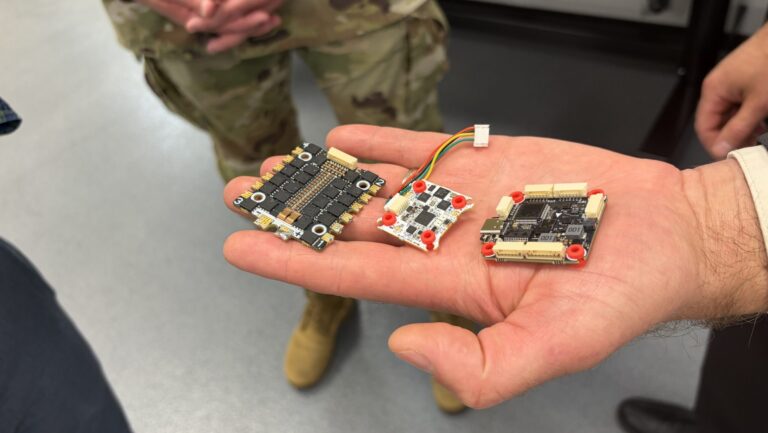
Inside halls the size of football fields, soon to be filled with the whir of machines and conveyor belts, US Army officials have revealed unprecedented details on their plan to scale up drone component production. This industrial offensive is part of a new advanced manufacturing strategy set to be released in the coming weeks, with the primary goal of securing the American supply chain.
Unprecedented speed: Moving from years of development to weeks of execution at Tobyhanna depot
The effort to transform an organizational culture accustomed to development cycles of up to eight years into one capable of delivering results in just a few months represents a major challenge. Jonathan Strzelec, chief of Tobyhanna’s Transformation Office, explained that success depends on massive support from both industry and Pentagon leadership. „Every small win matters when you’re trying to flex an entire system,” he stated during a tour of the depot.
The strategy aligns with the Department of Defense’s broader „Drone Dominance” initiative, which aims to eliminate the need to purchase parts from countries like China. The focus is on two vital but highly complex components: brushless motors and circuit card assemblies, essential for GPS, live video feeds, and motor speed control.
Technological independence: Mass production of motors and circuit cards becomes a national priority
The US Army officially launched a new brushless motor assembly line at the Tobyhanna depot today, with an initial goal of producing 200,000 units. The line has an impressive capacity of 1,500 motors per day, enough to equip 375 drones. Plans are even more ambitious for circuit cards, with officials hoping to reach a capacity of one million units per day by the end of fiscal year 2027.
This move is crucial, given that most electronic components currently come from external sources considered risky. The depot will manufacture four of the five circuit cards required for a first-person-view (FPV) drone, delegating only the radio function card to external experts.
Public-private partnerships: How small firms can use Army infrastructure to innovate quickly
A key novelty in this strategy is opening military facilities to small vendors, particularly startups backed by venture capital firms. Col. James Crocker explained that the vision is to allow companies to rent Army equipment, thereby avoiding the massive costs and time required to build their own factories.
This public-private partnership model not only scales production at a lower cost but also offers strategic versatility. The assembly lines can be rapidly modified to produce components for military vehicles or even the commercial automotive industry in the event of a national emergency. „If we hit another situation like the Covid era, when auto production was stalled by a lack of circuit cards, we could legally manufacture these components here for commercial partners,” Strzelec concluded.