The United States Navy faces a deepening national security challenge, with its future naval airpower hinging on an urgent decision from the Pentagon. While new aircraft carriers, such as the USS Gerald R. Ford, showcase America’s expeditionary might, their recent operational successes obscure a growing vulnerability: an aging fighter fleet. Without swift action on the next-generation F/A-XX fighter, the US’s ability to counter China’s military ascent, particularly in the Pacific, could be severely compromised.
A Dangerous Problem: The Aging US Naval Air Fleet
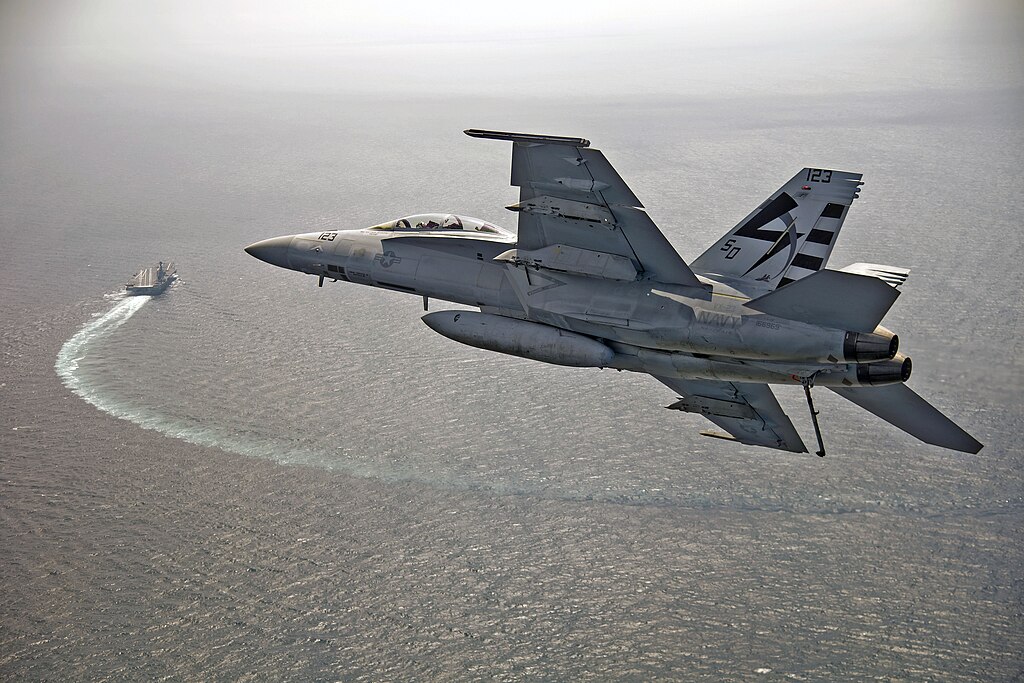
Despite the powerful strategic options offered by a modern carrier like the USS Gerald R. Ford and its formidable Carrier Air Wing, the stark reality is that the Navy’s current aircraft, including the F/A-18EF and F-35C, are nearing the performance limits required in a conflict scenario with a peer adversary. Recent operational successes, while commendable, have masked this „quiet danger” of an aging fleet, a problem becoming increasingly evident amidst China’s escalating ambitions.
Bureaucratic Stagnation: F/A-XX Stuck in Decision Limbo at the Pentagon
Despite the critical need openly expressed by Navy leadership, the F/A-XX program—a plane with a dry technical name but immense strategic importance—is mired in the Pentagon’s decision-making labyrinth. „We need F/A-XX in the United States Navy,” Adm. James Kilby stated in June, emphasizing that „we’re talking about a fight in the Pacific.” Yet, various excuses—from the vulnerability of aircraft carriers to Chinese missiles to speculation about drones replacing manned fighters, or even the supposed inability of America’s industrial base to produce both the Air Force’s F-47 and the new Navy stealth jet simultaneously—are causing unacceptable delays. Meanwhile, China is sea-testing its advanced new carrier and developing at least two new stealth aircraft. The latest word suggests another year or two delay for the F/A-XX, an error that could doom naval aviation.
Range and Reach: The Core Requirements for the New Fighter
To confront threats from China, Navy carrier airwings desperately need a strike aircraft with superior survivability and range, capable of mounting thousand-mile strikes through the integration of advanced missiles and robust aerial refueling capabilities. Naval air leaders are acutely aware of this tactical imperative: extending the strike fighters’ operational range to provide maximum lethality and maneuver room for the carrier. This echoes the strategic drives that led to the range and engine improvements of the Grumman F6F Hellcat in World War II and the design of the F-14 Tomcat with its AN/AWG-9 radar and Phoenix missile for the „outer air battle” against Soviet bombers in the Cold War.
Integrated Strike: Advanced Missiles and Stealth Tankers as Part of the Solution
Over the past decade, the Navy accurately anticipated China’s military development and began preparing a three-fold plan for the F/A-XX to dominate extended-range air battles: longer-range missiles, a stealthy tanker drone with surveillance capabilities, and, centrally, a new strike fighter with enhanced range, payload, and stealth. The missiles are already here: the Long-Range Anti-Ship Missile (LRASM) and the SM-6 missile, capable of engaging air, land, and sea targets, have been integrated. The MQ-25 Stingray stealth tanker drone is also slated to join the fleet in 2026, combining aerial refueling capacity with sensors and communication relays, enabling strike fighters to significantly extend their mission radius.
Transforming Carrier Warfare: Unprecedented Combat Radius
The combination of the F/A-XX, the MQ-25 drone, and advanced missiles will fundamentally transform carrier force projection capabilities. While today’s F-35C and F/A-18EF have an estimated combat radius of around 600 nautical miles, a predicted 25% increase for the F/A-XX, coupled with the extended range of modern missiles (over 250 nautical miles for the SM-6/AIM-174B), could extend the combat radius to 1,000 miles. With on-station refueling provided by the MQ-25, the range could reach 1,000-1,500 miles from the ship, allowing aircraft carriers to operate from a much wider swath of the ocean, significantly increasing maneuver room under combat conditions and reducing vulnerability.
The Ticking Clock: F/A-XX’s Urgent Window of Opportunity
The timing is critically urgent. Production of the F/A-18EF ends in 2027, and the F/A-XX is its designated replacement. Companies like Boeing and Northrop Grumman already possess mature prototypes and ready production lines. A decision now to move to the next phase of engineering and manufacturing design would initiate a countdown toward low-rate initial production and official first flight. With a deliberate approach, similar to the Air Force’s handling of the B-21 bomber, an F/A-XX could take to the skies by 2028 or 2029. There is no time to waste. Pentagon leadership must heed the Navy’s requirements and advance the F/A-XX program immediately.