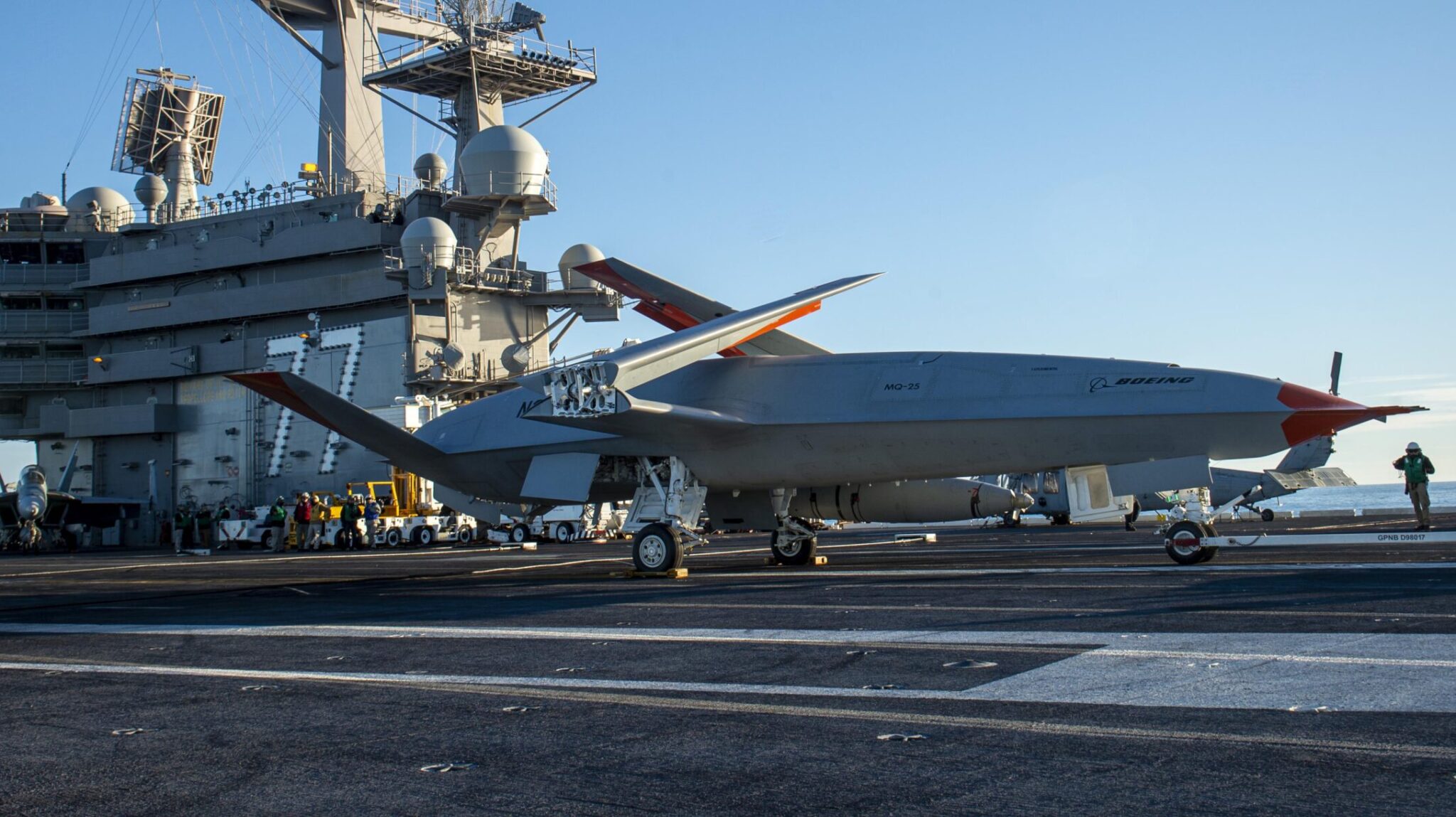
The US Navy announced this week that it has successfully completed the installation of a new control room on its aircraft carriers, designed for the crew to operate and monitor the service’s next-generation unmanned tanker, the MQ-25A Stingray.
This new section, referred to as the “Unmanned Air Warfare Center” (UAWC), was installed aboard the USS George H.W. Bush (CVN-77), according to a statement from Naval Air Systems Command.
“This major installation represents a multi-year effort coordinated across multiple ship maintenance periods and the ship’s deployment schedule,” the statement mentioned. “The CVN-based control room, known as the UAWC, includes software and hardware systems that constitute the first fully operational and integrated Unmanned Carrier Aviation Mission Control System (UMCS) MD-5E Ground Control Station (GCS).”
Capt. Daniel Fucito, the unmanned carrier aviation program manager, stated that the new UAWC will form the “foundation” for how the Navy will pilot both the MQ-25 and other unmanned aircraft in the future, such as the forthcoming Collaborative Combat Aircraft.
Manufactured by Boeing, the MQ-25 will not only refuel strike fighters but also provide limited intelligence, surveillance, and reconnaissance capabilities. The control system, now installed on the George H.W. Bush and set to be deployed on other carriers, was developed by the Navy and incorporates capabilities from Lockheed Martin’s Skunk Works. The USS George H.W. Bush (CVN-77) is scheduled to participate in testing the new control center early next year.
“This will be the first time pilots from the Unmanned Carrier-Launched Multi-Role Squadron (VUQ) 10 will operate the control stations from an aircraft carrier,” said Joe Nedeau, a civilian leading the efforts. “They will use the actual Ground Control Station hardware and software aboard CVN-77 to communicate with a simulated air vehicle in the lab at Pax River.”