SPACECOM Commander Stresses Need for Satellites to Dodge Threats and Pursue Enemy Spacecraft
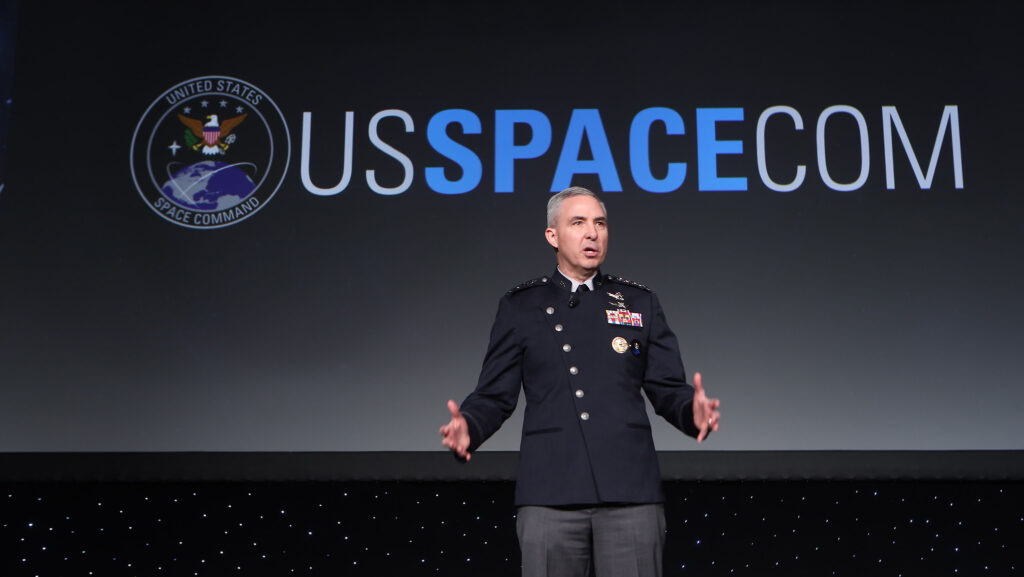
Huntsville, Ala. – US Space Command (SPACECOM) is intensifying its calls for new on-orbit mobility capabilities to enable satellites to evade threats and even pursue enemy spacecraft. SPACECOM Commander Gen. Stephen Whiting emphasized today that these capabilities are crucial for achieving „space superiority.”
Whiting Stresses Importance of Sustained Space Maneuver
“Sustained space maneuver is crucial to our resilience and lethality through the mobility and endurance of our spacecraft,” he said at the annual Space & Missile Defense Symposium. „This year, we’re elevating the importance of executing maneuver without threat, especially in geosynchronous orbit, where assets like space situational awareness satellites must have the agility to move when and where they’re needed to enable space superiority.”
SPACECOM Advocates for Enabling Technologies
For several years, SPACECOM has been advocating for more resources to develop enabling technologies that allow future satellites to maneuver quickly and over long periods. These include next-generation propulsion systems, on-orbit refueling systems, and even in-orbit „gas stations.”
Limited Funding for Space Access, Mobility, and Logistics
Despite SPACECOM’s calls, the Space Force’s fiscal 2026 budget initially contained no funds for what it calls „Space Access, Mobility and Logistics” (SAML). However, the Trump administration’s final request included $14.5 million.
Maneuver Warfare Needed in Space for Both Defensive and Offensive Purposes
Whiting explained that, as in other military domains, space operations need to enable maneuver warfare, where movement and maneuver are used to generate a decisive advantage. He said that this is necessary for both defensive and offensive purposes.
Limitations of Satellites with Limited Fuel
“If a satellite has limited fuel, it can’t just swerve to avoid threats or chase new opportunities without sacrificing its mission life. It becomes predictable, vulnerable and easy for [adversaries],” Whiting said.
Advantages of Satellites with On-Orbit Mobility
If a satellite could „maneuver freely, changing routes on a whim, making such invasive moves or repositioning itself unpredictably,” it could then move „to gain the upper hand, or even go on the offensive if necessary.”
Updates on Operation Olympic Defender (OOD)
Whiting also provided updates on SPACECOM’s recent efforts, including progress in Operation Olympic Defender (OOD), a plan for how allies will fight together in space as a multinational force. Australia, Canada, France, Germany, New Zealand, and the United Kingdom participate in OOD.
Initial Operational Capability Achieved for OOD
„We reached initial operational capability, or IOC, earlier this year, together; we’ve conceptualized requirements for our multinational course; developed the first MNF [multinational force] OOD concept of operations; outlined national contributions in the MNF OOD operational order; and created a space domain awareness conference,” he said.
Missile Warning/Missile Defense Data Fusion Pilot Completed
SPACECOM also completed its missile warning/missile defense data fusion pilot, integrating numerous data streams into a common operating picture to enable faster, more accurate analysis and better decision-making.
Next Pilot Project to Enhance Space Attack Assessment Tools
The next SPACECOM pilot project for data fusion will expand on this foundation by incorporating a suite of space attack assessment tools to enhance combat and level assessments tasking and planning capabilities in a protracted conflict.