Under the pressure of escalating threats in the Indo-Pacific, anti-submarine warfare technology is undergoing a digital revolution. In an era where Russian and Chinese fleets are becoming „invisible,” advanced sensors and open architectures are emerging as the new strategic weapons for undersea supremacy.
The Sound of Silence: A 30-Pound Challenge
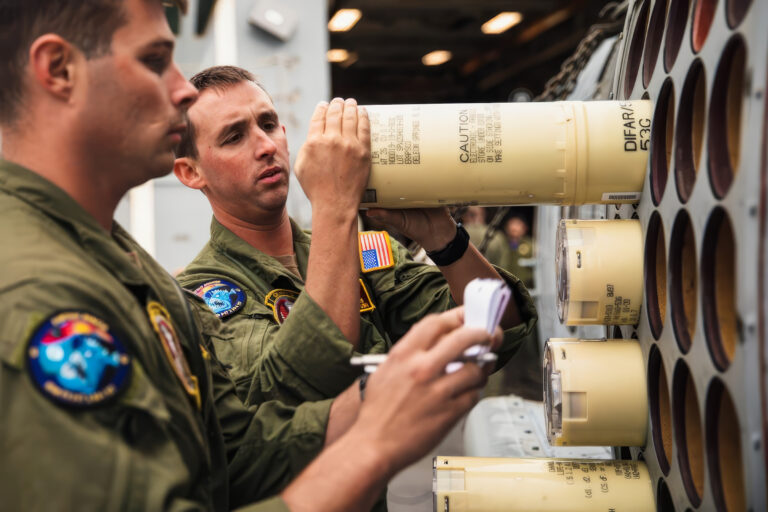
The current global security landscape is defined by an underwater arms race where the primary objective is detecting enemy submarines that are increasingly difficult to track. While Western naval forces enjoyed a clear advantage for decades, recent technological leaps by Russia and China have drastically reduced the acoustic signature of their submersibles. The answer to this threatening „silence” weighs approximately 30 pounds and is encased in a launch tube: the sonobuoy.
These devices, which may look like simple PVC pipes when released from P-8 Poseidon aircraft, are actually powerhouses of innovation. Engineered to withstand a water impact equivalent to 100Gs, these systems instantly transform from missile-like projectiles into sophisticated sensing stations, vital for maintaining control in contested waters.
The „Open Buoy” Revolution: Lego-Style Flexibility in the Theater of Operations Unlike the analog systems of the past, the next generation of maritime sensors relies on digitalization and interoperability. The major breakthrough is the „Open Buoy” concept—a modular architecture that allows for rapid capability upgrades without the need to redesign or recertify the entire system.
This approach, comparable to the structure of Lego bricks, enables the integration of diverse payloads—ranging from electronic warfare sensors to intelligence and reconnaissance systems—into a pre-qualified airframe. The result is a dramatic compression of the delivery timeline: what previously took years to qualify can now be deployed to the fleet in a matter of months.
Automation and the Future of ASW
To meet the surging demand for sensors in global hotspots, manufacturing processes have been radically transformed through automation and Machine Learning. The focus is on automating „dull, dirty, and dangerous” tasks, allowing a highly skilled workforce to concentrate on complex, high-precision subassemblies.
The impact is reflected in the numbers: tasks that once took over a minute for a single unit are now performed in parallel—42 units at a time—in just three minutes. This industrial resilience serves as the backbone of maritime strategy, ensuring the fleet is constantly equipped with technology designed to outpace adversary advancements.
Beyond Sonar: An Integrated Maritime Ecosystem
The future of maritime dominance is no longer limited to sound detection alone. The evolution is shifting toward transforming sonobuoys into nodes within a complex data mesh network, communicating seamlessly with unmanned platforms and autonomous undersea systems. Through this digital integration, the underwater battlespace becomes transparent, ensuring tactical superiority in an increasingly unpredictable environment.