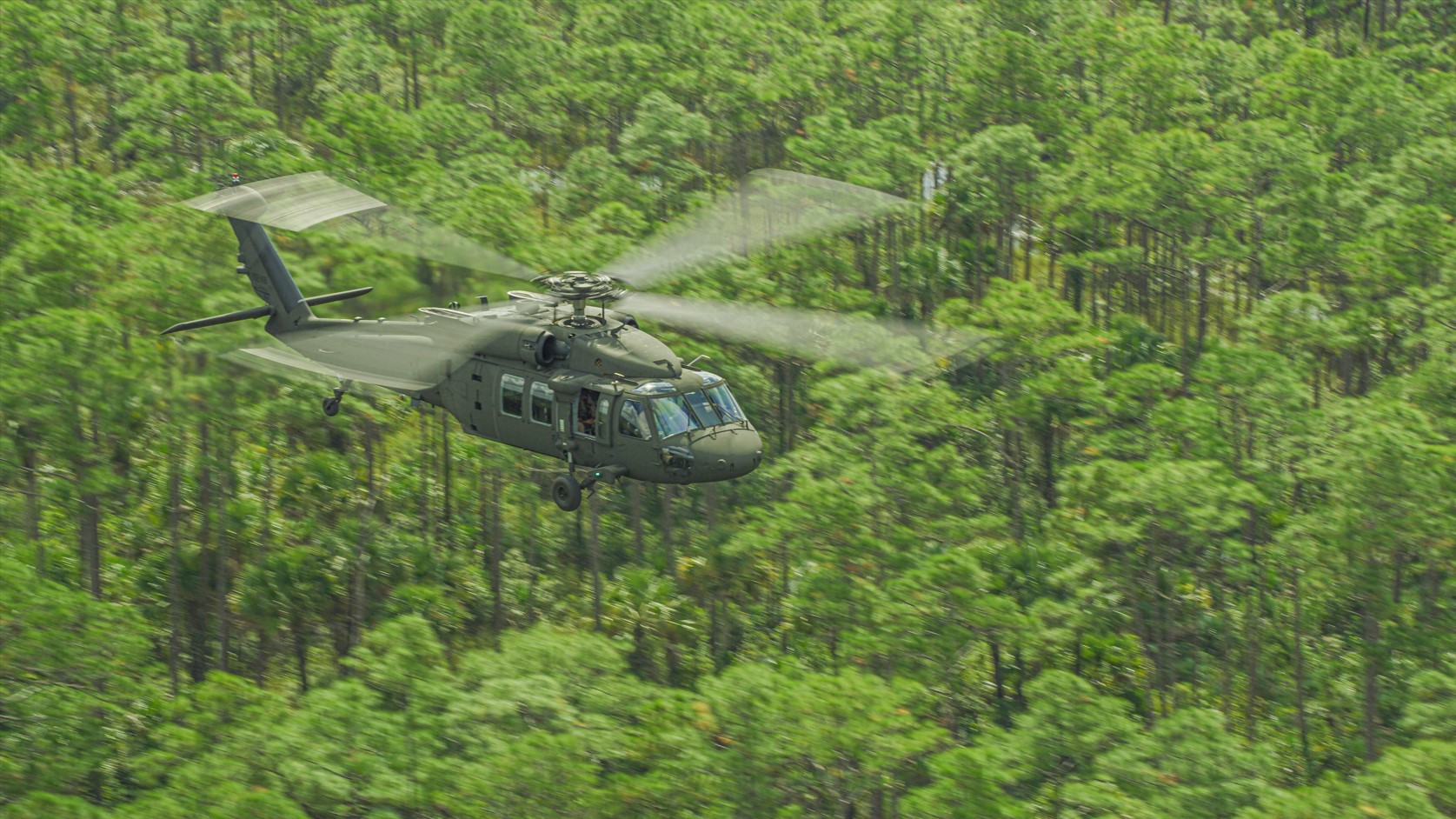
With approximately 4,000 UH-60 Black Hawk helicopters operating globally, the platform is set to play a pivotal role in enhancing interoperability with the U.S. Army’s newest aircraft—the Future Long-Range Assault Aircraft (FLRAA). As the Army aims to modernize its rotary wing fleet, significant focus is being placed on updates under the Improved Turbine Engine Program (ITEP), utilizing Modular Open Systems Approach (MOSA), and establishing a robust digital backbone.
“The Army has invested heavily in rotary wing platforms,” stated Army Col. Ryan Nesrsta, program manager for Utility Helicopters at U.S. Army PEO Aviation. “This investment will necessitate ongoing interoperability and adaptive solutions to address evolving threats.”
A significant milestone in this modernization effort was the recent delivery of two GE Aerospace T901 ITEP flight-test engines, set to replace the aging GE T700 engines in the UH-60M Black Hawk. The T901 engine promises a 50% increase in power and improved fuel efficiency, effectively extending the helicopter’s range and payload capabilities.
“The new ITEP engine will provide division commanders with enhanced options for assault mission planning and execution,” said Hamid Salim, vice president for Army & Air Force Systems at Lockheed Martin Sikorsky. “This advancement represents a game changer for the Army and National Guard units, enhancing safety and reducing operational costs.”
The Army’s Utility Helicopters Project Office (UHPO), alongside the Aviation Turbine Engines Project Office, is targeting a first flight of the ITEP-powered Black Hawk in late fiscal year 2025 or early 2026.
MOSA and Multi-Domain Operations
The evolving role of the UH-60M Black Hawk is critical for operating within a complex 21st-century security environment. It is expected to significantly contribute to multi-domain operations and the Joint All Domain Command and Control (JADC2) initiative.
“Army Aviation will be able to extend its operational reach to 500 km with the ITEP engine,” noted an Army Aviation Center of Excellence representative. The integration of launched effects and multi-domain capabilities will enhance the Army’s ability to conduct missions beyond the forward line of troops, supporting ground commanders more effectively.
The UHPO aims to ensure that the Black Hawk remains relevant through 2070 by employing MOSA, gradually integrating technology upgrades, and fostering collaboration with industry partners for adaptable and cost-effective systems.
Sikorsky has also leveraged past investments from the Future Attack Reconnaissance Aircraft (FARA) program to accelerate the integration of new capabilities, including crewed-uncrewed teaming. “Our digital infrastructure supports real-time adaptation to the aircraft, enhancing situational awareness,” Salim explained, emphasizing the Black Hawk’s potential to manage drone swarms for tactical advantages.
Autonomous Capabilities
The Army has explored increasing autonomy in the Black Hawk helicopters. A successful demonstration in late 2022 showcased an uncrewed Black Hawk performing various missions, including resupply and casualty evacuation operations. “Through ongoing collaboration with DARPA, we are maturing technologies essential for the FLRAA’s optional piloted vehicle capabilities,” Nesrsta stated, addressing the concurrent push for sensor fusion and advanced algorithms.
This approach is expected to reduce technical risks while facilitating the integration of autonomous systems, aligning with both existing Black Hawk and future FLRAA requirements to enhance operational effectiveness.
Ongoing Relevance and Future Mission Requirements
As Black Hawk operations in regions such as Ukraine and the Indo-Pacific adapt to contemporary security needs, the Army is prioritizing modernization and interoperability for rotary-wing aircraft. „The FLRAA platform will enhance rapid air assault capabilities into adversarial territories,” the Army Aviation Center of Excellence noted, while the established fleet types, including the Chinook and Apache, will support various essential missions for years to come.
“With its versatility and unmatched performance in low-tier air domains, the Black Hawk is indispensable for various operations,” Salim concluded. He emphasized the necessity of evolving the platform to meet future demands, such as improved engine performance and increased operational flexibility through MOSA.
As the Army continues to innovate, integrating both crewed and uncrewed systems will play a crucial role in maintaining operational readiness and effectiveness in contested environments, ensuring that the UH-60 remains a vital component of military operations for decades to come.