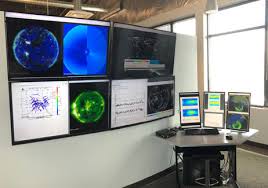
The new command and control (C2) software developed by the Space Rapid Capabilities Office (Space RCO) will play a crucial role in maneuvering satellites for the Space Force’s “orbital warfare” missions, according to Space RCO Director Kelly Hammett.
The Rapid Resilient Command and Control (R2C2) program is managed by the Combined Program Office (CPO), established in 2023 to consolidate legacy projects from Space RCO, based at Kirtland Air Force Base (AFB) in New Mexico, and the Space Force’s main acquisition unit, Space Systems Command (SSC) in Los Angeles. The initiative aims to quickly deploy C2 capabilities for systems engaging in what the Space Force terms dynamic space operations, employing a commercial cloud architecture.
“This fall, we have already established live contacts with flying satellites at Kirtland through the experimental systems operated by Space Systems Command’s prototyping center, overseen by Col. Joseph Roth,” Hammett informed reporters at the Spacepower 2024 conference hosted by the Space Force Association in Orlando, Florida.
The goal, according to Hammett, is to utilize R2C2 “to operate some of the more experimental satellites,” including the Tetra constellation of small satellites being developed for the Space Force by Orion Space Solutions, part of Arcfield. This initiative aims to demonstrate autonomous rendezvous, proximity operations, and docking for on-orbit refueling.
“Eventually, all the flying systems for Delta 9, the Orbital Warfare Delta, will use R2C2,” Hammett noted, adding that Space Operations Command “just signed out a memorandum to that effect.”
Delta 9 is tasked with “protect and defend operations while providing national decision authorities with options to deter and, when necessary, defeat orbital threats.” It also supports Space Domain Awareness by conducting space-based battlespace characterization operations and engages in on-orbit experimentation and technology demonstrations. Specifically, Delta 9 operates the Geosynchronous Space Situational Awareness Program (GSSAP) satellites, which monitor adversarial activities in orbit.
“I think there are things that we will need to be able to, I guess I’ll say, ‘dogfight’ in space,” remarked Lt. Gen. Doug Schiess, commander of Space Forces – Space, the Space Force unit responsible for operations within US Space Command.
“Kelly’s point is he’s looking to the future and considering the systems we will eventually receive. I’m hopeful that we will continue developing such technologies to ensure we have the optimal conditions for learning. In a conflict, it may be necessary to deploy systems that can negate an adversary’s capacity to attack us. We’ll need that capability,” Schiess added.
He specifically identified the increasing threat posed by China, which is progressively deploying highly mobile satellites in geosynchronous Earth orbit—where numerous critical US military satellites are stationed.
“China is constructing a kill web, a kill chain, or whatever terminology you prefer, with 400 different ISR [intelligence, surveillance, and reconnaissance] satellites … to the extent that they can effectively track and target our forces almost all the way from Hawaii, potentially even from the coast of California. This elevates the risk to those forces, and therefore, we must possess effectors that enable us to counter their capabilities,” he explained.