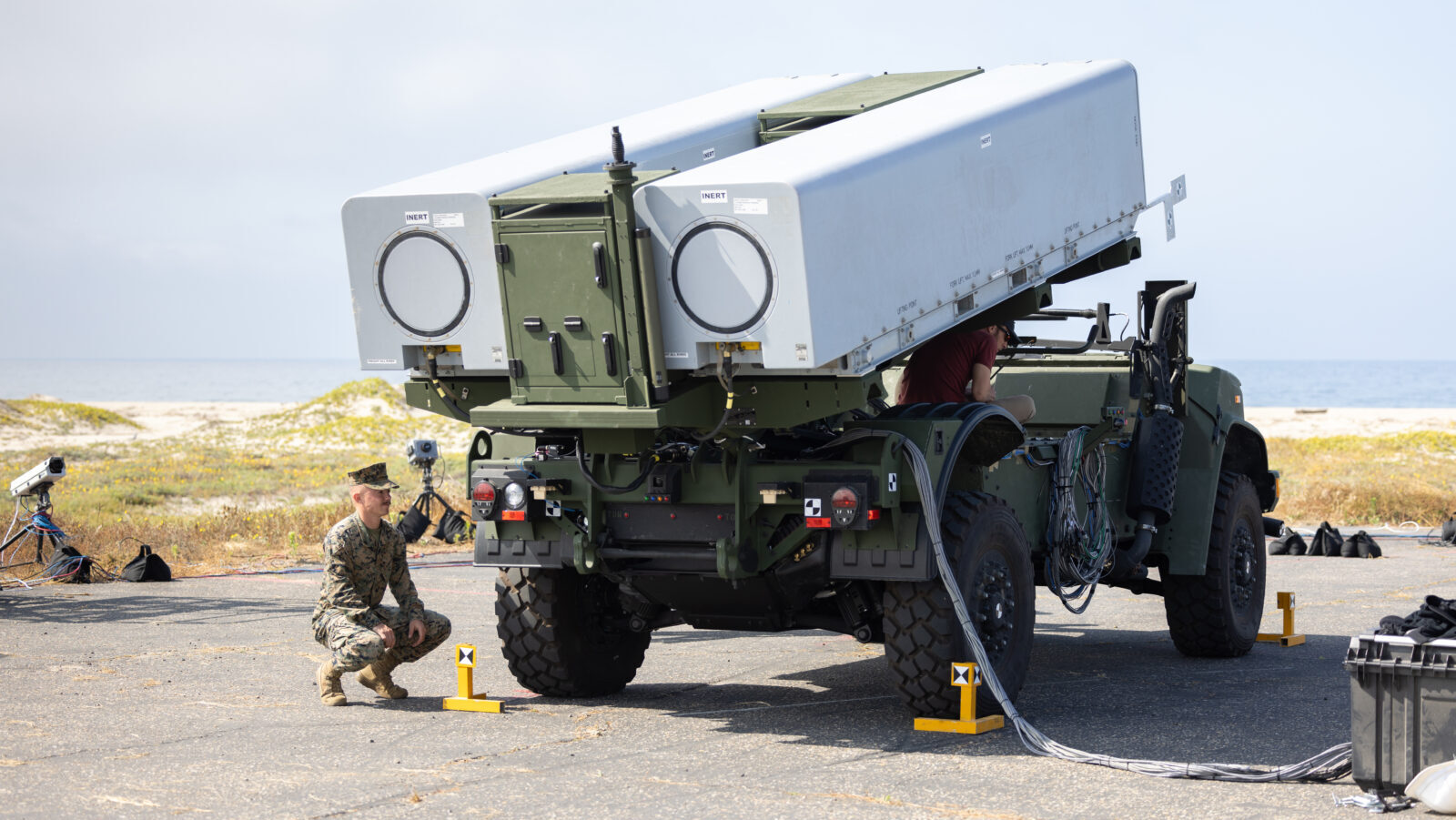
The US Marine Corps is moving forward with a plan to enhance the autonomous navigation capabilities of Joint Light Tactical Vehicles (JLTVs), which are set to serve as the foundation for an unmanned mobile anti-ship weapon system, as stated by the vehicle manufacturer.
“By seamlessly integrating cutting-edge autonomous technologies with Oshkosh systems, we’re equipping the Marine Corps to strengthen sea denial capabilities, enhance operational agility, and maintain a decisive technological edge against evolving threats,” said Pat Williams, chief programs officer at Oshkosh Defense.
Oshkosh is under contract to produce the Remotely Operated Ground Unit for Expeditionary Fires (ROGUE Fires) for the Marine Corps. This weapon system integrates the Navy Marine Expeditionary Ship Interdiction System (NMESIS), which is a ground-based anti-ship missile launcher equipped with two Naval Strike Missiles mounted on the JLTV chassis.
The latest development involves a $30 million investment by the Marines to incorporate autonomous navigation using Fonterra’s AutoDrive system into the vehicles, moving away from reliance on teleoperations or a leader-follower configuration.
“Fielding self-driving ground autonomy on ROGUE Fires is crucial to the Marines’ modernization plans…that will reduce casualties and improve our warfighters’ ability to fight and win,” stated Christian Seifert, Head of Robotic Missile Systems at Forterra.
Although the two companies did not provide specific details on the integration and testing of the enhanced capabilities on ROGUE Fires, Williams indicated that they expect to start delivering the 48 vehicles this June.
As the USMC seeks to rapidly develop and deploy a new autonomous launcher suitable for the Indo-Pacific region, the Army is also advancing several systems, including the Autonomous Multi-domain Launcher. Additionally, the Army is developing a fifth Precision Strike Missile (PrSM) designed for use with an autonomous launcher aimed at targeting beyond 1,000 kilometers.
Brig. Gen. Rory Crooks, the director of the Long-Range Precision Fires Cross Functional Team, elaborated in December 2024 that initial work on the fifth PrSM increment is underway, with a science and technology development initiative set to commence in fiscal 2026. He noted the goal is to create a missile that can be deployed from an autonomous vehicle.
“If you’re familiar with an [M270 Multiple Launch Rocket System] MLRS pod, it’s about 13 feet long,” the one-star general explained to the audience. “If you have something without a cab that’s autonomous, you might be able to employ something longer than that.”
“We’re in the science and technology phase of something that we might eventually refer to as Increment 5,” Crooks added. “You might be able to employ something that’s actually longer … and you might be able to achieve ranges that, right now, don’t seem realistic.”