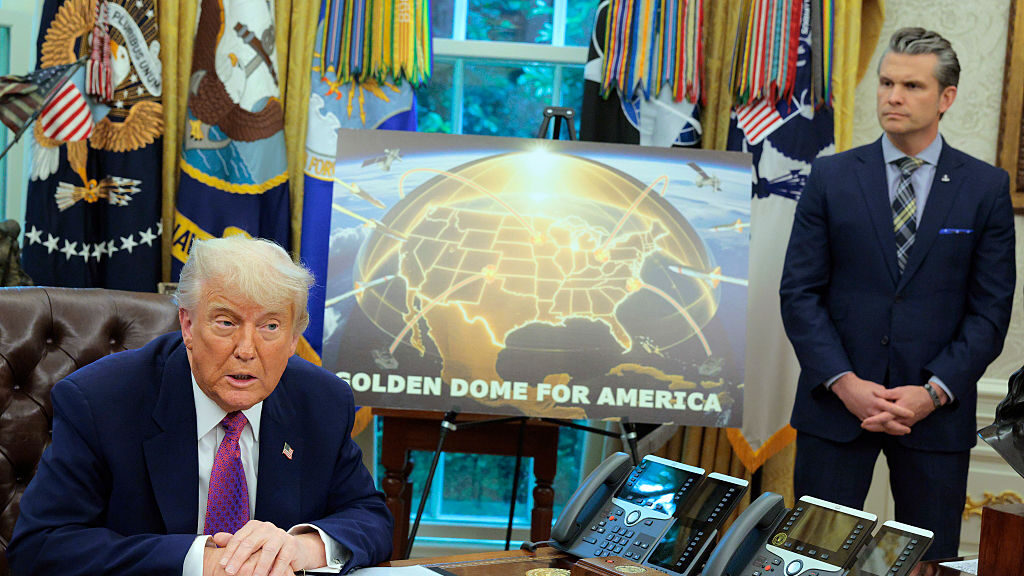
A Bold and Controversial Homeland Shield
President Donald Trump announced a sweeping new missile defense project called the “Golden Dome,” estimating its cost at $175 billion. The initiative aims to create a comprehensive, layered shield around the United States capable of intercepting missiles launched from anywhere—including space. Trump has appointed Vice Chief of Space Operations Gen. Michael Guetlein to lead this ambitious effort.
A Vision for Total Missile Defense
During a briefing in the Oval Office, Trump claimed that, once operational, the Golden Dome will be able to stop threats from across the globe and even from space, making it “the best system ever built.” He expressed confidence that the project would be fully operational before the end of his term, announcing an initial funding infusion of $25 billion, despite ongoing legislative uncertainty in Congress.
A Multi-Phase, Multi-Platform Approach
While details remain sparse, experts describe the project as a „system of systems” — combining sensors and interceptors across land, air, and space domains. The plan includes sensors on the ground and satellites, along with terrestrial and space-based interceptors designed to target missiles during their boost phase—shortly after launch—before they reach their targets. The approach emphasizes a phased deployment, gradually adding capabilities over several years.
Leadership and Strategic Focus
Guetlein, with extensive space systems experience—including the Pentagon’s SBIRS missile warning constellation—was seen as a top contender to lead the effort. He highlighted the increasing threat of cruise missiles that can evade radar and called the project “bold and aggressive” in protecting the homeland against emerging advanced threats, including hypersonic weapons.
Technical, Political, and Financial Challenges
Despite Trump’s optimism, experts warn that the project faces immense hurdles. The estimated cost could balloon into the hundreds of billions or even a trillion dollars, especially given the technical challenges of deploying space-based interceptors and the high costs of spectrum management. Officials have voiced concerns about spectrum security, as the system relies on radars operating in the 3.1-3.45 GHz band, which may be contested for commercial use.
Critics also question the strategic stability implications, fearing that a robust missile shield could destabilize nuclear deterrence by undermining second-strike capabilities. There are concerns about potential conflicts of interest, with some critics pointing out that Elon Musk’s SpaceX might benefit from winning contracts related to the project.
A Competitive Landscape
During the announcement, Senators and officials emphasized that the project would be open to multiple defense contractors and tech companies, fostering competition. Trump highlighted the role of Silicon Valley and innovative startups alongside established defense giants like Lockheed Martin and Raytheon. Analysts from TD Cowen suggest that while a fully impenetrable missile shield may be unrealistic, Golden Dome could significantly advance space-based missile defense capabilities and shape future strategic deterrence.
Boasting of Superiority
Trump concluded by touting U.S. technological leadership, claiming the United States possesses “super technology” that no one else has, though he provided no specific details. The project’s ambitious scope and the president’s high-profile endorsement signal a major push for advanced missile defense—despite skepticism from some experts about its feasibility.
Overall, the Golden Dome represents a major leap in missile defense thinking—one laden with potential but fraught with technical, financial, and geopolitical obstacles.