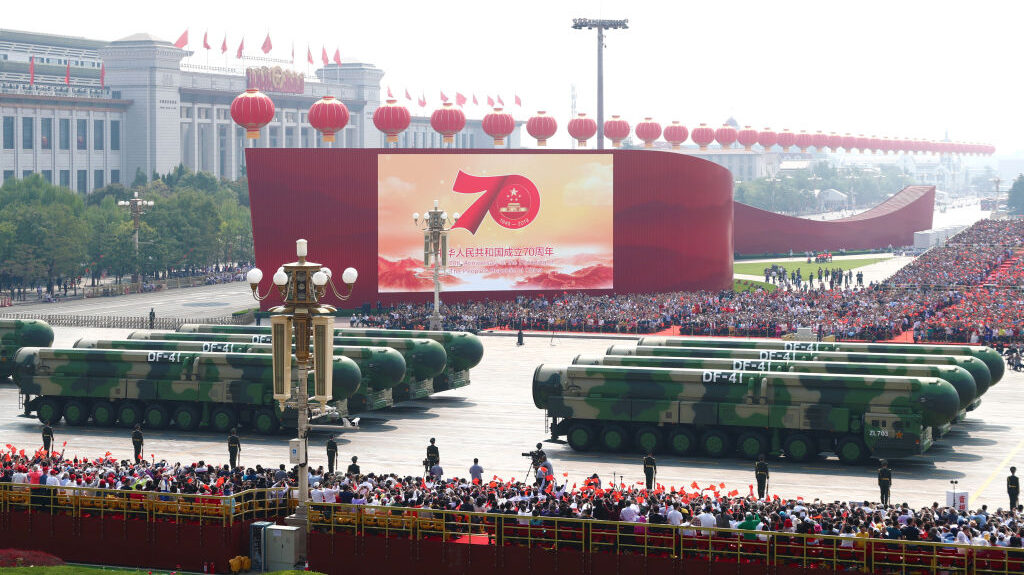
Massive buildup signals shifting global nuclear power dynamics
In a startling development, China has significantly increased its nuclear stockpile, adding approximately 100 warheads in just a year, according to new data from the Stockholm International Peace Research Institute (SIPRI). The nation’s nuclear arsenal has grown from an estimated 500 warheads in 2024 to over 600 in 2025, marking one of the most rapid increases among nuclear-armed states.
Beijing’s Nuclear Growth Outpaces Other Nations
China now possesses more nuclear warheads than the combined total of the United Kingdom and France, with its expansion surpassing all other countries in pace. Since 2023, Beijing has been adding roughly 100 new warheads annually—an escalation that highlights its ambitious efforts to bolster its nuclear capabilities. The country is also heavily investing in missile infrastructure, with around 350 ICBM silos either completed or nearing completion across desert regions in the north and mountainous areas in the east.
Potential Match with Global Powers by 2030s
Depending on its force organization, China could match the ICBM counts of nuclear giants like Russia and the United States by the end of the decade. Although China’s overall stockpile remains in third place globally, its rapid growth means it could reach a projected maximum of 1,500 warheads by 2035. Nevertheless, even at that peak, China’s nuclear arsenal would still comprise only about one-third of the roughly 5,000 warheads each held by Russia and the US, which together account for nearly 90% of the world’s nuclear weapons.
Strategic Implications and Global Tensions
Hans M. Kristensen of SIPRI and the Federation of American Scientists notes that Russia views China’s nuclear escalation with mixed feelings. While some Russian factions may see it as a counterbalance against US dominance, others are wary of China surpassing Russia’s international standing. “They’re long-term worried that they will become number three,” Kristensen explained. This growing Chinese arsenal signals a potential shift in the traditional nuclear power hierarchy, indicating that the US and Russia are no longer the sole dominant players.
Global Nuclear Arms Overview
As of 2025, the world’s nuclear warhead count is estimated at approximately 12,241, a slight decline from 12,405 in 2024, primarily due to the dismantling of older systems by the US and Russia. However, active modernization and new deployments of nuclear weapons keep global tensions high. The number of deployed, ready-to-use warheads has increased slightly to 9,614.
Russia’s Rapid Modernization and New Capabilities
Russia is nearing the completion of its strategic nuclear modernization program, replacing Soviet-era missiles with newer models like the Sarmat (SS-29), Yars (SS-27 Mod 2), and hypersonic weapons such as Avangard. Development is ongoing for next-generation systems like Osina, Kedr, and Yars-M, although deployment timelines remain uncertain. Russia is also advancing its naval nuclear capabilities, including the Poseidon (Status-6) strategic torpedo, designed for special-purpose submarines, with multiple vessels expected to carry these weapons by 2027.
Emerging Dual-Capable Missiles and Technological Advancements
Several nations, including China, India, Pakistan, and North Korea, are actively increasing their delivery systems’ versatility by developing dual-capable missiles that can carry either nuclear or conventional payloads. Conversely, the US, UK, France, and Israel have yet to develop or deploy such dual-capable missile systems.
US Modernization Challenges and European Deployments
Both the US and Russia face delays in delivering new nuclear platforms. The US Columbia-class submarine program has fallen behind schedule due to design, manufacturing, and pandemic-related issues. Similarly, the Sentinel ICBM replacement is encountering costs and testing delays. Meanwhile, the US is investing in modernizing nuclear storage facilities across Europe, including the UK, to support new stockpiles, with about 2,100 upgraded B61-12 guided bombs stationed at NATO bases.
North Korea’s Growing Nuclear Threat
North Korea continues to expand its nuclear program, with SIPRI estimating around 50 assembled warheads and fissile material sufficient for up to 90 nuclear devices. Its missile arsenal, mostly dual-capable, is likely to carry both conventional and nuclear warheads. Recently, North Korea claimed to have launched a Hwasong-11(KN23) missile targeting Ukraine—marking a notable example of its expanding missile testing and potential proliferation of nuclear delivery capabilities. Kristensen suggests that Pyongyang may be gaining advanced technology in collaboration with Russia to enhance its nuclear systems.
Shifting Nuclear Power Dynamics
The rapid buildup by China underscores a changing nuclear landscape, with concerns about rising tensions and the potential for new arms races. As these developments unfold, the balance among nuclear powers continues to evolve, emphasizing the importance of diplomatic efforts to manage proliferation and ensure global security.